 How-to
Which Humic Acid Application Method Works for Commercial Farms?
Last Updated: November 14, 2026
Quick Summary
The right humic acid application depends on your crop, equipment and ability to measure results. Soil methods (granular broadcast, liquid broadcast or banded placement) suit most commercial farms, while foliar and fertigation passes supplement them. Replicated untreated strips are essential before scaling any method.
- Granular humate should be incorporated to about 100 mm, ideally within 24 hours.
- Keep banded humate separated from seed unless the label permits seed contact.
- Run a jar test for compatibility before mixing any foliar or fertigation tank.
- Foliar passes supplement soil applications and cannot replace them for root-zone effects.
- Use at least three replicated treated and untreated strips per field to judge results.
Table of Contents
- Soil Application Methods at Commercial Scale
- Humic Acid Foliar Application: Equipment, Timing and Limits
- Humic Acid Fertigation Through Irrigation and Drip Lines
- Seed Priming and Treatment Before Planting
- Setting the Humic Acid Application Rate by Crop, Soil and Formulation
- When to Apply Humic Acid to Crops and Tank-Mix Checks Before You Start
- Frequently Asked Questions
Humic acid application is one of the most debated inputs on commercial farms today, and the evidence behind it is more mixed than many product sales sheets suggest. This guide sets out the application methods commonly used by UK growers, what the research does and does not show, and how to decide what suits your own system.
Humic acid is a fraction of soil organic matter that is extracted and sold as a liquid or granular input. Our dedicated humic acid root growth article explains how these substances act on roots and in the soil. Humic substances are the larger family of complex organic molecules formed as plant and animal material breaks down, and humic acid is the portion soluble in alkaline solution but not in acid. Fulvic acid is the smaller, more soluble fraction of the same family.
A field study from Iowa State University reported that soil applications of humic acids positively affected a range of growth and yield parameters. The study does not give the rates or the size of the effects, so treat the finding as directional rather than a precise guide to what you will gain.
On the soil side, humic materials are thought to influence soil structure, nutrient availability and microbial activity.
Our view is that the mechanism is plausible but the magnitude is uncertain. Before changing a programme, ask your product supplier for trial data from conditions close to your own.
Soil Application Methods at Commercial Scale
Soil application is the most common route for humic products, and on a commercial holding the method you choose should be driven by three things: where you need the material to end up, what equipment you already run, and whether you can measure the result. The table below sets out the practical trade-offs between the main delivery routes.
| Method | Typical placement | Best fit | Main operational risk |
|---|---|---|---|
| Granular broadcast and incorporate | Top 100-150 mm of soil | Combinable rotations, large acreages, low-labour systems | Uneven spread pattern and dust at headlands |
| Liquid broadcast ahead of cultivation | Surface, then worked in | Vegetable and root crops, high-value fields | Run-off if heavy rain follows before incorporation |
| Banded or starter-fertiliser injection | Seed row / rooting zone | Row crops, maize, potatoes, sugar beet | Salt or ammonia injury if placed too close to seed |
| Fertigation (see next section) | Root zone via irrigation | Drip and trickle-irrigated horticulture | Emitter blockage from precipitation |
Granular application. Calibrate the spreader before the season, not on the day. A simple tray test across the bout width will show whether the pattern is even; most practitioners find a coefficient of variation below about 15% across the working width is a reasonable target for a granular humate blend. Check the product's bulk density against your spreader's calibration chart, because humate granules are often lighter than compound fertiliser and will throw a different distance.
Liquid soil application. Liquid products mix more evenly through the soil volume and are easier to place accurately, but they need volume to carry them. Apply in a water volume that wets the top 100 mm rather than a fine mist, and incorporate or irrigate in before the surface dries.
Banded and starter placement. Injection through a fertiliser applicator puts material in the rooting zone with minimal handling, but placement matters. Keep humate bands separated from the seed by a soil buffer unless the label specifically permits seed contact, because concentrated organic salts and any accompanying ammonia can delay germination. This is the method most sensitive to soil moisture at drilling, in dry seedbeds, banded material can sit inert until rain arrives.
Timing around existing operations. Application at planting or as a side-dressing pass can often be fitted around existing operations, which may avoid a separate machinery movement. If you are applying ahead of cultivation, do it as close to drilling as the label allows so the material is not exposed on the surface for weeks.
Measuring whether it worked. Do not judge a soil application by appearance. Leave replicated untreated strips through each field, at least three per field and wide enough for a combine or harvester to pass cleanly, and record the same measurements on treated and untreated areas: establishment counts, root mass at a set growth stage, tissue nutrient results and final yield at a consistent moisture.
Watch out: incorporating granular humate too deeply, or leaving liquid on the surface without incorporation or irrigation, puts the material below or above the zone where it can do any good, check placement depth against the label before the pass, not after.
Humic Acid Foliar Application: Equipment, Timing and Limits
Foliar spraying puts humic material directly on the leaf, bypassing the soil, and it is the method most often oversold. Used well it can support a crop during a stress period or a peak demand window; used as a substitute for soil-applied material it will disappoint. Our foliar application techniques guide for better absorption covers the spray details that make the difference.
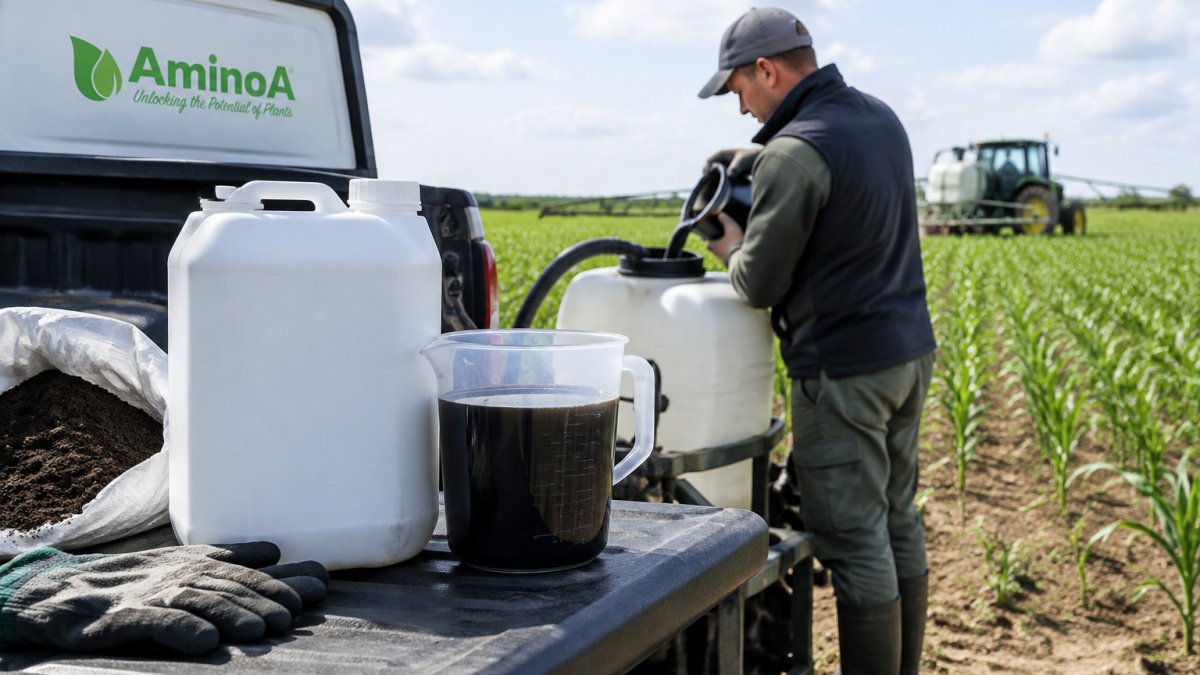
Sprayer set-up. Humic liquids are usually dark, slightly alkaline and prone to leaving residue, so start with clean lines and filters. Use a nozzle that gives a medium droplet spectrum and good canopy penetration rather than a fine mist, which drifts and evaporates before it lands. Check the product's recommended water volume on the label; a common pattern is 100-200 L/ha for arable canopies and higher volumes for dense horticultural crops, but the label governs.
Water quality and tank-mix compatibility. This is the step most often skipped. Humic products can precipitate in hard water or at low pH, and they can react with high-calcium fertilisers and some crop-protection products.
Timing. Spray in calm conditions and avoid the hottest part of the day, when rapid drying reduces uptake. Early morning or late afternoon is the usual window. Match the pass to the crop growth stage the label supports, vegetative stages and early reproductive stages are the common targets, and keep to the maximum number of passes and the interval between them.
Limits and realistic expectations. Foliar work cannot replace soil-applied material for root-zone effects, and heavy canopy cover limits how much reaches the leaves. Uptake through the leaf is finite, so a foliar pass is a supplement, not a substitute. Results are also product-specific: humic products differ in concentration, pH and formulation, so a result with one product does not transfer to another.
Testing before you scale. Test on a small area first, and test properly. Lay out replicated strips, at least three treated and three untreated per field, and record leaf colour scores, tissue nutrient results at a set interval after spraying, and final yield at a consistent moisture. Keep the spray date, water volume, product rate, tank-mix partners and weather on the record so the result can be attributed.
Watch out: mixing humic acid with a calcium fertiliser or an unlisted crop-protection product without a jar test is the most common cause of blocked filters, scorched leaves and wasted passes, confirm compatibility in the jar before the tank.
Humic Acid Fertigation Through Irrigation and Drip Lines
Fertigation delivers humic material through the irrigation system. It suits drip-irrigated horticultural crops and can reach the root zone precisely, with the dose controlled by the injection rate.

Before injecting anything, check water quality and product compatibility. Hard water and some fertiliser combinations can precipitate, which blocks emitters. Flush the lines after each application and run a compatibility test in a jar before committing a full tank.
Plan the injection to match the crop growth stage. Keep records of the dose, the duration and the field response so you can judge the result next season.
Seed Priming and Treatment Before Planting
Seed treatment and priming are less common than soil or foliar methods, but they are worth knowing. The research includes a 2014 comparison of seed priming, foliar spray and soil application, though the summary we have does not state the comparative results.
Seed treatment is applied before sowing and needs careful handling to avoid harming germination. Follow the product label, check the seed-treatment compatibility with any fungicides already on the seed, and test germination on a sample before drilling the whole field.
Setting the Humic Acid Application Rate by Crop, Soil and Formulation
No universal rate exists. The right rate depends on the crop, the soil type and organic matter, and the product formulation. Start from the manufacturer's recommended range and adjust based on your trial results.
Our practical advice is to run a strip trial, leaving an untreated control, and measure yield and quality rather than relying on appearance. For more crop-specific reference points, see our guides on liquid biostimulant application rates for wheat and biostimulant nitrogen uptake in cereals.
If you are working out foliar passes for wheat, our foliar fertiliser application rates guide compares rates and timing.
When to Apply Humic Acid to Crops and Tank-Mix Checks Before You Start
Timing depends on the crop and the method. Soil applications are usually made before or at planting, while foliar and fertigation passes follow the crop growth stage. Keep to the label for maximum passes per season.
Before mixing, run a jar test to check physical compatibility with other products in the tank, and check the water pH and hardness. Avoid mixing with products the label does not list as compatible. Write the mix order down and follow it every time.
Watch out: mixing products that the label does not list as compatible can cause precipitation or phytotoxicity, so always confirm compatibility first.
Subscribe to our newsletter for practical application guidance from the AminoA team, and get in touch with us for product information and current pricing.
Frequently Asked Questions
What are the main methods of applying humic acid to crops?
The main routes are soil application, foliar spray, seed treatment or priming, and fertigation through irrigation or drip lines. Each suits different crops and growth stages. Soil application targets root-zone conditions, foliar spray gives a fast response to leaf-applied material, and seed treatment supports early establishment. Product literature for commercial formulations lists application at planting, side-dressing and foliar use, and irrigation. Growers should confirm the label recommendation for their formulation, since rates and compatibility differ between products. Field results from the cited studies vary, so trial plots on your own farm remain the most reliable way to confirm value.
Can humic acid be applied through drip irrigation or fertigation?
Yes, product guidance for some humic and fulvic formulations includes application through irrigation. Before injecting any product, check the label for compatibility with your irrigation system and fertiliser programme. Filter the water, dilute the product fully, and flush the lines after use to prevent emitter blockage. Water quality, particularly hardness and pH, can affect how the product behaves in the tank. Run a small compatibility test in a bucket before treating a full block, and record the injection rate and volume so you can compare results across the season.
When should humic acid be applied during the growing season?
Timing depends on the crop, the growth stage and the application method. Common product guidance includes application at planting, side-dressing application during active growth, and foliar application at specific stages. Avoid spraying foliar treatments in strong sun or during heat stress, when leaf uptake and crop tolerance can be reduced. Align applications with periods of high nutrient demand, and log the growth stage at each pass so that timing effects can be assessed at harvest. Agronomist advice tailored to your crop and region is the safest guide.
What factors affect the effectiveness of humic acid applications?
Results depend on the formulation, the application rate, soil conditions, crop type, water quality and timing. Soil organic matter, pH and moisture all influence how humic substances interact with the soil. Tank-mix compatibility and water hardness can also affect performance and cause precipitation. The research available here does not provide numerical effect sizes for most conditions, so realistic expectations should be set cautiously. Measure yield and input use against untreated strips to judge the agronomic and economic return on your own land.