 how-to
Liquid Biostimulant Application Rates for Wheat
Table of Contents
- Liquid Biostimulant Application Rates for Wheat: The Numbers That Matter
- Wheat Biostimulant Application Timing: Growth Stages That Respond Best
- Foliar Biostimulant for Wheat: Why Leaf Uptake Beats Soil Drenching
- Factors That Change Your Application Rate
- Biostimulant Tank Mix Compatibility: What You Can and Cannot Mix
- Biostimulant Application with a Sprayer: Nozzles, Water Volume and Calibration
- Common Mistakes to Avoid When Applying Liquid Biostimulants
- Frequently Asked Questions
Last Updated: 8 October 2026
Liquid Biostimulant Application Rates for Wheat: The Numbers That Matter
Getting liquid biostimulant application rates for wheat right is less about memorising a single figure and more about matching the dose to the growth stage, the product and the weather. At AminoA, we build our L-α amino acid products around that reality, because the wrong rate wastes money and the right one lifts yield.
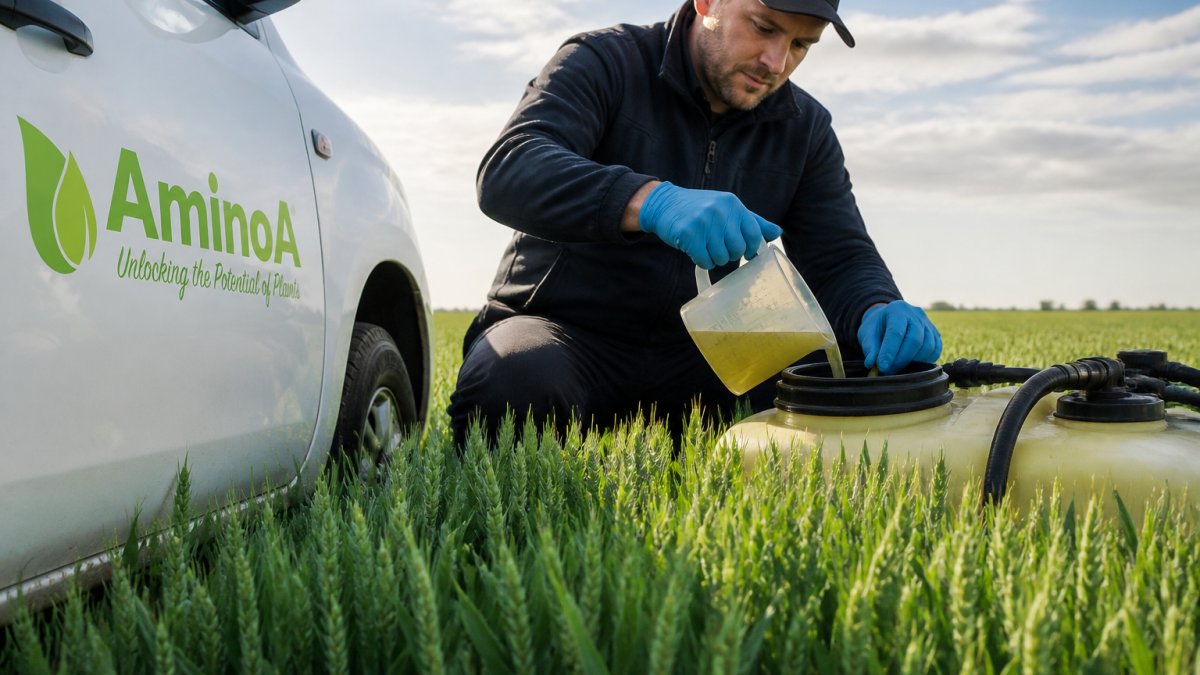
Most growers applying a foliar biostimulant to wheat work within a broad range of roughly 0.5 to 2.0 litres per hectare per pass, diluted in enough water to wet the canopy evenly. The exact figure depends on the product's concentration, the crop's growth stage and how much stress the plant is under. This guide breaks down the numbers, the timing and the tank-mix rules that decide whether your spend pays off.
Below, we cover the standard rate ranges, how to calculate your own dose, and the mistakes that quietly cut results. For official guidance on biostimulant products and their approval, the Agricultural Industries Confederation biostimulant guidance is worth bookmarking.
Standard rate ranges for winter and spring wheat
Winter wheat usually needs a lower rate per pass but more passes across the season. Spring wheat, with its shorter window, often takes fewer, slightly stronger applications.
A sensible starting framework:
- Winter wheat: 0.5-1.5 L/ha per application, across 2-3 passes
- Spring wheat: 1.0-2.0 L/ha per application, across 1-2 passes
- Stressed crops: stay at the lower end and split the dose
These are ranges, not rules. The product label always wins. If a label states a maximum rate, that figure is your ceiling.
How to calculate the right dose for your crop
The right dose balances three things: product concentration, crop stage and water volume.
Work through it in this order:
- Check the label for the maximum rate per hectare
- Match the rate to the growth stage you are targeting
- Adjust down for young or stressed crops
- Confirm your water volume gives even coverage
A common mistake is treating the label maximum as the target. In practice, most wheat responds well at the middle of the range. Pushing to the top end rarely adds yield and always adds cost.
Wheat Biostimulant Application Timing: Growth Stages That Respond Best
Wheat biostimulant application timing matters more than the rate itself. Applying the right dose at the wrong stage wastes the product entirely.
The crop responds most at three points: early tillering, stem extension and grain fill. Each stage has a different job to do.
Key application windows from tillering to grain fill
- Tillering: supports root development and tiller survival
- Stem extension: helps the plant through rapid growth
- Flag leaf to grain fill: supports grain size and quality
- Stress events: apply within days of frost, drought or heat
Aim to apply when the plant is actively growing and the leaf surface is dry. Early morning or late evening reduces evaporation losses.
Foliar Biostimulant for Wheat: Why Leaf Uptake Beats Soil Drenching
A foliar biostimulant for wheat delivers nutrients straight to the leaf, where the plant can use them within hours. Soil drenching relies on root uptake, which is slower and depends on soil conditions.
Leaf tissue absorbs amino acids quickly, especially when the product is in the L-form. That speed matters most during stress, when roots are working poorly and the plant needs fast support.
The trade-off is coverage. Foliar feeding only works if the spray reaches the leaf evenly. Poor coverage means patchy results, which is why calibration and water volume matter so much.
Factors That Change Your Application Rate
Several variables shift the rate up or down. Ignoring them is how growers end up either underfeeding or overspending.
| Factor | Effect on Rate | What to Do |
|---|---|---|
| Crop stage | Early stages need less | Stay at lower end |
| Stress level | Stressed crops absorb less | Split the dose |
| Canopy density | Dense canopy needs more water | Raise water volume |
| Product concentration | Stronger products need less | Follow the label |
| Weather | Heat and wind cut uptake | Spray early or late |
The one factor growers most often overlook is canopy density. A thick crop needs more water to reach the lower leaves, even if the product rate stays the same.
Biostimulant Tank Mix Compatibility: What You Can and Cannot Mix
Biostimulant tank mix compatibility decides whether you can save a pass or whether you risk damaging the crop. Amino acids generally mix well with many fungicides and insecticides, but not all.
Always jar-test before mixing in the main tank. A jar test takes minutes and can save a whole spray load.
Rules that keep you safe:
- Jar-test every new combination first
- Add products in the correct order
- Never mix concentrated products directly
- Check the label for known incompatibilities
Velcourt trials found that adding AminoA FLO to reduced fungicide rates maintained yields and improved green leaf area in winter wheat. That is the kind of result a careful tank mix can deliver.
Biostimulant Application with a Sprayer: Nozzles, Water Volume and Calibration
Biostimulant application with a sprayer comes down to three things: the right nozzle, enough water and accurate calibration. Get these wrong and even the perfect rate fails.
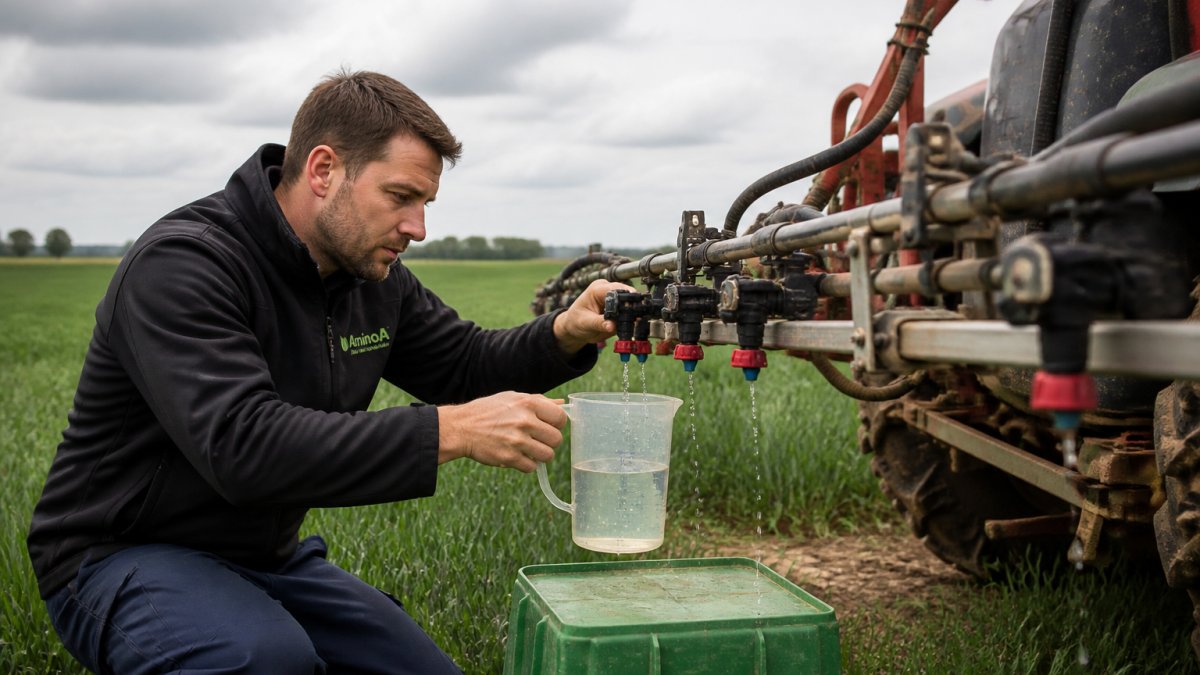
Use a medium or coarse droplet nozzle to reduce drift and improve leaf contact. Fine droplets drift in the wind and evaporate before they land.
Water volume typically sits between 100 and 200 litres per hectare for a wheat canopy. Denser crops need the higher end. Calibrate before every season and after any nozzle change.
A simple calibration check:
- Measure output from a single nozzle over one minute
- Compare against your target rate
- Adjust pressure or speed to match
- Repeat across several nozzles to spot wear
Common Mistakes to Avoid When Applying Liquid Biostimulants
The same handful of errors show up again and again. Fixing them costs nothing and protects your investment.
- Spraying in the heat of the day and losing product to evaporation
- Treating the label maximum as the target rate
- Skipping the jar test before a new tank mix
- Using fine nozzles that drift off target
- Applying to a dry, stressed crop without splitting the dose
- Failing to calibrate the sprayer before the season
For broader guidance on integrated crop management and input use, the AHDB crop nutrition resources and Defra guidance on sustainable farming are useful references.
Most of these mistakes trace back to rushing. A little planning before you fill the tank pays for itself.
Frequently Asked Questions
How much liquid biostimulant should I apply to wheat?
Typical rates for AminoA products range from 0.5 to 2.0 litres per hectare, depending on growth stage and crop condition. Always check the specific product label for the exact dose. For a 200-hectare wheat farm, that means 100 to 400 litres per application. Start with the lower rate on healthy crops and increase for stressed or high-yield-potential fields. Calibrate your sprayer first to ensure accurate delivery.
Can liquid biostimulants be tank-mixed with foliar fertiliser?
Yes, many liquid biostimulants can be tank-mixed with foliar fertilisers, but compatibility varies by product. Always perform a jar test first: mix small quantities in the same ratios you plan to use and watch for separation, clumping or excessive foaming. AminoA products are formulated for easy tank mixing, but check the label for specific exclusions. If in doubt, apply separately with a 24-hour gap to avoid crop damage.
When should liquid biostimulants be applied to wheat?
Apply during key growth stages: early tillering to support root development, stem elongation for stress resilience, and flag leaf emergence to boost grain fill. For winter wheat, a late-autumn application can help with cold tolerance. Spring wheat benefits most from applications at tillering and booting. Avoid spraying during full flower or when rain is forecast within six hours. Early morning or late afternoon is ideal to reduce evaporation.
Can biostimulants improve wheat's tolerance to drought or other stress?
Yes. Amino acid biostimulants help wheat cope with stress by supporting osmotic adjustment and antioxidant production. Trials with AminoA FLO showed that even with reduced fungicide rates, winter wheat maintained yields and improved green leaf area, indicating better stress resilience. Apply before a known stress event (e.g., forecast drought) for best results. While biostimulants are not a silver bullet, they can reduce yield losses when integrated into a broader crop management plan.
Wheat margins are tight, and every input has to earn its place. AminoA manufactures 100% L-α amino acid biostimulants through enzymatic hydrolysis, with high levels of nitrogen, potassium, iron and magnesium, and ten years of experience supporting growers. If you want to cut back on agrochemicals without risking yield, our products are built to help. Subscribe to our newsletter for application guidance, trial results and seasonal timing advice.