 how-to
Signs of Nutrient Deficiency in Stressed Plants
Table of Contents
- How Stress Affects Nutrient Uptake in Crops
- Visual Signs of Common Nutrient Deficiencies
- Distinguishing Nutrient Deficiency from Disease Symptoms
- Foliar Feeding for Stress Resistance
- Biostimulants for Crop Stress: Amino Acids as a Solution
- Diagnostic Methods for Nutrient Deficiency in Stressed Plants
- Correcting Nutrient Deficiencies: Practical Solutions
- Frequently Asked Questions
Last Updated: September 30, 2026
How Stress Affects Nutrient Uptake in Crops
When crops face environmental pressure, their ability to absorb and use nutrients breaks down, and signs of nutrient deficiency in stressed plants become increasingly visible. Drought, waterlogging, cold snaps, and heat stress all trigger the same problem: roots cannot efficiently pull nitrogen, phosphorus, potassium, and micronutrients from the soil.
This is where signs of nutrient deficiency in stressed plants become visible. The plant looks starved even when nutrients are present. Soil testing shows adequate levels. Yet the crop displays classic deficiency symptoms anyway.
The root cause is stress-induced dysfunction. When a plant fights cold or drought, it diverts energy away from nutrient transport. Root cells struggle to maintain the active uptake systems that pull minerals across cell membranes. Water stress is particularly damaging, roots cannot move dissolved nutrients without adequate moisture.
Understanding this link matters because it changes how you respond. Applying more fertiliser to a stressed crop rarely fixes the problem. The plant cannot use it. Instead, stress resistance becomes the priority. Crops that recover their physiological function recover their nutrient uptake capacity.
This is why biostimulants matter. Products containing amino acids work by supporting root function and metabolic recovery during stress. They help the plant's own systems work better when conditions are difficult.
Visual Signs of Common Nutrient Deficiencies
Nutrient deficiency symptoms follow predictable patterns. Each nutrient produces a distinct visual signature on leaves, stems, and overall plant structure. Learning to spot these signs lets you diagnose problems before yield is lost.
Nitrogen deficiency
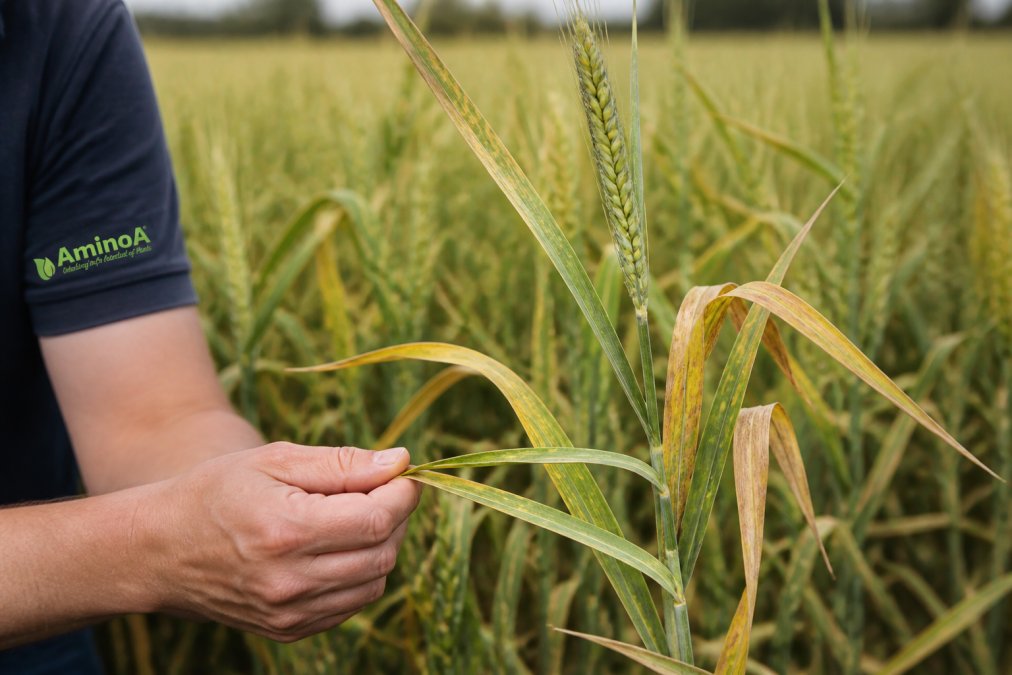
Nitrogen shortage shows first in older leaves. Lower leaves turn pale yellow whilst younger growth stays green. The plant looks washed-out overall. Stems become thin and weak. Growth slows noticeably.
Nitrogen moves within the plant, so deficiency starts where nitrogen pools, the oldest leaves. As the plant reallocates nitrogen upwards to new growth, older foliage is sacrificed. This pattern is diagnostic.
Stressed plants show nitrogen deficiency faster because:
- Root uptake slows under stress
- The plant cannot remobilise nitrogen efficiently
- Drought and cold both reduce nitrogen availability in soil
Phosphorus and potassium deficiency
Phosphorus deficiency appears as purple or reddish discolouration. Leaves darken. Stems may turn purple. Growth is stunted. Root development suffers most.
Phosphorus is immobile in plants, so symptoms appear on older leaves first and stay there. The purple tint is caused by anthocyanin accumulation when phosphorus is scarce.
Potassium deficiency shows as scorching on leaf edges. Margins turn brown or yellow. Tissue dies back from the edge inward. Fruit quality declines, berries and tomatoes lack firmness and flavour.
Potassium controls water movement and cell strength. Without it, plants wilt more easily and fruit ripens unevenly.
Both deficiencies worsen under stress because:
- Waterlogging locks up phosphorus in soil
- Heat stress increases potassium loss through transpiration
- Cold slows all nutrient uptake
Iron, magnesium, and micronutrient deficiency
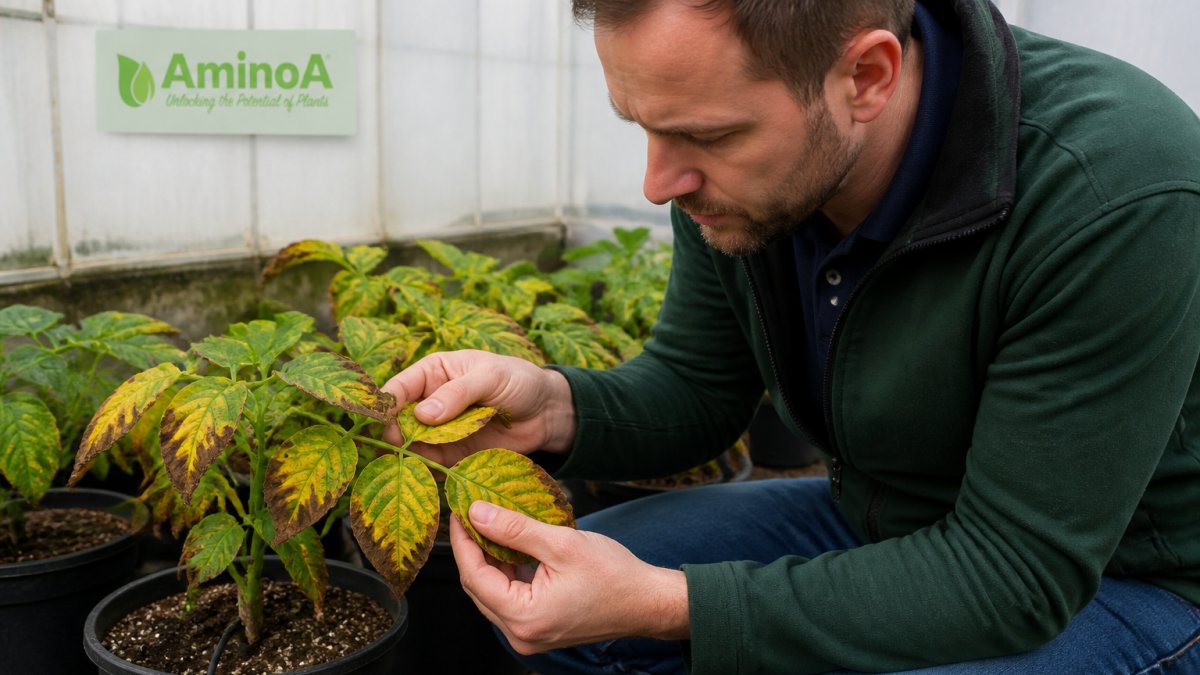
Iron deficiency causes interveinal chlorosis. Leaf veins stay green but tissue between them turns yellow. Symptoms appear on young leaves first because iron doesn't move within the plant. This is the opposite of nitrogen.
Magnesium deficiency also shows interveinal yellowing but typically on older leaves. Magnesium is mobile, so the plant pulls it from old growth to support new leaves.
Other micronutrients, boron, zinc, manganese, copper, produce less obvious symptoms. Boron deficiency causes distorted growth and hollow stems in some crops. Zinc deficiency creates small, mottled leaves. These are harder to spot until damage is severe.
Stress amplifies micronutrient problems because:
- Soil pH changes under waterlogging, locking up iron and manganese
- Heat increases zinc and copper mobility, sometimes causing deficiency
- Root damage from stress reduces all micronutrient uptake
Distinguishing Nutrient Deficiency from Disease Symptoms
Nutrient deficiency and disease look similar but require opposite responses. Applying fungicide to a nitrogen-deficient crop wastes money. Fertilising a diseased plant doesn't help.
Nutrient deficiency is symmetrical. Symptoms appear evenly across the plant. All leaves of similar age show the same pattern. The deficiency progresses predictably from old to new leaves (for mobile nutrients) or new to old (for immobile nutrients).
Disease is random. Symptoms start in one area and spread. Spots, lesions, or wilting appear unevenly. Neighbouring plants may show different severity.
Nutrient deficiency develops slowly over weeks. Disease accelerates rapidly, especially in wet conditions.
Rule of thumb: If the whole field shows the same symptom at the same time, suspect nutrient deficiency. If one patch is worse than another, suspect disease.
Stressed plants complicate diagnosis because stress weakens disease resistance. A crop under drought stress may show both deficiency symptoms and increased disease pressure. Address stress first through improved irrigation and biostimulant support. Then reassess whether disease treatment is needed.
Foliar Feeding for Stress Resistance
Foliar feeding delivers nutrients directly through leaves when roots cannot absorb them efficiently. This bypasses the root uptake problem entirely.
Foliar applications work fastest during stress because:
- Nutrients enter leaf tissue in hours, not days
- The plant uses them immediately for recovery
- No root dysfunction delays uptake
Foliar feeding is not a permanent fix. It supports the crop whilst stress continues. Once stress eases and roots recover, soil-based nutrition becomes effective again.
Best practice for foliar feeding:
- Apply in early morning or late evening to avoid leaf burn
- Use water with neutral pH
- Include a spreader-sticker to help nutrients adhere
- Repeat every 7-10 days during stress period
- Combine with biostimulants for maximum effect
Foliar feeding for stress resistance works best when paired with root support. Amino acid biostimulants applied to soil help roots recover function. Foliar nutrients feed the plant whilst recovery happens. Together, they accelerate the plant's return to normal physiology.
Biostimulants for Crop Stress: Amino Acids as a Solution
Amino acids are the building blocks of plant proteins. When plants face stress, they consume amino acids rapidly to repair damage and produce stress-response proteins. External amino acid supply can replenish what stress depletes.
AminoA provides 100% L-α amino acids produced through enzymatic hydrolysis. Every amino acid is in the L form, the active form plants use directly. This matters because synthetic amino acids or D-form versions are biologically inert.
How amino acids support stressed crops:
- Restore protein synthesis when stress disrupts it
- Provide nitrogen in a form roots absorb even under stress
- Reduce energy cost of nutrient uptake
- Trigger natural stress-response pathways
Amino acid biostimulants for crop stress work through multiple mechanisms. They are not fertilisers, they contain nitrogen, but their value comes from metabolic support, not nutrient quantity.
Research from Velcourt trials showed that adding AminoA FLO to reduced fungicide rates maintained yields and improved green leaf area in winter wheat. This demonstrates that biostimulant support allows farmers to reduce chemical inputs without sacrificing performance.
Amino acids accelerate recovery from:
- Drought stress
- Cold stress
- Heat stress
- Agrochemical phytotoxicity
- Waterlogging damage
Diagnostic Methods for Nutrient Deficiency in Stressed Plants
Visual assessment is the first step. Walk the field. Look for the patterns described above. Note whether symptoms are uniform or patchy. Check whether older or younger leaves are affected first.
Soil testing provides baseline data. A standard soil nutrient test measures available phosphorus, potassium, and micronutrients. However, soil tests can be misleading during stress. Nutrients may be present in soil but unavailable to roots. A soil test showing adequate potassium does not rule out potassium deficiency if the crop is waterlogged.
Tissue testing is more reliable during stress. A leaf or stem sample is analysed for actual nutrient content. Tissue tests show what the plant has absorbed, not what is in soil. This directly answers the question: is the plant deficient?
Tissue testing is most useful for:
- Confirming visual diagnosis
- Tracking recovery after intervention
- Identifying micronutrient problems that are hard to see
- Comparing healthy and stressed plants side by side
Monitor crop response to intervention. Apply a biostimulant or foliar feed to part of the field.
Correcting Nutrient Deficiencies: Practical Solutions
Step 1: Remove or reduce the stressor. Improve irrigation during drought. Install drainage during waterlogging. Provide shade cloth during extreme heat. Nutrient uptake will not recover whilst stress continues.
Common mistakes to avoid:
- Applying more fertiliser when roots cannot use it
- Ignoring the stressor and expecting nutrition alone to fix the problem
- Using synthetic amino acids or inferior products that are not fully bioavailable
- Waiting too long to intervene, early treatment prevents yield loss
Frequently Asked Questions
What are the main visual signs of nutrient deficiency in stressed plants?
Nutrient deficiency in stressed plants typically appears as yellowing or pale foliage, stunted growth, poor root development, and abnormal leaf colouration. Nitrogen deficiency shows as lower leaf yellowing; phosphorus deficiency causes purple or reddish discolouration; potassium deficiency results in leaf scorching at the edges. Iron deficiency creates interveinal chlorosis (yellowing between leaf veins). Stressed plants often display multiple deficiencies simultaneously, making diagnosis more complex than in unstressed crops.
How can foliar feeding for stress resistance help recovery?
Foliar feeding bypasses root uptake limitations caused by soil compaction, cold temperatures, or waterlogging, delivering nutrients directly through leaves. This method is particularly effective for stressed plants because it works when soil nutrient availability remains locked or inaccessible. Foliar applications of amino acids and micronutrients can restore plant vigour within days, improving photosynthesis and hormone production. This approach complements soil-based correction and is especially valuable during critical growth stages when the plant cannot wait for slow root recovery.
What role do amino acid biostimulants play in mitigating crop stress?
Amino acid biostimulants for crop stress work by enhancing root development, improving nutrient uptake efficiency, and boosting the plant's natural stress-resistance mechanisms. L-α amino acids stimulate hormone production, increase chlorophyll synthesis, and strengthen cell walls, helping plants withstand drought, cold, heat, and agrochemical damage. They also improve the plant's ability to absorb and utilise existing soil nutrients more effectively, reducing the total nutrient requirement. This makes biostimulants particularly valuable when combined with reduced agrochemical rates or in organic systems.
How do I distinguish between nutrient deficiency and disease symptoms in my crops?
Nutrient deficiencies follow predictable patterns: they affect entire fields uniformly, appear first on older or younger leaves depending on the nutrient's mobility, and progress gradually. Disease symptoms, by contrast, appear randomly, cluster in patches, and often include spots, lesions, or fungal growth. Deficiencies show symmetrical patterns (e.g., leaf edges or veins), whilst diseases are asymmetrical. Soil testing and leaf analysis confirm nutrient status; disease requires pathogen identification. Stressed plants often show both simultaneously, so visual inspection combined with soil and tissue testing provides the clearest diagnosis.