 comparison
Biostimulants vs Synthetic Fertilisers: Cost-Benefit
Table of Contents
- The Real Cost of Nitrogen: Why Farmers Are Recalculating Inputs
- Biostimulants vs Synthetic Fertilisers: A Cost-Benefit Comparison Table
- Cost Per Hectare: Comparing Short-Term Outlay and Long-Term Investment
- Nutrient Use Efficiency in Crops: Getting More from Every Gram Applied
- The Case for Reducing Synthetic Fertiliser Reliance in Your Programme
- L-α Amino Acid Biostimulant Benefits: Beyond the NPK Label
- Decision Framework: When to Use Biostimulants, Fertilisers, or Both
- Conclusion: Balancing Agronomy and Economics
- Frequently Asked Questions
Last Updated: September 5, 2026
The Real Cost of Nitrogen: Why Farmers Are Recalculating Inputs
The biostimulants vs synthetic fertilisers cost-benefit question has shifted from an agronomic curiosity to a boardroom necessity. With ammonium nitrate prices swinging wildly and environmental regulation tightening across the UK, the true cost of a nitrogen programme now extends far beyond the invoice. Growers are discovering that the real expense sits in nutrient losses, soil degradation, and the yield ceiling imposed by stress events that straight NPK cannot address.
At AminoA, we have spent a decade helping UK farmers interrogate their input spend. The conversation usually starts with the bag price and ends with something more complex: what does each kilogram of applied nutrient actually deliver to the crop? That distinction matters because the two input families work through entirely different mechanisms. A synthetic fertiliser feeds the soil's chemistry directly, while a biostimulant works on the plant's own physiology to improve how efficiently it uses what is already there.

Biostimulants vs Synthetic Fertilisers: A Cost-Benefit Comparison Table
The biostimulants vs synthetic fertilisers cost-benefit comparison is not a straight either/or. Each input targets a different constraint in the system, and the smartest programmes combine both. The table below summarises how they stack up across the factors that drive margin.
| Factor | Synthetic Fertilisers | Amino Acid Biostimulants |
|---|---|---|
| Primary function | Direct nutrient supply | Improves nutrient use efficiency in crops |
| Speed of response | Rapid, visible green-up | Supports metabolic processes over days |
| Cost profile | Commodity-linked, volatile | Lower per-hectare outlay, stable |
| Soil impact | Can acidify, low residual benefit | Supports microbial activity |
| Stress mitigation | Limited | High (cold, heat, drought, phytotoxicity) |
| Yield contribution | Baseline nutrition | Lifts ceiling when stress or efficiency limits yield |
The key insight is that these columns are not competitors. Synthetic fertiliser sets the foundation; a biostimulant determines how much of that foundation the plant converts into harvestable yield. For growers weighing reducing synthetic fertiliser reliance, the biostimulant column becomes the tool that protects output while cutting bag rates.
Cost Per Hectare: Comparing Short-Term Outlay and Long-Term Investment
Synthetic nitrogen appears cheaper on a straight cost per hectare basis, and for a single season it often is. The economics fracture, however, when you account for what the crop actually uses. Research into nitrogen dynamics consistently shows that a significant portion of applied synthetic nitrogen can be lost to leaching, volatilisation, and denitrification before the crop ever accesses it (fao.org). That is not a fertiliser problem; it is an efficiency problem.
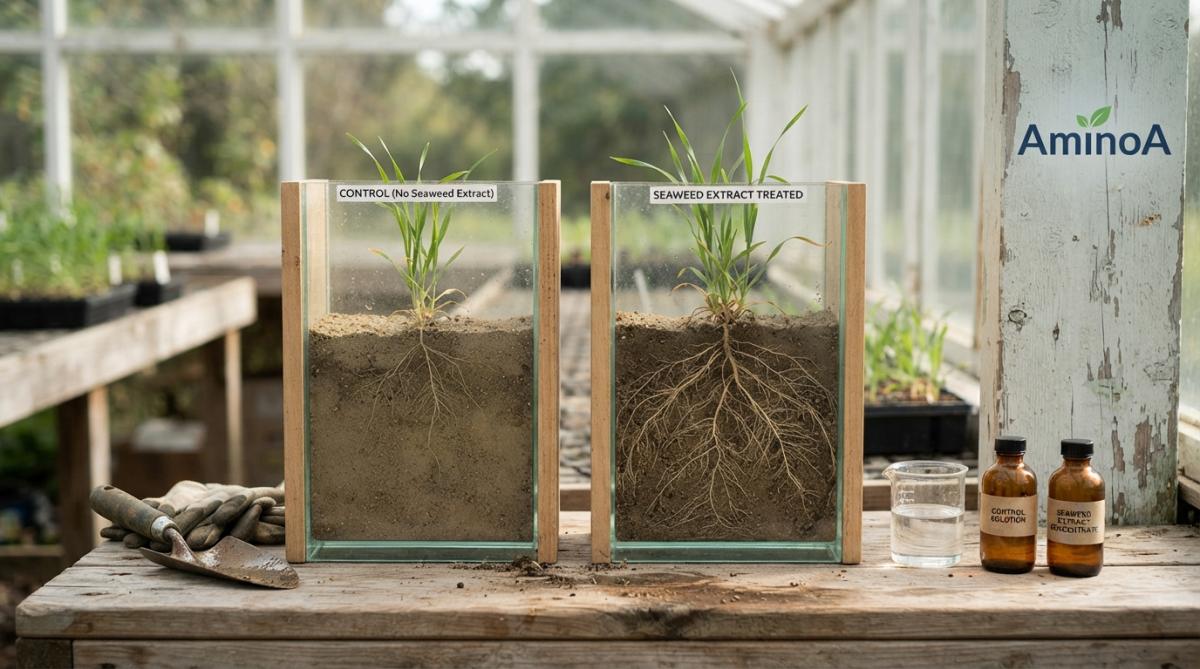
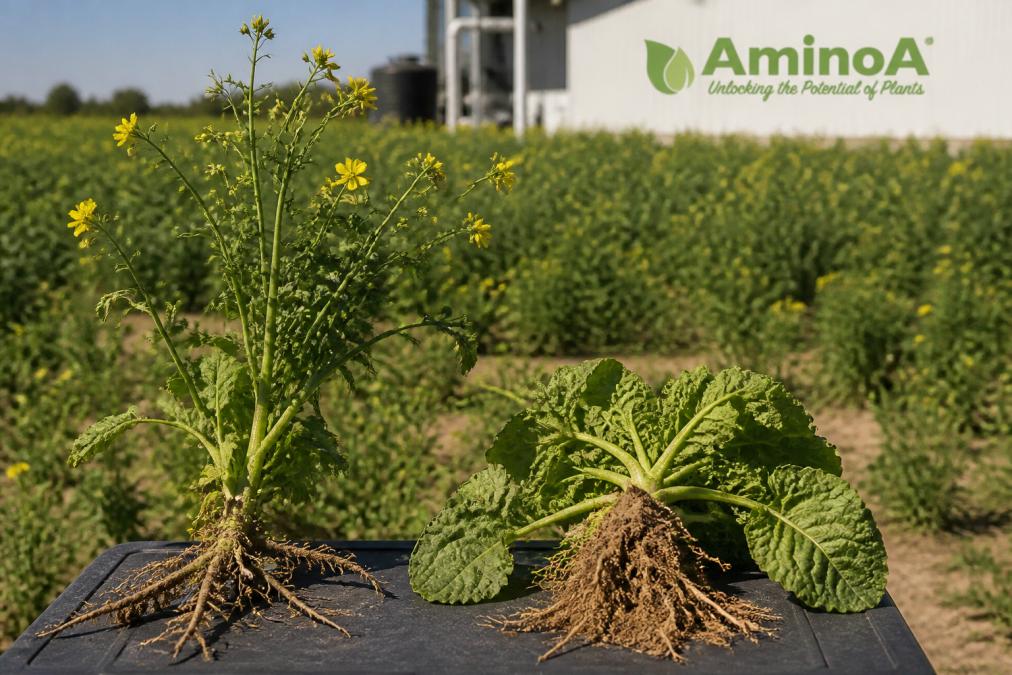
Biostimulants change the calculation by improving nutrient use efficiency in crops. When amino acids stimulate root development and metabolic activity, the plant scavenges more of the available nitrogen pool. Growers who integrate biostimulants frequently report being able to trim synthetic rates while maintaining or improving yields. The long-term picture also favours a blended approach: healthier soil biology and reduced dependency on volatile commodity markets.
Nutrient Use Efficiency in Crops: Getting More from Every Gram Applied
Nutrient use efficiency in crops is the metric that separates average programmes from exceptional ones. It measures how effectively a plant converts applied nutrients into biomass and yield. When this figure is low, every input decision becomes more expensive because a smaller fraction of the spend delivers value.
L-α amino acids play a direct role here. They are the building blocks the plant uses to construct enzymes, proteins, and transport mechanisms. Supplying these in the L form, which is the biologically active configuration, allows the plant to allocate energy towards growth rather than amino acid synthesis. Independent trials, including work by Velcourt, have demonstrated the practical effect: adding an amino acid biostimulant to reduced fungicide programmes maintained yields and improved green leaf area in winter wheat (ahdb.org.uk).
The Case for Reducing Synthetic Fertiliser Reliance in Your Programme
Reducing synthetic fertiliser reliance has become an economic imperative, not just an environmental preference. The volatility of the ammonium nitrate market has made budget planning difficult, and regulatory pressure continues to mount around nitrogen application limits and water quality. Growers who depend entirely on synthetic inputs carry that risk directly on their balance sheet.
Biostimulants offer a mechanism to de-risk. By improving the efficiency of every gram applied, they create headroom to reduce rates without sacrificing yield potential. This matters most in high-stress seasons. When drought or cold suppresses nutrient uptake, a crop treated with amino acids maintains better metabolic function and recovers faster. The realistic expectation is not that a biostimulant replaces your fertiliser programme, but that it allows you to run a leaner one with the same output.
L-α Amino Acid Biostimulant Benefits: Beyond the NPK Label
The L-α amino acid biostimulant benefits extend into areas where synthetic fertiliser has no mechanism to act. Produced through enzymatic hydrolysis, these products deliver every essential amino acid in the biologically active L form, alongside nitrogen, potassium, iron, and magnesium. This composition supports root, leaf, and bud development, stimulates blossom and fruit formation, and builds resistance to cold, heat, drought, and agrochemical phytotoxicity.
For growers who suffered tank mix damage last season, the phytotoxicity angle deserves attention. Amino acids support the plant's natural recovery processes, helping it metabolise and overcome the stress of incompatible applications. The practical benefit is a more resilient crop that holds its yield potential through the unpredictable events that define UK growing seasons.
Decision Framework: When to Use Biostimulants, Fertilisers, or Both
The decision hinges on where your constraint sits. If soil indices are low and the crop is starved of basic nutrition, synthetic fertiliser remains non-negotiable. No biostimulant replaces a genuine nitrogen deficiency. If nutrition is adequate but the crop is underperforming due to stress, poor rooting, or inefficient uptake, that is where the biostimulant earns its place.
A practical framework looks like this:
- Soil test first. Establish your baseline nutrition before making any input decision.
- Fertiliser for the foundation. Apply synthetic nitrogen to meet the crop's basic requirement.
- Biostimulant for efficiency. Add an amino acid product at key growth stages to maximise uptake and stress tolerance.
- Integrate and adjust. Use tissue testing and yield mapping to refine rates in subsequent seasons.
This integrated approach, supported by guidance from AHDB nutrient management recommendations, offers the strongest path to margin protection.
Conclusion: Balancing Agronomy and Economics
The biostimulants vs synthetic fertilisers cost-benefit analysis ultimately comes down to risk management. Synthetic fertiliser delivers the raw nutrition your crop needs, but its cost volatility and environmental footprint are growing liabilities. Biostimulants offer a way to make that nutrition work harder, protecting yield through stress and improving the efficiency of every input pound.
The most profitable programmes will not choose between these tools. They will use synthetic fertiliser to set the foundation and L-α amino acid biostimulants to build resilience and efficiency on top of it. For growers ready to test this approach, AminoA offers scientifically backed products designed to improve return on investment without compromising yield. Subscribe to our newsletter for practical guidance on integrating biostimulants into your programme.
=== FAQ ANSWERS (ARTICLE CONTENT, AUDIT EACH ONE SEPARATELY, SAME RULES) ===
Frequently Asked Questions
Are biostimulants more cost-effective than synthetic fertilisers?
It depends on your metric. Synthetic fertilisers deliver cheap, immediate nitrogen, but their efficiency can be low. Biostimulants often cost more per litre but improve the efficiency of applied nutrients. The most cost-effective approach is usually integrated: maintaining a baseline NPK programme while using biostimulants to reduce waste and boost yields. This lowers your overall cost per tonne of crop produced, improving margin rather than just cutting the input bill.
Can biostimulants completely replace synthetic fertilisers in commercial farming?
For most commercial operations, complete replacement is unrealistic. Biostimulants do not supply the macronutrient volumes crops remove at harvest. Their role is to improve nutrient use efficiency in crops, helping plants access and process the nutrients already in the soil and applied as base fertiliser. In practice, farmers use them to reduce synthetic fertiliser reliance while maintaining yields, rather than eliminating synthetic inputs entirely.
How do L-α amino acid biostimulant benefits improve nutrient use efficiency?
L-α amino acids act as chelating agents, keeping nutrients like iron and magnesium available in the root zone. They also reduce energy costs associated with nutrient uptake and transport, allowing the plant to redirect energy to growth. This means a greater proportion of applied nitrogen is taken up rather than lost. Velcourt trials on winter wheat showed adding an amino acid biostimulant to reduced fungicide rates maintained yields and improved green leaf area.
What are the long-term economic benefits of switching to biostimulants?
The main long-term benefit is soil health. Healthier soil biology improves nutrient cycling, reducing the amount of purchased fertiliser needed each season. Biostimulants also support stress tolerance, which protects yield potential during dry springs or heat events. Over a 3-5 year period, growers typically report more consistent yields and lower cost per tonne, though this depends on your rotation and baseline soil fertility.
This article was written using GrandRanker
Frequently Asked Questions
Q: Are biostimulants more cost-effective than synthetic fertilisers?
A: It depends on your metric. Synthetic fertilisers deliver cheap, immediate nitrogen, but their efficiency can be low. Biostimulants often cost more per litre but improve the efficiency of applied nutrients. The most cost-effective approach is usually integrated: maintaining a baseline NPK programme while using biostimulants to reduce waste and boost yields. This lowers your overall cost per tonne of crop produced, improving margin rather than just cutting the input bill.
Q: Can biostimulants completely replace synthetic fertilisers in commercial farming?
A: For most commercial operations, complete replacement is unrealistic. Biostimulants do not supply the macronutrient volumes crops remove at harvest. Their role is to improve nutrient use efficiency in crops, helping plants access and process the nutrients already in the soil and applied as base fertiliser. In practice, farmers use them to reduce synthetic fertiliser reliance while maintaining yields, rather than eliminating synthetic inputs entirely.
Q: How do L-α amino acid biostimulant benefits improve nutrient use efficiency?
A: L-α amino acids act as chelating agents, keeping nutrients like iron and magnesium available in the root zone. They also reduce energy costs associated with nutrient uptake and transport, allowing the plant to redirect energy to growth. This means a greater proportion of applied nitrogen is taken up rather than lost. Velcourt trials on winter wheat showed adding an amino acid biostimulant to reduced fungicide rates maintained yields and improved green leaf area.
Q: What are the long-term economic benefits of switching to biostimulants?
A: The main long-term benefit is soil health. Healthier soil biology improves nutrient cycling, reducing the amount of purchased fertiliser needed each season. Biostimulants also support stress tolerance, which protects yield potential during dry springs or heat events. Over a 3-5 year period, growers typically report more consistent yields and lower cost per tonne, though this depends on your rotation and baseline soil fertility.