 comparison
Organic vs Synthetic Biostimulants for UK Arable Farms
Table of Contents
- How Organic and Synthetic Biostimulants Differ
- Liquid Biostimulants vs Granular Fertilisers: Uptake and Practicality
- Benefits of L-α Amino Acid Biostimulants for Arable and Horticultural Crops
- Efficacy and ROI: What the Field Data Shows
- Biostimulant Application Timing: Matching Inputs to Crop Growth Stages
- Compliance, Certification, and Tank-Mix Safety
- Frequently Asked Questions
Last Updated: 27 September 2026
How Organic and Synthetic Biostimulants Differ
Organic and synthetic biostimulants for commercial agriculture differ mainly in their source materials and how they are produced, not in the biological effect they aim to deliver. Both categories exist to improve nutrient uptake, root development and stress tolerance. The distinction lies in origin, purity and consistency.
This guide from AminoA breaks down where each type comes from, how it performs in the field, and how to decide what your rotation actually needs.
Biostimulants for commercial agriculture are substances or microorganisms applied to crops to stimulate natural processes that improve nutrient use efficiency, abiotic stress tolerance and crop quality, independent of their nutrient content (Biostimulants and plant protection product regulation). That definition matters because it separates a biostimulant from a fertiliser. A fertiliser feeds the plant directly. A biostimulant changes how efficiently the plant feeds itself.
Source Materials and Production Methods
Organic biostimulants come from plant extracts, seaweed, humic and fulvic substances, composts and animal by-products. Production is often a physical or fermentation process: extraction, hydrolysis or composting.
Synthetic biostimulants are manufactured from defined chemical compounds. They include pure amino acid formulations, peptide chains and synthetic hormone analogues.
The practical consequence is consistency. A seaweed extract varies with species, harvest timing and processing. A synthesised or enzymatically refined amino acid profile is far more predictable batch to batch. For a 200-hectare wheat block, predictability usually beats novelty.
Liquid Biostimulants vs Granular Fertilisers: Uptake and Practicality
Liquid biostimulants and granular fertilisers serve different jobs, and treating them as substitutes is the most common mistake we see. Granular products release bulk nutrition into the soil over weeks. Liquid biostimulants deliver small, targeted doses that the leaf or root takes up within hours to days.
Foliar uptake is fast because the leaf cuticle absorbs dissolved molecules directly. Granular uptake depends on soil moisture, temperature and root interception, which is why a dry spring can leave granular nitrogen sitting in the topsoil while the crop stalls.
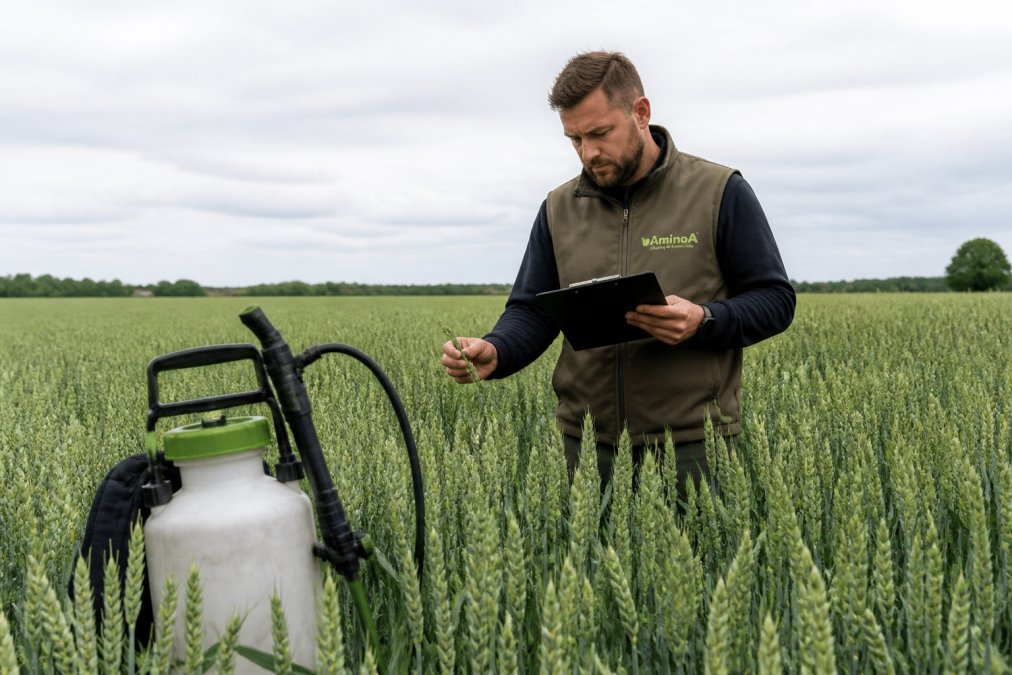
Practicality cuts both ways:
- Liquids need clean water, correct nozzle choice and sprayer capacity on the day
- Granules need a spreader pass, which is cheaper per hectare but slower to act
- Liquids can be tank-mixed with existing passes, saving a separate trip
- Granules suit base nutrition; liquids suit in-season correction
Benefits of L-α Amino Acid Biostimulants for Arable and Horticultural Crops
L-α amino acid biostimulants give crops a ready-made building block rather than a raw material that must be converted first. Plants normally synthesise amino acids from nitrate, a process that costs energy. Supplying the L-α form directly frees that energy for growth.
The benefits of L-α amino acid biostimulants show up across several areas:
- Stronger root and leaf development, which supports establishment and canopy
- Better blossom and fruit formation in high-value horticultural crops
- Improved tolerance to cold, heat and drought stress
- Reduced phytotoxicity damage from agrochemical tank mixes
- Measurable gains in yield and quality when timed to growth stages
At AminoA, we produce our biostimulants through enzymatic hydrolysis rather than acid hydrolysis. That matters because enzymatic breakdown preserves the L-α form. Only L-form amino acids are biologically active in plants; the D-form is largely unusable. Every essential amino acid in our range is supplied in the L form, alongside nitrogen, potassium, iron and magnesium.
Efficacy and ROI: What the Field Data Shows
Efficacy depends far more on timing and dose than on whether a product is organic or synthetic. A well-timed amino acid application at a stress point will typically outperform a poorly timed application of a more expensive product.
The clearest independent evidence we can point to comes from Velcourt trials, which found that adding AminoA FLO to reduced fungicide rates maintained yields and improved green leaf area in winter wheat. That is the outcome that matters commercially: same yield, lower input spend.
A common mistake is judging ROI on a single season with a single application. Biostimulant returns usually compound across a rotation, because healthier roots and better stress tolerance carry into the next crop.
Biostimulant Application Timing: Matching Inputs to Crop Growth Stages
Biostimulant application timing decides whether you get a return at all. The same product applied at the wrong stage is money spent for nothing.
Match the input to the growth stage:
| Growth Stage | Primary Goal | Typical Input Type |
|---|---|---|
| Establishment | Root development | Root-directed amino acids |
| Early vegetative | Canopy and leaf area | Foliar L-α amino acids |
| Pre-flowering | Blossom and fruit set | Foliar amino acid plus K |
| Stress events | Recovery and tolerance | Foliar amino acids |
| Grain fill | Quality and yield | Foliar amino acid plus Mg |
The rule of thumb: apply before the plant needs the help, not after the stress has already cut yield. Foliar applications work best in the early morning or late evening when stomata are open and evaporation is low.
Compliance, Certification, and Tank-Mix Safety
Compliance is where organic growers carry the most risk, and it is worth getting right before you buy. Organic certification bodies assess inputs against approved standards, and a product that is not listed can put your certification at risk even if it performs well.
For organic farm managers, the questions to ask any supplier are straightforward:
- Is the product approved for use under your certification body's standards?
- Can the supplier provide documentation to support that claim?
- Is the formulation free from synthetic chelators or prohibited additives?
Tank-mix safety is the other practical concern. Phytotoxicity damage usually comes from incompatible combinations, high spray concentrations or poor water quality rather than the biostimulant itself. Always jar-test a new mix before committing a full sprayer load, and follow label rates rather than pushing concentration for a faster result.
AminoA has operated in the UK market for 10 years, and our L-α amino acid formulations are designed to sit alongside standard agrochemical programmes without disrupting them.
The challenge for most growers is not choosing between organic and synthetic, but knowing which specific input earns its place in a tightly budgeted spray programme. AminoA manufactures 100% L-α amino acid biostimulants through enzymatic hydrolysis, supplying every essential amino acid in the biologically active L form with high levels of nitrogen, potassium, iron and magnesium. If you want to see how that performs on your own crops before committing to a full season, get in touch with AminoA to discuss a trial. Subscribe to our newsletter for field trial updates and application guidance.
Frequently Asked Questions
What is the primary difference between organic and synthetic biostimulants?
Organic biostimulants are derived from natural sources such as plant extracts, seaweed, and amino acids, while synthetic options are manufactured from petrochemical or mineral feedstocks. For commercial agriculture, the practical difference shows up in certification eligibility, tank-mix compatibility, and how quickly the crop can take up the active compounds. Organic products are typically permitted under organic certification schemes, whereas synthetic biostimulants generally are not.
Are organic biostimulants as effective as synthetic alternatives for yield improvement?
Effectiveness depends on the specific crop, timing, and formulation rather than the organic or synthetic label alone. L-α amino acid biostimulants, for example, are taken up rapidly through foliar application and support stress recovery during cold, heat, or drought periods. Velcourt trials found that adding AminoA FLO to reduced fungicide rates maintained yields and improved green leaf area in winter wheat, showing that organic inputs can hold performance when integrated correctly.
Do biostimulants replace the need for traditional fertilisers?
No. Biostimulants support plant processes such as root development and stress resistance, but they do not supply the bulk nitrogen, phosphorus, and potassium that a crop needs. They work alongside a balanced fertiliser programme, often allowing growers to reduce certain agrochemical inputs without losing yield. Think of them as a complement to nutrition, not a substitute for it.
How do I know which biostimulant application timing works best for my crops?
Timing should match key growth stages where the crop faces the most stress or has the highest demand. For cereals, that often means early tillering and flag leaf emergence. For horticultural crops like strawberries or tomatoes, applications around flowering and fruit set tend to give the best response. A small on-farm trial comparing treated and untreated strips is the most reliable way to confirm what works on your specific soil and rotation.