 comparison
Humic vs Amino Acid Biostimulants: Key Differences
Table of Contents
- Humic Acid vs Amino Acid Biostimulants: What's the Difference?
- Primary Functions: Soil Conditioner vs Plant Metabolism
- Benefits of L-Alpha Amino Acids for Direct Plant Uptake
- How Humic Acid Builds Long-Term Soil Fertility
- Plant Stress Mitigation Strategies: Which Biostimulant to Use
- Biostimulant Application Timing for Maximum Impact
- Can You Use Humic Acid and Amino Acids Together?
- Making the Right Choice for Your Cropping System
- Frequently Asked Questions
Last Updated: September 8, 2026
Humic Acid vs Amino Acid Biostimulants: What's the Difference?
The difference between humic acid and amino acid biostimulants comes down to where each works: humic acid conditions the soil, while amino acid biostimulants feed the plant directly. Humic substances are large, complex molecules derived from decomposed organic matter that improve soil structure and nutrient retention. Amino acids, by contrast, are simple organic compounds that plants absorb rapidly through their leaves and roots to fuel metabolism. At AminoA, we specialise in the latter, manufacturing natural L-α amino acid biostimulants.
Understanding this distinction matters because it changes how you plan your entire nutrition programme. Many growers lump all biostimulants together, then wonder why a soil product hasn't revived a stressed crop. The short answer: humic acid works on the ground you stand on, amino acids work on the plant in front of you. Below, we'll break down the science, the timing, and the practical scenarios where each earns its place in your spray programme.
Primary Functions: Soil Conditioner vs Plant Metabolism
Humic acid acts primarily as a soil conditioner. It increases the cation exchange capacity of the soil, helping clay soils drain better and sandy soils hold moisture and nutrients for longer. In practice, this means fertiliser you apply stays available to the crop instead of leaching away, and microbial activity in the rhizosphere gets a genuine boost. It is a long game, building fertility across seasons rather than feeding the plant instantly.
Amino acid biostimulants work on an entirely different level: plant metabolism. Because amino acids are the building blocks of proteins and enzymes, they participate directly in photosynthesis, respiration, and hormone regulation. Applied to the leaf, they are taken up within hours and shuttled straight into metabolic pathways (PubMed). The result is visible growth responses, stronger root and shoot development, and a plant better equipped to handle environmental pressure. If humic acid is the groundwork, amino acids are the active ingredient.
Benefits of L-Alpha Amino Acids for Direct Plant Uptake
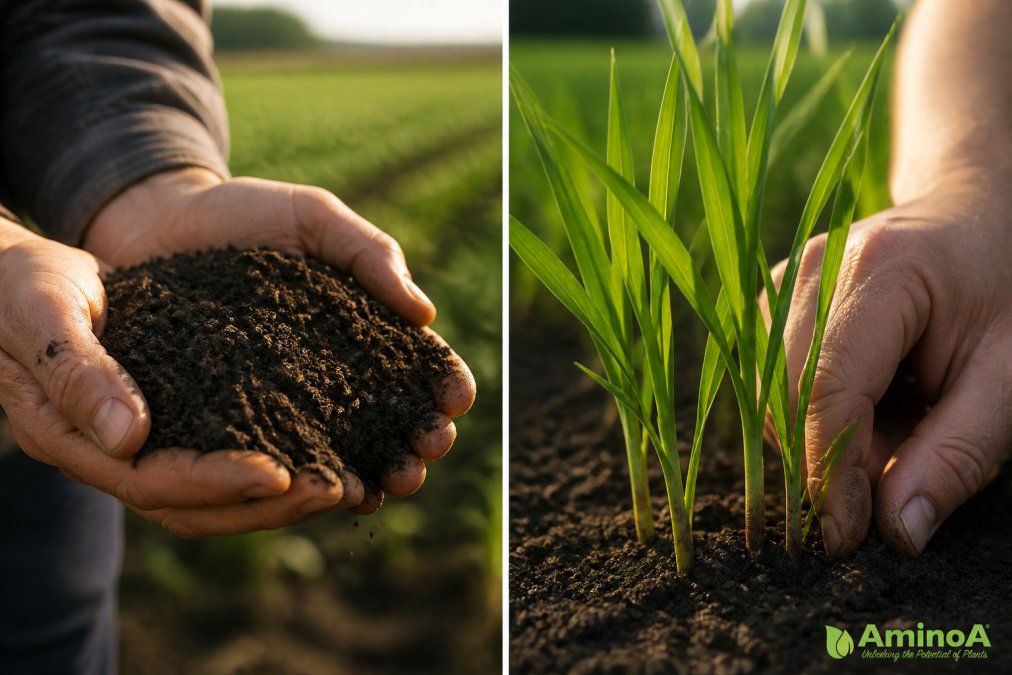
The benefits of L-alpha amino acids centre on their immediate, direct availability to the crop. Unlike complex proteins or synthetic nitrogen sources that require energy to break down, L-α amino acids are already in the biologically active form plants can use straight away. This is why they are the preferred tool for correcting deficiencies and driving growth at critical windows.
For growers, the practical upside is threefold. First, they stimulate root, leaf, and bud development, giving the crop momentum when it needs it most. Second, they encourage blossom, fruit formation, and grain fill, which directly supports yield and quality. Third, they supply nitrogen and other nutrients in a form that bypasses soil chemistry entirely, which makes them invaluable when soil conditions are cold, wet, or otherwise limiting uptake.
How Humic Acid Builds Long-Term Soil Fertility
Where amino acids deliver speed, humic acid delivers durability. Regular applications improve soil aggregation, which means better aeration and root penetration over time. The humic molecules bind to clay particles and create stable structures that resist compaction, and they chelate micronutrients such as iron and zinc, keeping them available to the crop rather than locked in the soil (acs.org).
This makes humic acid a sound investment for regenerative systems and land that has been intensively cropped. It is less about rescuing a crop in trouble and more about preventing trouble from developing in the first place. Many practitioners apply humic products ahead of the main fertiliser programme so that every subsequent input works more efficiently. The trade-off is that you will not see the rapid green-up or stress response that a foliar amino acid product delivers within days.
Plant Stress Mitigation Strategies: Which Biostimulant to Use
When it comes to plant stress mitigation strategies, the choice depends on the nature and timing of the threat. Amino acids are the standout option for acute, short-term stress such as frost, heatwaves, drought, or herbicide drift. They bolster the plant's own stress-response mechanisms, helping it maintain cellular function when conditions turn hostile. Crops treated with amino acids before a forecast cold snap or a drying wind tend to hold green leaf area and keep moving towards yield (sciencedirect.com).
Humic acid plays a supporting role in stress management, but through the soil. A healthy soil profile with good moisture retention gives roots a buffer during dry spells, and improved nutrient availability helps the plant stay strong. For a combined strategy, many agronomists recommend building soil health with humic products across the rotation while keeping amino acids on hand for the moments when the crop faces an immediate threat. The former reduces the likelihood of stress; the latter reduces its impact.
Biostimulant Application Timing for Maximum Impact
Biostimulant application timing separates effective programmes from wasted expenditure. Humic acid is best applied to the soil during cultivation, at drilling, or early in the season when it can influence seedbed conditions and nutrient release. Because it works through soil chemistry, it needs time and moisture to integrate, so autumn or early spring applications suit it well.
Amino acid biostimulants operate on a much tighter clock. They are most effective when applied at specific growth stages: tillering in cereals, early fruit set in top fruit, or just before and after a known stress event. Foliar applications of L-α amino acids are absorbed quickly, so they can be timed with precision around the weather forecast or a planned agrochemical pass. For growers running wheat and barley, a common approach is to add amino acids to the T1 or T2 fungicide timing, saving a pass while supporting the crop through its most demanding growth phase.
Can You Use Humic Acid and Amino Acids Together?
Yes, humic acid and amino acids complement each other well, and combining them is a legitimate strategy for growers who want both soil improvement and direct plant nutrition. The two products rarely conflict; they target different parts of the system. Humic acid improves the rooting environment, while amino acids feed the plant above ground. A typical programme might use humic acid at establishment to build the soil, then switch to amino acid foliar feeds through the growing season.
Compatibility in the tank is generally good, but always check the label and do a jar test before mixing with other products. Amino acids are known to mix well with many liquid fertilisers and agrochemicals, and some growers use them to help the crop cope with the phytotoxicity risk of certain fungicide or herbicide combinations. If you are unsure about your specific tank mix, a small-scale test on a few acres is the prudent route.
Making the Right Choice for Your Cropping System
Choosing between the two comes down to your primary constraint. If your limiting factor is soil quality, poor structure, or low organic matter, humic acid deserves a place in your programme. If your limiting factor is crop stress, nutrient uptake efficiency, or the need to maintain yield while reducing agrochemical inputs, amino acid biostimulants are the more direct answer. Many enterprises find they need both, but the emphasis should reflect where the bottleneck sits.
For growers looking to optimise harvests and reduce reliance on traditional agrochemicals, AminoA offers a specialist range of natural L-α amino acid biostimulants. Produced through enzymatic hydrolysis, our products contain high concentrations of nitrogen, potassium, iron, and magnesium, and every essential amino acid in the biologically active L form. Velcourt trials found that adding AminoA FLO to reduced fungicide rates maintained yields and improved green leaf area in winter wheat.
| Factor | Humic Acid | Amino Acid Biostimulants |
|---|---|---|
| Primary action | Soil conditioning | Plant metabolism |
| Speed of effect | Slow, cumulative | Rapid, visible within days |
| Best application | Cultivation, drilling | Foliar at growth stages |
| Main benefit | Nutrient retention, soil structure | Stress resistance, yield quality |
| Typical use | Building long-term fertility | Acute stress and growth windows |
The real difference between humic acid and amino acid biostimulants is a question of timescale: one builds the soil for the future, the other feeds the crop for today. A resilient cropping system often needs both, but knowing which lever to pull and when is what separates a good programme from a great one. If you are ready to see how L-α amino acids can improve root development, stress resistance, and yield quality on your farm, explore the AminoA range.
Frequently Asked Questions
Can humic acid and amino acids be used together in crop programmes?
Yes, they complement each other well. Humic acid improves soil structure and nutrient retention, creating a better environment for roots. Amino acid biostimulants provide readily available compounds that plants absorb directly to fuel growth and metabolic processes. A common strategy is applying humic acid to the soil in autumn or early spring to build fertility, then using foliar amino acid products during key growth stages or when stress conditions, such as drought or frost, are forecast.
How do amino acid biostimulants improve stress resistance in plants?
Plants under stress produce stress ethylene, which inhibits growth. L-alpha amino acids, particularly proline and betaine, help plants manage this response. They act as osmoprotectants, helping cells retain water, and serve as precursors for protective proteins. This allows the plant to maintain metabolic activity and continue growing during cold, heat, or drought. Products containing 100% L-alpha amino acids are absorbed rapidly through the leaf surface, providing an immediate source of building blocks for stress response.
What is the primary function of humic acid in soil health?
Humic acid is a soil conditioner. Its main role is to improve the physical, chemical, and biological properties of the soil. It increases the cation exchange capacity (CEC), which helps soil hold onto essential nutrients like potassium, calcium, and magnesium so they are less prone to leaching. It also promotes aggregate stability, improving soil structure and water infiltration. This creates a more favourable environment for beneficial microbial activity and robust root development.
Are L-alpha amino acids more effective than humic acid for yield enhancement?
They target different limitations. L-alpha amino acids directly influence plant metabolism, promoting cell division, pollen fertility, and fruit set. They are highly effective at preventing yield loss during stress periods. Humic acid improves yield indirectly by enhancing nutrient availability and root growth over the long term. For rapid, visible responses during the growing season, L-alpha amino acids can provide a more immediate return, but they do not replace the foundational benefits of humic acid for soil health.