 how-to
Foliar Fertiliser Application Rates for Wheat: A Practical Guide
Table of Contents
- What Foliar Fertiliser Rates Actually Deliver in Wheat
- Wheat Foliar Fertiliser Timing by Growth Stage
- Foliar Nitrogen for Grain Protein: What the Evidence Shows
- Foliar Urea Application Rate for Wheat: Getting the Numbers Right
- Spray Volume, Nozzle Choice and Canopy Interception
- Wheat Leaf Scorch from Fertiliser: Causes and Prevention
- Rates Beyond Nitrogen: Phosphorus, Potassium, Sulphur and Micronutrients
- Building Your Foliar Programme with AminoA
- Frequently Asked Questions
Last Updated: November 2, 2026
What Foliar Fertiliser Rates Actually Deliver in Wheat
Foliar fertiliser application rates for wheat work best when they match the crop's stage and the nutrient you are correcting, and the same holds for foliar fertiliser application rates for wheat across the season. Get the rate wrong and you either scorch leaves or waste money. Get it right and you can lift grain protein, protect yield, and cut total nitrogen input.
Recent trial work backs this up. A 2025 study in Agronomy journal research on split foliar nitrogen reported that split foliar nitrogen raised both wheat yield and protein concentration at nitrogen rates of 101-200 kg N/ha. Separately, research published on ScienceDirect foliar fertilisation study found foliar feeding held wheat productivity while cutting nitrogen input by up to 40%.
Growers who want that kind of efficiency without losing yield are the focus of our work. The catch is that foliar rates are not one-size-fits-all. They depend on the nutrient, the growth stage, and how well your spray reaches the leaf.
Below, we break down the rates, timing, and spray conditions that decide whether a foliar pass pays for itself. For the companion figures on liquid biostimulant rates for the same crop, see our liquid biostimulant application rates for wheat.
Wheat Foliar Fertiliser Timing by Growth Stage
Timing decides more of the outcome than the rate itself. The leaf can only take up what it can absorb, and uptake peaks at specific growth stages.
Apply foliar nitrogen and micronutrients when the crop is actively growing and the canopy is open enough for spray to reach the leaves. For most winter wheat, that means:
- Tillering to stem extension: corrects early deficiencies in zinc, manganese and phosphorus
- Flag leaf emergence: the highest-value window for nitrogen and potassium
- Grain fill: late-season nitrogen to support protein
Late-season application carries the biggest protein benefit but the tightest margin for error. Spray too late and the nitrogen never reaches the grain.
For a deeper look at which stages respond best, see our guide to foliar nutrition for cereal crops.
Foliar Nitrogen for Grain Protein: What the Evidence Shows
Foliar nitrogen is the most reliable lever for grain protein when soil nitrogen is already adequate. The evidence points to late-season passes as the key window.
The Agronomy (2025) work found protein concentration rose alongside yield when split foliar nitrogen was applied at 101-200 kg N/ha. That matters because protein and yield usually pull against each other. Getting both to rise is the goal most growers chase.
But there is a catch. AHDB guidance on foliar nitrogen recovery notes that foliar nitrogen recovery can match soil-applied nitrogen, yet the total quantity the crop retains is lower. In practice, foliar feeding supplements soil nitrogen, it does not replace it.
If you are weighing nitrogen rates against protein targets, our article on optimising nitrogen application rates walks through the wider calculation.
Foliar Urea Application Rate for Wheat: Getting the Numbers Right
The foliar urea application rate for wheat depends on concentration, not guesswork. Urea is a common foliar nitrogen source. The critical distinction, and the one most growers get wrong, is between the product rate (how much urea you put in the tank) and the nutrient rate (how many kilograms of nitrogen that delivers to the crop).
Converting a target nitrogen rate into product
Straight agricultural urea is 46% N by weight. That means every 1 kg of urea product delivers 0.46 kg of nitrogen. To hit a target nutrient rate, divide the target by 0.46:
- Target 5 kg N/ha → 5 ÷ 0.46 = 10.9 kg urea/ha
- Target 10 kg N/ha → 10 ÷ 0.46 = 21.7 kg urea/ha
- Target 15 kg N/ha → 15 ÷ 0.46 = 32.6 kg urea/ha
The 101-200 kg N/ha range from the 2025 studies is a total nitrogen figure, not a single-spray dose. Consider splitting the total across several passes rather than one heavy application, and follow the product label for per-pass rates.
Working out the concentration in the tank
Product rate per hectare is only half the calculation. You also need the concentration in the spray water, because that is what determines scorch risk. If you apply 21.7 kg urea in 200 L water/ha, the tank concentration is roughly 10.9% urea, a common ceiling for wheat at flag leaf. Halving the water volume to 100 L/ha doubles the concentration to about 21.7%, which is where leaf burn starts. The lesson: keep the product rate fixed and adjust water volume to control concentration, not the other way round.
Watch out: mixing urea too strong is the most common cause of leaf burn. Always check the product label and test on a small strip first.
UAN and other nitrogen sources
UAN (urea ammonium nitrate) and ammonium sulphate are other nitrogen sources; check the product label for guidance on rates and tank concentrations for each.
For the wider nitrogen picture, our article on optimising nitrogen application rates walks through how foliar passes fit alongside soil-applied nitrogen.
Straight agricultural urea is 46% N, so divide your target nitrogen rate by 0.46 to get the product rate.
| Target nutrient rate | Urea product rate | Note |
|---|---|---|
| 5 kg N/ha | 10.9 kg urea/ha | 5 ÷ 0.46 |
| 10 kg N/ha | 21.7 kg urea/ha | 10 ÷ 0.46 |
| 15 kg N/ha | 32.6 kg urea/ha | 15 ÷ 0.46 |
| 21.7 kg urea in 200 L water/ha | About 10.9% urea | Common ceiling at flag leaf |
| 21.7 kg urea in 100 L water/ha | About 21.7% urea | Where leaf burn starts |
Spray Volume, Nozzle Choice and Canopy Interception
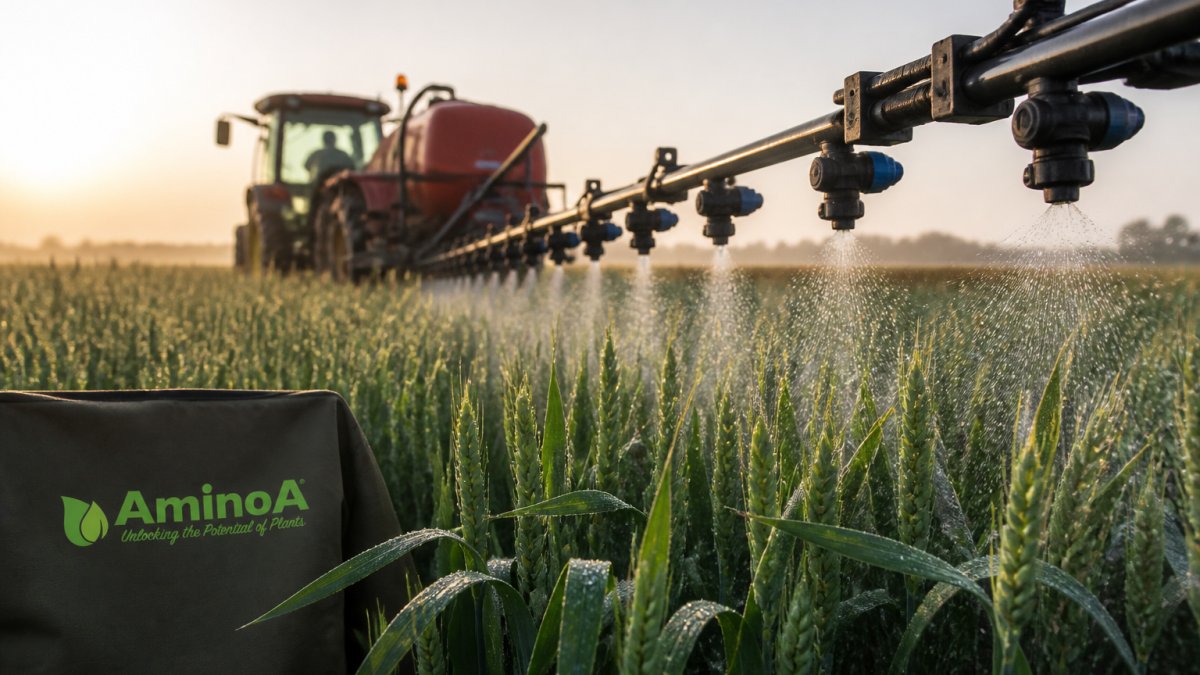
Spray volume and nozzle choice decide how much fertiliser actually lands on the leaf. A perfect rate delivered with poor coverage is money on the ground. This is the operational layer most rate guides skip, and it is where foliar passes succeed or fail in the field.
Water volume
Water volume affects both coverage and tank concentration, so the right volume depends on growth stage and the product label.
Nozzle choice and droplet size
Aim for fine-to-medium droplets in the 200-300 micron range. Fine droplets give better leaf coverage and uptake, but they drift more and evaporate faster in heat. Coarse droplets bounce off waxy wheat leaves and run to the ground. A flat-fan nozzle at 110° with a medium spray quality is a sensible default; an air-induction nozzle reduces drift but produces coarser droplets, so it is a poorer choice for uptake-critical passes. Keep boom height steady and match forward speed to the target volume rather than adjusting pressure alone.
Canopy interception
Canopy interception matters most at flag leaf and beyond. Once the canopy closes, droplets struggle to reach lower leaves, and the flag leaf, the one that contributes most to grain fill, is the target.
Tank mixing and compatibility
Foliar fertiliser is rarely sprayed alone. Jar-test every new combination before committing, and add products in the correct order, water conditioners first, then fertiliser, then agrochemicals, then adjuvants. High-salt fertiliser mixes can 'salt out' with some contact-acting fungicides, blocking nozzles and reducing efficacy. If you had phytotoxicity damage from a tank mix last season, test every new combination on a small area first.
Conditions
Check the product label for guidance on spray timing, weather conditions and rainfastness before applying.
For a full walkthrough of uptake mechanics, read our guide to foliar application techniques for better absorption.
Wheat Leaf Scorch from Fertiliser: Causes and Prevention
Wheat leaf scorch from fertiliser is nearly always a concentration or timing problem. The leaf burns when the salt load is too high or the spray lands in heat.
The main causes:
- Mixing urea or UAN too strong for the crop stage
- Spraying in bright sun or high temperatures
- Tank-mixing fertiliser with incompatible agrochemicals
- Poor water quality raising the salt effect
Prevention centres on keeping concentrations within label limits and checking tank mix compatibility before applying.
Rates Beyond Nitrogen: Phosphorus, Potassium, Sulphur and Micronutrients
Nitrogen gets the attention, but the other nutrients have their own rate logic. Foliar phosphorus, potassium, sulphur, zinc and other micronutrients correct deficiencies that soil applications cannot fix fast enough.
- Phosphorus: early-season correction, low rates, applied when roots are slow
- Potassium: flag leaf to grain fill, supports protein and stress tolerance
- Sulphur: supports nitrogen use and grain quality
- Zinc and manganese: small rates, high impact where deficiency shows
Micronutrient rates are typically small; match the rate to a confirmed deficiency and follow the product label.
Building Your Foliar Programme with AminoA
A foliar programme works when the rates, timing and spray technique all line up. That is where a well-built biostimulant fits alongside your nitrogen and micronutrient passes.
AminoA makes 100% L-α amino acid biostimulants through enzymatic hydrolysis. Every essential amino acid is in the L form, and our products are high in nitrogen, potassium, iron and magnesium. Growers use them to support root and leaf development, stress resistance, and yield and quality.
The proof point: Velcourt trials found that adding AminoA FLO to reduced fungicide rates maintained yields and improved green leaf area in winter wheat.
For the programme-building detail, read our guide to integrating amino acid biostimulants.
Frequently Asked Questions
What is the best foliar fertiliser rate for wheat?
There is no single figure, because the right foliar fertiliser rates depend on the product, the nutrient, the growth stage and the spray volume. Nitrogen rates for wheat are a total programme figure rather than a per-spray dose. Work from the product label, calculate the nutrient delivered per hectare, and keep individual spray concentrations modest to limit scorch risk.
When should foliar nitrogen be applied to wheat?
Wheat foliar fertiliser timing usually targets two windows. The first is around stem extension to flag leaf emergence, when the canopy is building and nutrient demand is high. The second is a late-season application at heading to grain fill, aimed at grain protein. Splitting doses across these windows is a common approach rather than relying on one large late spray.
Can foliar fertiliser scorch wheat leaves?
Yes. Wheat leaf scorch from fertiliser is most often linked to high urea or salt concentrations, low spray volumes, bright sunshine and slow drying conditions. The risk rises when you push the concentration to save water or mix products without checking compatibility. Keep doses within label limits, use adequate water volume for the canopy, spray in cooler parts of the day, and test any new tank mix on a small area first. In Velcourt trials, adding AminoA FLO to reduced fungicide rates maintained yields and improved green leaf area in winter wheat.
Is foliar feeding a substitute for soil-applied fertiliser?
No. Foliar nitrogen recovery is generally considered to be lower in total than soil-applied nitrogen. Foliar sprays are best used to top up specific nutrients at key stages, correct mid-season deficiency or support grain protein, not to replace the bulk of your base nitrogen. Build foliar fertiliser rates into a soil-first programme and use leaf analysis to confirm what the crop actually needs before you spray.
Getting foliar rates right is a balancing act: match the nutrient to the stage, keep concentrations within tolerance, and make sure the spray reaches the leaf. That is where AminoA helps. Our L-α amino acid biostimulants support stress resistance and crop quality, with nitrogen, potassium, iron and magnesium built in. Get started with AminoA and build a foliar programme that earns its place in your sprayer.