 ultimate-guide
Foliar Nutrition for Cereal Crops: Benefits & Timing
Table of Contents
- Why Foliar Nutrition Matters for Cereal Crops
- Liquid Biostimulants vs Granular Fertilisers: Understanding the Difference
- How L-α Amino Acids Enhance Foliar Nutrition
- Foliar Application Timing for Winter Wheat and Spring Barley
- Mitigating Abiotic Stress in Cereal Crops Through Foliar Biostimulants
- Maximising Yield and Quality: Real-World Performance Data
- Practical Considerations and ROI for Your Farm
- Frequently Asked Questions
Last Updated: September 19, 2026
Why Foliar Nutrition Matters for Cereal Crops
Foliar nutrition delivers essential nutrients directly to crop leaves, bypassing soil limitations and providing rapid nutrient uptake when plants need it most. For cereal crops like winter wheat and spring barley, foliar nutrition for cereal crops addresses nutrient deficiencies that soil-applied fertilisers alone cannot resolve quickly enough during critical growth stages.
The difference between adequate and optimised nutrition often determines yield potential. When root systems struggle with poor soil conditions, waterlogging, or nutrient lockup, foliar applications provide an immediate alternative pathway. Growers managing conventional or regenerative systems frequently encounter situations where traditional granular fertilisers cannot deliver nutrients fast enough to prevent yield loss.
Cereal crops face distinct nutritional demands across their growing cycle. Early spring growth requires rapid nitrogen uptake for leaf development. Mid-season applications support tillering and stem elongation. Later applications during grain fill influence both yield and quality. Foliar nutrition allows precise timing that matches these physiological windows, something granular fertilisers applied to soil cannot achieve with the same precision.
Liquid Biostimulants vs Granular Fertilisers: Understanding the Difference
Liquid biostimulants and granular fertilisers serve different purposes in crop nutrition, and understanding this distinction shapes how you integrate them into your programme. Granular fertilisers provide the bulk nutrient base, nitrogen, phosphorus, potassium, that builds soil reserves. Liquid biostimulants, particularly those based on amino acids, work as metabolic activators that enhance how efficiently plants utilise available nutrients.
The key difference lies in uptake speed and application flexibility. Granular products require soil moisture to dissolve and become available to roots, a process that can take days or weeks depending on conditions. Liquid foliar applications reach leaves within hours, delivering amino acids and micronutrients directly into plant tissues where they trigger metabolic responses. This speed matters most during stress periods, drought, heat, cold, or agrochemical application, when plants need rapid physiological support.
Granular fertilisers remain essential for building soil fertility and providing the macronutrient foundation. However, they work best in ideal conditions. When soil is cold, waterlogged, or compacted, root uptake slows dramatically. Foliar biostimulants bridge this gap, providing active support when soil conditions limit root function. Many growers find that combining both approaches, a solid granular programme plus strategic foliar applications, delivers better results than either alone.
How L-α Amino Acids Enhance Foliar Nutrition
L-α amino acids form the building blocks of plant proteins and play central roles in stress response, energy metabolism, and nutrient transport. When applied as foliar biostimulants, these amino acids enter plant tissues and immediately participate in metabolic processes that improve crop resilience and productivity.
The advantage of L-form amino acids specifically lies in their biological activity. Plants synthesise their own amino acids in the L-configuration, making L-α forms directly compatible with existing metabolic pathways. When foliar nutrition includes every essential amino acid in the L form, the plant recognises and utilises them immediately without metabolic conversion. This efficiency translates to faster physiological response compared to D-form or racemic mixtures.
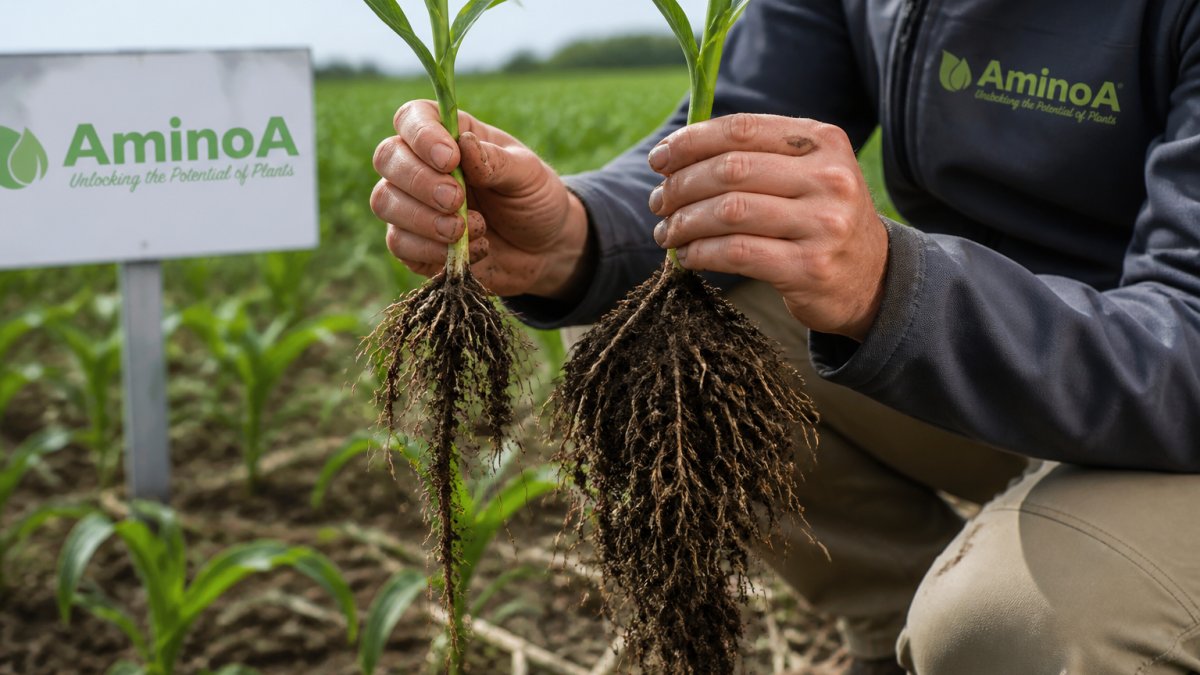
Amino acids enhance nutrient mobility within the plant, particularly important for micronutrients like iron and magnesium that often become immobile in leaves. By chelating these elements, amino acids keep them available for continued transport and utilisation. This mechanism proves especially valuable under stress, when plants prioritise nutrient redistribution to maintain critical functions. Additionally, amino acids stimulate root development when applied at the right growth stage, creating stronger root systems that access soil nutrients more effectively even after foliar applications finish.
Foliar Application Timing for Winter Wheat and Spring Barley

Timing foliar nutrition applications to match growth stages and physiological demand maximises response. For winter wheat, the critical windows occur at tillering (GS20-25), stem elongation (GS30-32), and flag leaf emergence (GS37-39). Spring barley benefits from applications at similar growth stages, adjusted for its shorter growing cycle.
Early-season applications during tillering support leaf development and tiller formation. At this stage, plants are establishing the shoot structure that will determine final grain-bearing capacity. A foliar application containing amino acids and micronutrients stimulates this process, encouraging more productive tillers. Many growers report improved green leaf area and earlier canopy closure when timing applications to this window.
Mid-season applications during stem elongation prevent nutrient stress during rapid biomass accumulation. This period demands sustained nitrogen supply for continued leaf growth and stem strength. If soil conditions limit root uptake, cold soil, waterlogging, or nutrient depletion, foliar applications provide critical support. Late applications at flag leaf emergence focus on grain fill support and stress mitigation. Weather stress during this period directly impacts final grain weight and quality.
Application frequency depends on your specific situation. A single well-timed application often delivers measurable response. Multiple applications at different growth stages provide more consistent support across the season, particularly valuable in challenging growing seasons. Spacing applications 14-21 days apart allows adequate time between applications for crop response without excessive overlap.
Mitigating Abiotic Stress in Cereal Crops Through Foliar Biostimulants
Abiotic stresses, drought, heat, cold, waterlogging, trigger metabolic disruption that reduces yield even when nutrient levels appear adequate. Amino acid-based biostimulants help plants maintain metabolic function under stress by supporting osmoprotectant synthesis and antioxidant defence systems.
Cold stress at emergence or during early growth slows root activity and nutrient uptake. Foliar applications containing amino acids and micronutrients bypass this limitation, providing immediate metabolic support. Plants receiving this support maintain growth momentum through cold periods, emerging stronger when temperatures improve. Similarly, drought stress triggers stomatal closure to conserve water, reducing photosynthetic capacity. Amino acids support the energy metabolism required to maintain cellular function under water limitation.
Heat stress during grain fill accelerates crop maturity and reduces grain weight if plants cannot maintain photosynthetic capacity. Foliar biostimulants containing amino acids support continued metabolic activity, helping plants sustain grain filling despite temperature stress. Waterlogging presents a different challenge, it damages root function by limiting oxygen availability. Foliar nutrition becomes essential when roots cannot absorb nutrients from saturated soil. Applications during or immediately after waterlogging events provide critical support for recovery.
Agrochemical phytotoxicity from fungicides, insecticides, or herbicides occasionally damages leaf tissue or disrupts metabolism. Foliar biostimulants containing amino acids and micronutrients support rapid recovery from this stress, minimising yield impact. This protection proves particularly valuable when tank mixes or application conditions create higher phytotoxicity risk.
Maximising Yield and Quality: Real-World Performance Data
Practical experience demonstrates that strategic foliar nutrition improves both yield and quality metrics in cereal crops. Velcourt trials with AminoA FLO showed that adding foliar amino acid biostimulants to reduced fungicide rates maintained yields whilst improving green leaf area retention in winter wheat.
The mechanism behind this improvement involves sustained leaf function. Fungicides protect against disease but provide no nutritional support. When applied alone, reduced fungicide rates sometimes result in marginal yield loss because the crop lacks the metabolic support to compensate for increased disease pressure. Adding a foliar biostimulant changes this equation. The amino acids and micronutrients maintain leaf photosynthetic capacity and stress resilience, allowing the crop to tolerate slightly higher disease pressure whilst maintaining full yield potential.
Quality improvements often accompany yield maintenance or gains. Grain protein content, test weight, and milling quality all respond to improved crop nutrition during grain fill. Foliar applications at flag leaf emergence and early grain fill directly influence these quality traits by maintaining nutrient supply during the critical period when grain composition is determined.
Practical Considerations and ROI for Your Farm
Implementing foliar nutrition requires consideration of application timing, equipment, and integration with existing programmes. Most growers apply foliar biostimulants using standard boom sprayers, making adoption straightforward without capital investment. Application rates and timings vary depending on your specific crop situation, soil conditions, and stress factors.
Integration with fungicide or insecticide programmes offers practical advantages. Tank-mixing foliar biostimulants with routine disease management applications reduces overall spray passes, saving fuel and labour costs. This approach also ensures applications occur at optimal growth stages when the crop is already being monitored. Compatibility with common fungicides and insecticides is essential, verify tank-mix compatibility before application.
Return on investment depends on several factors: the yield response achieved, the cost of the foliar product, and the value of improved quality. Growers managing marginal soil conditions, challenging weather seasons, or optimised fungicide programmes often see measurable ROI within a single season. The cost per hectare of a foliar biostimulant programme typically represents a small fraction of total input costs, making even modest yield improvements economically positive.
Risk mitigation also contributes to ROI.
| Application Stage | Timing (Growth Stage) | Primary Benefit | Best For |
|---|---|---|---|
| Early season | GS20-25 (Tillering) | Tiller formation, leaf development | Building productive shoot structure |
| Mid-season | GS30-32 (Stem elongation) | Sustained growth, stem strength | Supporting rapid biomass accumulation |
| Late season | GS37-39 (Flag leaf emergence) | Grain fill support, quality | Maximising grain weight and composition |
Frequently Asked Questions
What are the primary benefits of foliar nutrition for cereal crops?
Foliar nutrition delivers essential nutrients directly to plant leaves, bypassing soil uptake limitations. For cereal crops, this accelerates leaf and root development, strengthens stem structure, and improves grain fill. L-α amino acid biostimulants also enhance stress tolerance to cold, heat, and drought whilst boosting overall yield and grain quality. Velcourt trials demonstrated that foliar nutrition maintained yields whilst reducing fungicide rates in winter wheat, improving green leaf area retention.
How does foliar application timing for winter wheat affect crop performance?
Timing is critical for winter wheat foliar nutrition. Applications at GS25-GS32 (stem extension) support strong tillers and root establishment. A second application at GS39-GS49 (flag leaf emergence) maximises photosynthetic capacity and prepares the crop for grain fill. Late applications at GS65-GS71 (grain development) can still improve quality and kernel weight.
Can foliar biostimulants help cereal crops survive drought stress?
Yes. L-α amino acids enhance root development, all critical for drought resilience. Biostimulants like AminoA FLO help crops withstand water deficit.
How do L-α amino acids differ from standard NPK fertilisers in foliar sprays?
Standard NPK fertilisers provide raw nutrients but do not trigger plant metabolism or stress responses. L-α amino acids are building blocks for proteins and signalling molecules that activate the plant's own defence and growth systems. They improve nutrient uptake efficiency, reduce phytotoxicity risk from tank mixes, and work synergistically with fungicides and insecticides.