 ultimate-guide
Sustainable Soil Management for Large Farms
Table of Contents
- The Core Principles of Sustainable Soil Management
- Benefits of Amino Acid Biostimulants for Soil Health
- SFI Soil Standards for Commercial Farms
- Reducing Synthetic Inputs in Arable Farming Without Losing Yield
- Reduced Tillage and Residue Management at Scale
- Measuring Progress: Soil Testing and Field Records
- Common Mistakes When Changing Soil Management on Large Farms
- Conclusion
- Frequently Asked Questions
Last Updated: 1 October 2026
The Core Principles of Sustainable Soil Management
Sustainable soil management is the practice of maintaining and improving soil function, structure and biological activity so that land remains productive across rotations rather than declining under repeated cultivation. For large arable holdings, that definition has a hard commercial edge: it is the difference between a field that responds to inputs and one that quietly stops responding. This guide from AminoA sets out the strategies that hold up at scale, from organic matter and reduced tillage through to SFI payments and amino acid biostimulants.
The throughline here is straightforward. Most soil programmes fail on large farms not because the principles are wrong, but because they are applied as a single field trial rather than a whole-farm system. Scale changes everything: machinery capacity, residue volumes, labour windows and cashflow all constrain what works.
Why Organic Matter Is the Metric That Matters
Organic matter is the single best proxy for whether a soil is functioning. It drives water-holding capacity, aggregate stability, nutrient cycling and biological activity at once, which is why agronomists track it ahead of almost any other soil measure.
The practical difficulty is that organic matter moves slowly. Building it takes years of consistent management, and it can be lost far faster than it is gained. On large holdings, that asymmetry is the whole argument for treating soil as a long-term asset rather than an annual input decision.
Benefits of Amino Acid Biostimulants for Soil Health
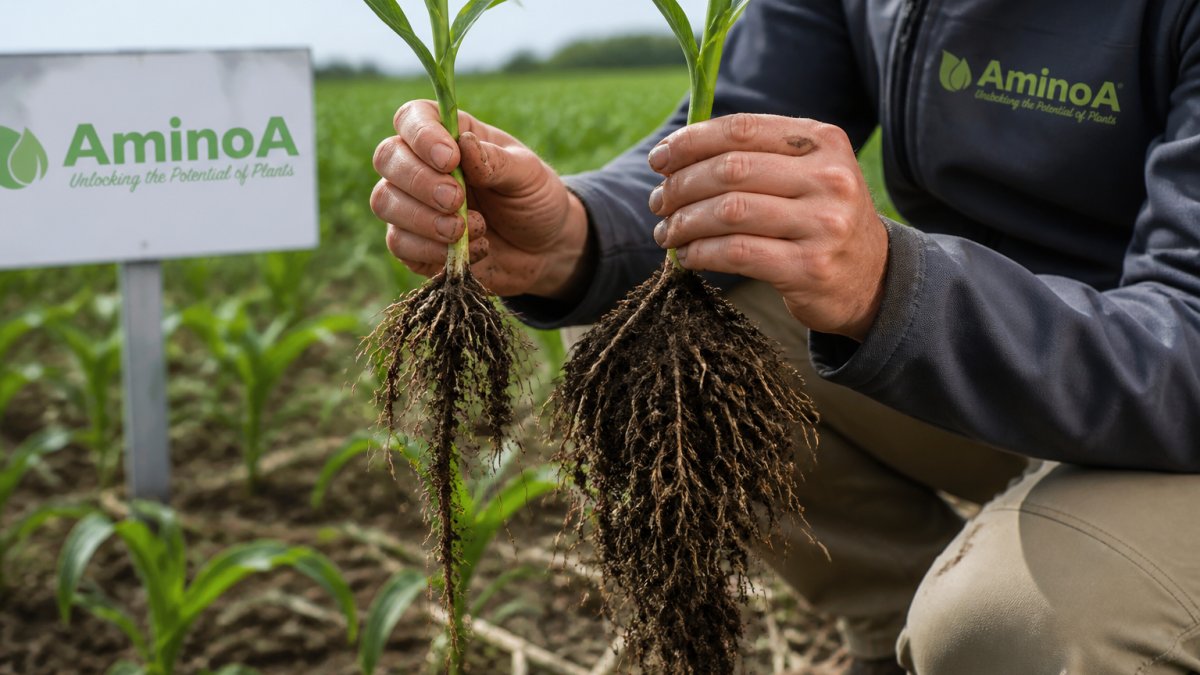
Amino acid biostimulants support soil health indirectly but significantly: they feed the crop at moments when root function is compromised, which keeps root exudation and residue return going through the season. The crop stays productive, and the soil biology that depends on those root inputs stays fed.
How L-α Amino Acids Support Root Development and Stress Resistance
L-α amino acids are the form plants can take up and use directly, without the conversion steps required for other nitrogen sources. Applied as a foliar or root treatment, they support root and leaf development and help the plant maintain function under cold, heat and drought stress.
SFI Soil Standards for Commercial Farms
SFI soil standards are the payment framework under which English farms are paid for actions that improve soil health, and they are the main route by which soil management now carries a direct financial return. For commercial arable businesses, the standards turn soil improvement from a cost into a revenue line.
Which SFI Actions Pay Best on Large Arable Holdings
The actions that pay best at scale are those that fit machinery you already run and land you already farm. Soil assessment actions are low-cost and quick to deliver; cover cropping and organic matter additions carry more value but demand establishment windows and seed spend.
| Action type | Effort at scale | Best fit | Watch out for |
|---|---|---|---|
| Soil assessment | Low | All arable land | Sampling consistency |
| Cover cropping | Medium | Land before spring crops | Establishment window |
| Organic matter addition | Medium-High | Land near a source | Haulage and spreading cost |
| Reduced cultivation | High | Suitable soil types | Blackgrass pressure |
Defra guidance on the Sustainable Farming Incentive
Reducing Synthetic Inputs in Arable Farming Without Losing Yield
Reducing synthetic inputs without losing yield is achievable, but only where the reduction is targeted rather than uniform. Blanket cuts across a whole farm remove the inputs that are still doing work, and yield follows them down.
Reduced Tillage and Residue Management at Scale
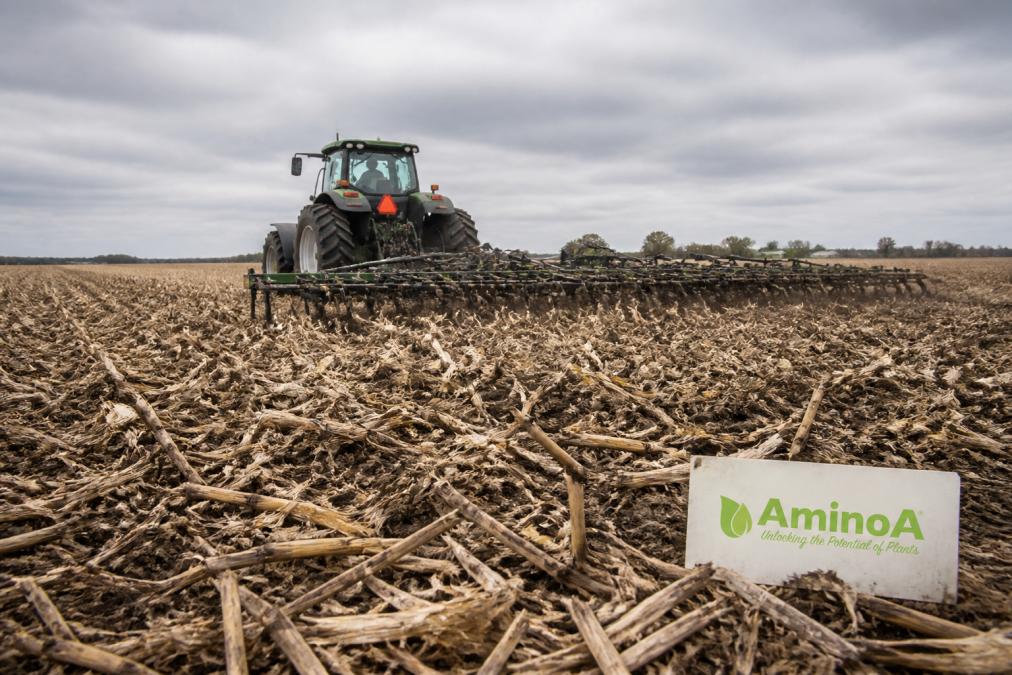
Reduced tillage is the practice of cultivating only the depth needed for establishment, leaving the majority of the soil profile and its structure undisturbed. At scale, the challenge is not the principle but the residue.
Measuring Progress: Soil Testing and Field Records
Soil testing and field records are what turn a soil programme from a set of good intentions into a managed system. Without them, you cannot tell whether an action is working until the effect is large enough to see in the yield monitor, by which point you have lost seasons.
A workable measurement routine on a large farm includes:
- Fixed sampling grid, consistent depth and timing
- Organic matter, pH, and key nutrients tracked per field
- Records of cultivations, residues and cover crop establishment
- Application records for every biostimulant and input
- Yield maps matched back to field and treatment
Common Mistakes When Changing Soil Management on Large Farms
The mistakes that derail soil programmes on large farms are predictable, and most of them come down to pace and measurement rather than technique.
Conclusion
Soil management on a large holding is a long game, and the farms that win it are the ones that measure consistently and change one thing at a time. AminoA supplies L-α amino acid biostimulants produced through enzymatic hydrolysis, with every essential amino acid in the L form and a high content of nitrogen, potassium, iron and magnesium. Where a crop is under stress, or where you are reducing fungicide rates, they help maintain root and leaf development, resistance to cold, heat and drought, and ultimately yield and quality.
Frequently Asked Questions
What are the core principles of sustainable soil management for large farms?
Four principles drive it: keep soil covered, minimise disturbance, maintain living roots in the ground for as much of the year as possible, and diversify what you grow. On large holdings these translate into practical choices such as chopping and spreading straw rather than burning it, moving to reduced or strip tillage, introducing cover crops between cash crops, and widening rotations beyond continuous cereals. Each principle builds organic matter and biological activity, which in turn improves structure, infiltration and nutrient cycling across whole fields rather than just headlands.
How can large-scale farms reduce reliance on synthetic fertilisers?
Start with soil testing to establish a baseline for organic matter, pH and available nutrients, then match inputs to measured demand rather than a blanket rate. Precision application, variable-rate spreading and regular tissue testing all cut waste. Adding amino acid biostimulants can support the crop through stress periods and improve nutrient uptake, which often allows a modest reduction in nitrogen rates without a yield penalty. Change one field at a time and compare against your standard programme before committing the whole rotation.
What role do biostimulants play in long-term soil health?
Biostimulants work on the plant and the soil biology rather than replacing fertiliser outright. Amino acid products, particularly L-α forms, are taken up directly by the crop and support root development, shoot growth and tolerance to cold, heat and drought stress. Healthier root systems explore more soil, exude more carbon compounds and feed the microbial population, which over several seasons contributes to better aggregation and organic matter retention. They sit alongside good rotation and reduced tillage, not instead of them.
How does the Sustainable Farming Incentive support soil management?
The SFI pays for actions that protect and improve soil, including maintaining a green cover, adding organic matter such as compost or mulch, and using no-till or reduced-tillage establishment. Payment rates and eligible actions are set out in the current scheme guidance on the Defra website, and they change between scheme years, so check the latest version before planning. For large farms, stacking several soil actions across different parcels usually produces a more useful income stream than a single measure.
What are the benefits of reduced tillage for large-scale operations?
Reduced and no-till establishment cuts diesel use, machinery wear and labour hours per hectare, which matters most where you are covering several hundred hectares. It also preserves soil structure and fungal networks that ploughing disrupts, so water infiltrates faster and erosion risk falls. The trade-offs are real: grass weeds can build up, residue management becomes critical, and yields may dip for a season or two while structure recovers. Strip tillage is a common middle path for heavier land.
How can farmers improve soil organic matter on a commercial scale?
Organic matter builds slowly, so the practical levers are cover crops, straw incorporation, organic amendments such as compost or digestate, and longer, more diverse rotations. On large farms, prioritise the fields with the lowest levels first and use them as your test beds. Measure with a laboratory test every two to three years rather than relying on visual assessment. Realistic expectations matter: a shift of a few tenths of a percent over five years is a solid result on heavy arable land.
Can biostimulants reduce agrochemical use without lowering yields?
They can support a reduction, but the honest answer is that results depend on your starting point, disease pressure and season. Velcourt trials found that adding AminoA FLO to reduced fungicide rates maintained yields and improved green leaf area in winter wheat, which shows the approach can hold performance when rates are trimmed. The realistic expectation is a gradual step-down across several seasons with close monitoring, not an immediate halving of your spray programme. Trial on a few tramlines first.