 How-to
How to Choose Cover Crop Seed Mixes for Nitrogen Fixation
Last Updated: November 21, 2026
Quick Summary
Choose a cover crop seed mix by setting the legume share by weight first, then filling the remainder with species that solve your biggest secondary problem. Keep legumes dominant for nitrogen fixation, and always check the declared species percentages on the label rather than the number of species listed.
- Inoculation is the step growers skip most often, and it quietly costs them the most.
- Drill within days of harvest, not weeks, because every week lost in September reduces growth.
- Dig up plants six to eight weeks after emergence and inspect roots for pink, active nodules.
- Compare mixes on cost per unit of legume seed, not cost per bag.
- Terminate while the crop is still vegetative and before it flowers heavily.
Table of Contents
- Why Nitrogen-Fixing Cover Crops Earn Their Place in the Rotation
- Building a Legume Cover Crop Seed Mix: Species and Proportions
- Matching Cover Crop Sowing Dates to Your Rotation
- Inoculation, Soil pH and Nodulation Checks
- Seed Rates, Costs and Comparing Mixes Like for Like
- Cover Crop Termination: Timing the Destroy Date
- Common Mistakes When Sowing Nitrogen-Fixing Mixes
- Planning Your Next Cover Crop Mix with AminoA
- Frequently Asked Questions
Why Nitrogen-Fixing Cover Crops Earn Their Place in the Rotation
Nitrogen-fixing cover crops are plants, mostly legumes, that work with soil bacteria to convert atmospheric nitrogen into a form the following crop can use. Because legumes can contribute nitrogen in rotations beyond arable fields, the same principles can inform choices about cover crops in raised beds.
A cover crop is not a fertiliser replacement. It is a slow, cumulative investment in soil biology, structure and nutrient cycling.
Below, we walk through how to build a mix, time it to your rotation, and set expectations you can defend to your agronomist.
What legumes actually contribute to soil nitrogen
Legumes fix nitrogen through a symbiotic relationship with rhizobia bacteria. The plant feeds the bacteria carbon; the bacteria convert atmospheric nitrogen into ammonia the plant can use.
The critical word is available. Not all fixed nitrogen reaches your cash crop: some is used by the cover crop itself, some leaches, and some is locked up in organic matter.
For the fundamentals of how this process works in practice, our dedicated guide on using cover crops to fix nitrogen in farming goes deeper into the biology.
Setting realistic nitrogen expectations
Treat legume nitrogen as a supplement, not a substitute. A well-established legume cover crop can contribute a meaningful portion of a following crop's nitrogen requirement, but the figure swings widely with establishment, termination timing and soil conditions.
The mistake we see most often is assuming a fixed number. For a defensible starting point, learn to calculate crop nitrogen requirements accurately so you compare the cover crop contribution against a real baseline.
Building a Legume Cover Crop Seed Mix: Species and Proportions
A legume cover crop seed mix works best when it balances nitrogen fixation with structure, ground cover and weed suppression. Pure legume stands fix well but leave soil exposed and can be tricky to establish. Mixed stands spread risk and deliver more benefits per hectare.
Vetch, clover and the legumes that fix the most
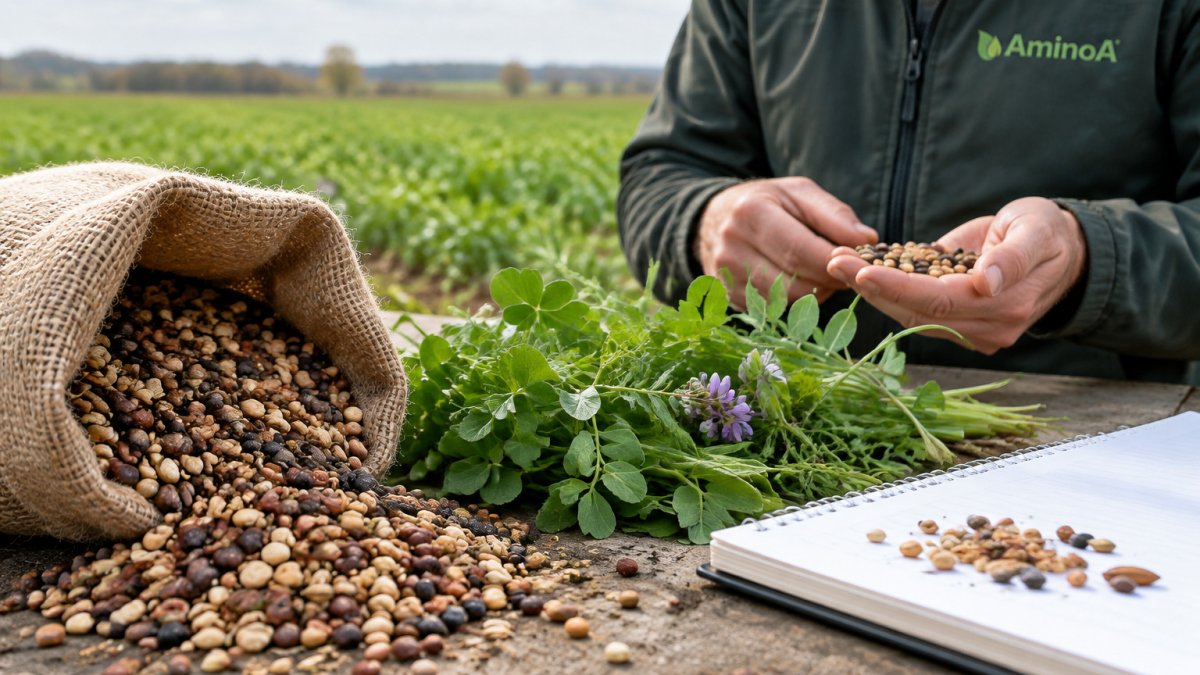
Hairy vetch is the workhorse: vigorous, winter hardy and high biomass, which means more nitrogen fixed and better weed suppression.
Common vetch establishes faster than hairy vetch but is less winter hardy. Good for later sowings and milder districts.
Crimson clover fixes well and establishes quickly, with good autumn ground cover. It is less reliable through hard winters.
White and red clover are slower to establish but persist and suit grazing or longer-term leys more than short cover windows.
Mixing legumes with rye, oats and brassicas
Legumes rarely perform best alone. A typical balanced mix pairs a legume with a cereal and a brassica:
- Rye for structure, biomass and winter hardiness
- Oats for rapid establishment and autumn ground cover, winter-killed in cold conditions
- Mustard or oil radish for fast biomass and compaction remediation through deep rooting
- Linseed for fine-root structure and biodiversity
The trade-off is real: every non-legume dilutes the nitrogen-fixing proportion. If nitrogen is your primary goal, keep legumes dominant; if you want a multi-benefit mix, accept a lower fixation ceiling. For growers combining legumes with deep-rooting species, our guide on using cover crops to reduce soil compaction covers the structural side.
Indicative proportions and how to set them
There is no single correct ratio, but a practical starting point is to set the legume share by weight first, then fill the remainder with species that solve your biggest secondary problem:
- Nitrogen-first mix: aim for a legume-dominant blend, with vetch or clover making up the majority of the seed weight, and a small cereal component for structure. This suits a following high-nitrogen-demand crop and an early sowing window.
- Balanced multi-benefit mix: split the seed weight more evenly between legume, cereal and brassica. Expect a lower nitrogen ceiling but better ground cover, weed suppression and structural benefit.
- Structure-first mix: lead with rye or oats and keep a legume as a minor component. This suits fields where erosion, drainage or organic matter are the priority and nitrogen is secondary.
A mix with five species but a tiny legume share will fix less than a three-species mix with a strong vetch component. Check the declared species percentages on the label, not just the number of species listed.
Species compatibility and competition within the mix
Grasses and brassicas are not neutral passengers.
A common pattern is to pair a vigorous cereal with a vigorous legume so neither dominates, and to avoid putting a slow-establishing clover alongside a fast, tall grass without adjusting the ratio.
Watch out: a mix that looks diverse on the label can behave like a monoculture in the field if one species outcompetes the rest in your soil and sowing window.
Matching Cover Crop Sowing Dates to Your Rotation
Cover crop sowing dates decide how much nitrogen you capture. The earlier a legume goes in, the more growing days it has before winter, and the more nitrogen it fixes.
A practical rule most agronomists work to: drill within days of harvest, not weeks. Every week lost in September is a week of growth the legume never recovers.
Winter hardiness matters here. Fitting cover crops into a tight rotation also raises questions about the wider sequence, which is why we point growers to this guide on managing crop rotation for soil microbiome health.
Inoculation, Soil pH and Nodulation Checks
Inoculation is the step growers skip most often, and it quietly costs them the most. Legume seed needs the correct rhizobia strain in the soil; if that strain is missing, the plant cannot fix nitrogen no matter how healthy it looks.
Check three things before you drill:
- Inoculant: use a fresh, correct-strain product, especially on land that has not grown that legume recently
- Soil pH: rhizobia work best in a pH range most arable soils sit comfortably within; acidic patches suppress nodulation
- Nodulation: dig up plants six to eight weeks after emergence and inspect roots for pink, active nodules. White or absent nodules mean fixation is not happening
A nodulation check takes ten minutes and tells you more about your mix than any label claim.
Seed Rates, Costs and Comparing Mixes Like for Like
Comparing cover crop seed costs is harder than it looks, because mixes are sold by weight, by species proportion and by claimed benefit. A cheap mix and a well-built mix are rarely the same thing.
| Comparison point | What to check | Why it matters |
|---|---|---|
| Legume percentage | Share of vetch or clover by weight | Drives nitrogen-fixing potential |
| Species count | Number and type of species | Diversity versus fixation trade-off |
| Seed rate | Recommended kg per hectare | Affects establishment density |
| Inoculation | Pre-inoculated or not | Determines whether fixation happens |
| Winter hardiness | Suited to your district | Prevents winter kill losses |
Indicative sowing rates
Sowing rates vary with species, seed size and establishment method, so always follow the supplier's recommendation for the specific blend. As a practical guide for a drilled mix:
- Hairy vetch: often sown in the region of 25-35 kg per hectare as a pure stand, lower when blended.
- Common vetch: similar order to hairy vetch, adjusted for seed size and germination.
- Crimson clover: commonly around 10-15 kg per hectare as a pure stand.
- Cereal component (rye or oats): often 40-80 kg per hectare depending on the share of the mix and the goal.
These are starting points, not prescriptions. A late sowing needs a higher rate to compensate for reduced tillering and growth; an early sowing can often be drilled at the lower end. Check the thousand-seed weight and germination on the label, because two bags of the same species can differ in seed count.
Comparing cost like for like
A simple method is to divide the bag price by the kilograms of legume seed in the bag, then divide again by the recommended legume sowing rate to get a cost per hectare of legume establishment.
Watch out: a low headline price per bag can hide a low legume share and a high filler proportion. Always ask for the species breakdown by weight before comparing quotes.
We do not publish AminoA product pricing here because it depends on quantity, timing and delivery; contact us directly for a current quote.
Cover Crop Termination: Timing the Destroy Date
Cover crop termination timing is the single biggest lever on how much nitrogen reaches your following crop.
Aim to destroy the crop while it is still vegetative and before it flowers heavily. Hairy vetch in particular becomes woody and hard to manage if left too long.
The release of nitrogen after termination is not instant. Residue breakdown takes weeks, and the timing of that release should line up with when your following crop needs nitrogen most.
Common Mistakes When Sowing Nitrogen-Fixing Mixes
The same errors come up again and again. Avoiding them is worth more than any single species choice.
- Sowing too late. Late drilling is the most common reason legume mixes underperform.
- Skipping inoculation. No rhizobia, no fixation, regardless of seed quality.
- Over-diluting the legume. Too many non-fixing species leaves little room for nitrogen contribution.
- Ignoring pH and compaction. Poor soil conditions suppress nodulation before the crop has a chance.
Planning Your Next Cover Crop Mix with AminoA
A well-chosen mix is only half the job.
At AminoA, we manufacture natural L-α amino acid biostimulants for growers looking to support root development, stress resistance and overall crop performance alongside their soil-building programme.
If you are weighing cover crops against bought-in inputs, our guide on natural alternatives to synthetic nitrogen fertilisers covers the wider picture.
The gap between a cover crop that fixes nitrogen and one that merely grows is usually management, not seed.
Frequently Asked Questions
Which cover crops fix the most nitrogen?
Hairy vetch is generally the strongest nitrogen fixer among commonly sown species, followed by crimson clover and common vetch. Legumes fix nitrogen through rhizobia bacteria in root nodules, so the amount depends on how well the crop nodulates and how long it grows. A mix that includes a vigorous legume plus a grass or brassica for ground cover usually delivers more reliable total nitrogen than a legume alone, because the non-legume component supports establishment and biomass.
How much nitrogen can a legume cover crop add to the soil?
The nitrogen contribution depends on biomass, legume proportion and termination timing, so treat any figure as a guide rather than a promise. A dense, well-nodulated legume stand terminated in spring can contribute meaningful nitrogen to the following crop, but much of it is released slowly as residues break down. Test your soil and account for the legume's nitrogen in your following-crop plan rather than assuming a fixed saving on bagged fertiliser.
When should I sow a nitrogen-fixing cover crop?
Sow as soon as possible after the preceding crop is cleared, while soil is still warm and moisture is available. Late summer to early autumn sowings give legumes enough growing season to nodulate and build biomass before winter. Later sowings favour winter-hardy species such as hairy vetch and limit the nitrogen fixed. Match the sowing window to your rotation and the species in the mix, and check establishment before the first hard frost.
Do cover crop seed mixes need inoculated legume seed?
Inoculation is worth checking, especially on fields that have not grown the same legume recently. Rhizobia bacteria specific to each legume group are needed for nodulation, and pre-inoculated seed removes the guesswork. Confirm the inoculant matches the species in your mix, store seed correctly and avoid mixing inoculant with incompatible treatments. After establishment, dig up a few plants and check for pink, active nodules to confirm fixation is happening.