 How-to
How to Calculate Crop Nitrogen Requirements Accurately
Last Updated: November 6, 2026
Quick Summary
Crop nitrogen requirements are calculated by subtracting the nitrogen the soil supplies from the total nitrogen the crop needs for its target yield. The gap between the two is the fertiliser nitrogen you apply. Accuracy depends on realistic yield targets and careful soil sampling.
- Crop demand equals your realistic yield target multiplied by nitrogen removed per tonne of crop
- Soil nitrogen supply combines the N-min test result with an estimate of mineralisation
- Sample soil in zones, taking multiple cores per zone at a consistent depth, usually 30 cm
- Credit nitrogen from a previous legume crop in your soil supply estimate
- Track nitrogen use efficiency each season and adjust rates gradually based on results
Table of Contents
- What Crop Nitrogen Requirements Mean and Why Accuracy Matters
- Setting a Realistic Yield Target and Estimating Crop Nitrogen Demand
- Estimating Soil Nitrogen Supply Through Sampling and Testing
- Worked Calculation: From Crop Demand to Fertiliser Nitrogen Rate
- Working Out Nitrogen Use Efficiency and Adjusting Rates
- Planning Nitrogen Application Timing and In-Season Recalculation
- Your Next Step: Building a Nitrogen Budget Worksheet for Your Fields
- Frequently Asked Questions
What Crop Nitrogen Requirements Mean and Why Accuracy Matters
Crop nitrogen requirements are the amount of nitrogen a crop needs to reach its target yield.
Too little nitrogen cuts yield and protein. Too much wastes money, pollutes water, and can lower quality.
Here's the core idea. Your fertiliser rate is the crop's total nitrogen demand minus what the soil already supplies.
- Crop demand depends on your yield target and crop type
- Soil supply depends on testing, mineralisation, and previous crop history
- The gap between them is what you apply as fertiliser
Many growers find that small errors in soil supply cause the biggest mistakes.
Setting a Realistic Yield Target and Estimating Crop Nitrogen Demand
Your yield target drives everything else. Set it too high and you over-apply nitrogen.
A common approach is to base the target on your field's recent history.
Crop nitrogen demand is the total nitrogen the crop takes up to produce that yield.
- Use your own historical yields where you have reliable records
- Adjust downward for known problems like waterlogging or disease pressure
- Check your variety's typical nitrogen uptake per tonne
Remember that a crop does not need all its nitrogen at once. Demand rises through the season, which matters when you plan timing later on.
Estimating Soil Nitrogen Supply Through Sampling and Testing
Soil nitrogen supply is the nitrogen the soil releases to the crop during the season. It is the number most growers underestimate or ignore.
Soil testing gives you a measured starting point. To check whether soil testing reliably reveals crop nutrient deficiencies, see how test results compare with what the crop actually shows.
Testing does not capture everything. The soil keeps releasing nitrogen as organic matter breaks down, so your test is a snapshot, not a forecast.
Sampling Design, Timing and Uncertainty
Good sampling is the difference between a useful number and a misleading one. A single core from one corner of a field tells you very little.
- Divide fields into zones with similar soil type and history
- Take multiple cores per zone and mix them into one sample
- Sample at a consistent depth, usually the top 30 cm for arable land
Expect real uncertainty. Two samples taken metres apart can differ noticeably. Treat your result as a range, and plan a safety margin rather than trusting a single figure.
Accounting for Mineralisation, Previous Crop and Residues
Soil organic matter releases nitrogen slowly through mineralisation. This process is easy to forget, but it can supply a large share of the crop's needs.
Previous crops change the picture. Legumes add nitrogen to the soil, while cereal residues with high carbon can tie nitrogen up temporarily as they break down.
- Credit nitrogen from a previous legume crop in your supply estimate
- Account for the nitrogen tied up by straw or stubble incorporation
- Consider the organic matter level of the field, as higher levels usually mean more mineralisation
Most growers find these effects hard to quantify precisely. Use them to adjust your estimate in the right direction, then check the result against crop performance.
Worked Calculation: From Crop Demand to Fertiliser Nitrogen Rate
A worked example is only useful if every assumption is visible, so you can swap in your own figures and see where the answer moves. Once you have your rate, guidance on optimising the nitrogen application rate for your crop shows how to fine-tune it. The example below uses a winter wheat field, and the same five steps apply to any combinable crop.
Step 1: Set the yield target and crop nitrogen demand
Suppose your three-to-five-season average for the field is 8.0 t/ha, and you adjust down slightly to 7.8 t/ha because the field has a history of drought stress on the shallowest part. If the crop removes roughly 23 kg N per tonne of grain at that yield level, crop demand is:
7.8 t/ha × 23 kg N/t = 179 kg N/ha
Round to 180 kg N/ha for planning. Keep the unrounded figure in your worksheet so the rounding does not compound through later steps.
Step 2: Estimate soil nitrogen supply (SNS)
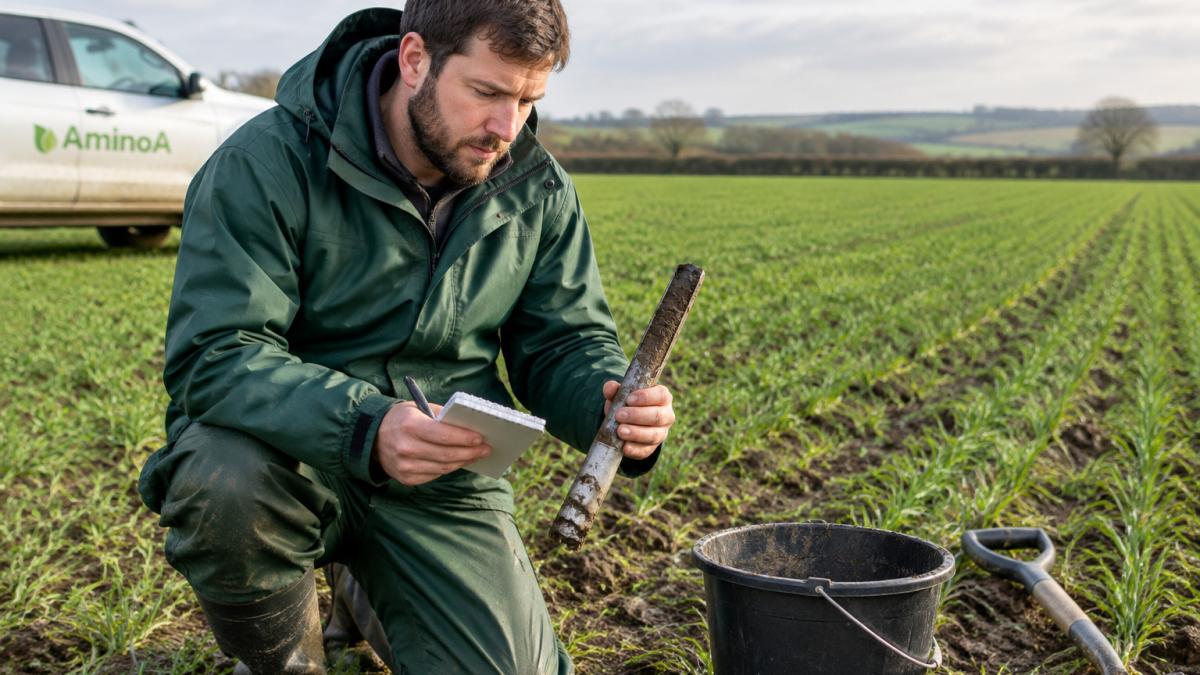
Your N-min test result, taken in late winter to the standard 30 cm depth across representative zones, reads 55 kg N/ha. You add an estimate for mineralisation from soil organic matter and previous crop residues.
SNS = 55 + 20 = 75 kg N/ha
If the previous crop had been a legume, you would add a further credit, commonly in the region of 20-40 kg N/ha depending on the legume and how much was incorporated, and the SNS figure would rise accordingly.
Step 3: Subtract supply from demand
Fertiliser N requirement = crop demand − SNS
180 − 75 = 105 kg N/ha
This is the nitrogen the fertiliser programme needs to deliver, not the product weight you spread.
Step 4: Convert to a product rate for a named fertiliser
Ammonium nitrate (34.5% N) is the common straight nitrogen product. Divide the required N rate by the nutrient content expressed as a decimal:
105 ÷ 0.345 ≈ 304 kg/ha of ammonium nitrate
If you were using urea (46% N), the same requirement becomes:
105 ÷ 0.46 ≈ 228 kg/ha of urea
Watch out: urea carries a higher nitrogen concentration but is more vulnerable to volatilisation losses if it is not incorporated or washed in, so the product rate is not the only number that changes when you switch products.
Step 5: Scale to the field and check the answer
On a 12 ha field, 304 kg/ha of ammonium nitrate is about 3.65 tonnes of product for the field. Compare the final N rate against your previous seasons and any current guidance for the crop and region.
- Record each input separately so a later change can be traced
- Keep the product analysis on file, blends and compound products vary
- Recalculate whenever the yield target or soil test changes
current fertiliser product analyses and nutrient content
The five steps below set out the worked example, with the figures used at each stage so you can swap in your own.
| Step | Figure used | Result |
|---|---|---|
| Crop demand | 7.8 t/ha × 23 kg N/t | 179 kg N/ha, rounded to 180 |
| Soil nitrogen supply | 55 N-min + 20 mineralisation | 75 kg N/ha |
| Fertiliser N requirement | 180 − 75 | 105 kg N/ha |
| Ammonium nitrate (34.5% N) | 105 ÷ 0.345 | About 304 kg/ha |
| Urea (46% N) | 105 ÷ 0.46 | About 228 kg/ha |
Working Out Nitrogen Use Efficiency and Adjusting Rates
Nitrogen use efficiency, often called NUE, measures how much of the applied nitrogen the crop actually uses.
A basic calculation divides the nitrogen removed in the harvested crop by the total nitrogen applied.
Use this to adjust next season's plan. If efficiency is low, consider a smaller rate, a different timing, or a better-matched product.
- Track nitrogen removed in harvest for each field
- Compare efficiency across fields and seasons
- Adjust rates gradually rather than making large changes at once
Biostimulants can complement a nitrogen programme, though they do not replace a proper calculation.
Planning Nitrogen Application Timing and In-Season Recalculation
A nitrogen budget set in February is a plan, not a commitment. If you are moving your overall nitrogen approach towards a regenerative system, this in-season review is where that change becomes practical. The most accurate growers treat it as a live document with fixed review points through the season, so the total rate is confirmed against what the crop is actually doing rather than what was assumed at drilling.
Set decision points at named growth stages
A practical schedule uses three or four review points rather than continuous tinkering:
- Early spring, before the first dose: confirm the SNS figure is still valid, check that the soil has drained, and confirm the yield target against any winter damage.
- First node detectable (GS31-32): review the first split and confirm the total planned rate before the main dose.
- Flag leaf (GS37-39): the key decision point for the final split, this is where crop condition, tissue results and weather forecasts should adjust the remaining nitrogen.
Use crop measurements, not just colour
Visual colour is a blunt instrument. Two measurements give a firmer basis for adjusting the final split:
- Green area index (GAI): a measure of how much green leaf the crop is carrying. If GAI at flag leaf is well below the target for the growth stage, the crop may not be able to use the full planned nitrogen; if it is well above, the crop may already have enough and the final split can be trimmed.
- Tissue testing: a plant tissue test at the agreed growth stage gives a measured nitrogen status, which is more reliable than colour alone, particularly where varietal or disease differences confuse the picture.
Use these to move the final split up or down within a sensible band, typically no more than 20-30 kg N/ha either way, rather than rewriting the whole budget. If you are weighing foliar feeding against soil application for uptake, compare the options before deciding on the final split.
Recalculate when the assumptions change
Some events justify a full recalculation rather than a small adjustment:
- A very wet winter or spring that has likely leached nitrate below the rooting zone, the SNS figure may be lower than the test suggested
- A dry spell that has stalled growth and reduced the realistic yield target
- Visible nitrogen deficiency or stress that tissue testing confirms
Watch out: adding nitrogen 'to be safe' after a wet spell is one of the most common causes of over-application, because the lost nitrogen is often already reflected in a lower yield potential, recalculate both sides of the budget, not just the supply side.
Keep the worksheet live
Update the worksheet at each decision point with the date, the measurement taken and the change made. At harvest, compare the planned rate with the nitrogen removed in the crop. That comparison is the single most useful input to next season's budget, because it shows whether the plan was accurate or merely plausible.
growth stage guides and GAI measurement guidance
Your Next Step: Building a Nitrogen Budget Worksheet for Your Fields
A written worksheet keeps the calculation consistent across seasons. It also makes it easy to spot where an estimate has gone wrong.
Your worksheet should list the yield target, crop demand, soil test result, mineralisation estimate, previous crop credit, and final fertiliser rate. Add a column for the outcome so you can compare plan against result.
Start with one field this season. Once you trust the process, extend it across the farm.
Frequently Asked Questions
How do you calculate a crop's nitrogen requirement?
Multiply the nitrogen uptake per tonne of expected yield by your realistic yield target, then subtract the soil nitrogen supply. The result is the amount of nitrogen the crop still needs from fertiliser or other sources. Reference uptake values should come from recognised UK guidance for the specific crop. Check the figures against your own field history, because a target set too high will inflate the rate and waste input cost and can increase losses.
How can soil nitrogen supply be estimated?
Soil nitrogen supply can be estimated from a soil nitrogen test taken before the crop starts active uptake, combined with the field's previous crop, cultivation history and soil organic matter. Sampling should follow a consistent depth and be taken from a representative pattern across the field. Residual soil nitrogen varies widely between seasons, so treat a single test as an estimate and recalculate if conditions change.
What is nitrogen use efficiency, and how is it calculated?
Nitrogen use efficiency is the proportion of applied nitrogen that is taken up by the crop and removed in the harvest. A simple version divides the nitrogen removed in the crop by the nitrogen applied, expressed as a percentage. Tracking this figure season to season shows whether your rates are too high or too low, and helps you adjust future calculations for each field.
When should nitrogen fertiliser be applied during the growing season?
Nitrogen is usually split into several applications timed to crop growth stages rather than applied in one dose. Early applications support tillering or establishment, while later doses target stem extension and grain development. Timing should match periods of high crop demand and avoid wet conditions when losses through leaching or denitrification are most likely. Adjust later doses using in-season observations of crop condition.
Subscribe to our Newsletter for practical nitrogen planning tips and updates from AminoA.