 How-to
Biostimulant compatibility with fertilisers explained
Last Updated: November 22, 2026
Quick Summary
Biostimulant compatibility with fertilizers should never be assumed, because some combinations work cleanly while others throw sediment, split, or lock up nutrients. Check the label, understand the formulation, and run a small jar test before committing to a full tank. Biostimulants support the crop but do not supply nutrients, so they cannot replace the fertiliser.
- A jar test takes about ten minutes plus a short observation period and costs almost nothing.
- Add powders and soluble products first, then liquid biostimulants, then liquid fertilizers last.
- Leave the jars undisturbed for 30 minutes, check again after 2 hours, and overnight if possible.
- High-calcium products are often problematic and sulphate-based fertilizers vary in compatibility.
- Never rescue a spoiled tank by adding more water or another product.
Table of Contents
- Can biostimulants be mixed with fertilisers?
- Amino acid biostimulant compatibility and what drives it
- Compatibility by fertiliser type and formulation
- Running a fertiliser jar test before you mix a full tank
- Getting the biostimulant mixing order right
- Water quality, pH and measurable thresholds
- Biostimulant and fertiliser application timing
- Troubleshooting an incompatible tank mix and choosing your next step
- Frequently Asked Questions
Can biostimulants be mixed with fertilisers?
Yes, biostimulants can often be mixed with fertilisers, but biostimulant compatibility with fertilizers should never be assumed. Some combinations work cleanly; others throw sediment, split, or lock up nutrients. The reliable answer comes from checking the label, understanding the formulation, and running a small jar test before a full tank.
That caution matters because the two inputs do different jobs. According to the American Society of Agronomy's explainer on biostimulants and soil fertility, biostimulants do not supply nutrients and cannot replace the nutrients a fertiliser provides. They support the crop; the fertilizer feeds it. At AminoA, we make that distinction central to every recommendation we give growers.
Amino acid biostimulant compatibility and what drives it
Amino acid biostimulant compatibility is driven by four things: the product formulation, the fertiliser's salt concentration, the water you dilute with, and the order you add each component. Change any one and the result can shift.
Amino acid products vary widely. Amino acid formulation chemistry, not just the amino acid content, decides how a product behaves in a tank.
A common mistake is treating every amino acid product as interchangeable. A highly concentrated liquid behaves differently from a dilute one, and a product with high mineral content can react with certain fertiliser salts.
Compatibility is a physical question first and a chemical one second. Cloudiness, sediment, or separation tells you more in ten minutes than a spec sheet tells you in an hour.
For a deeper look at picking the right product, our guide on choosing amino acid biostimulants walks through what separates one formulation from another.
Compatibility by fertiliser type and formulation
Compatibility is not uniform across fertiliser types. Liquid and soluble fertilisers generally mix more predictably with liquid biostimulants than high-analysis solid fertilisers dissolved at the last minute.
The table below summarises the general pattern. Treat it as a starting point, not a guarantee, and always confirm with a jar test.
| Fertiliser type | General compatibility | Watch for |
|---|---|---|
| Liquid nitrogen solutions | Usually mixes well | High salt load can stress the biostimulant |
| Soluble NPK powders | Mixed, depends on concentration | Undissolved solids, precipitation |
| High-calcium products | Often problematic | Reaction with phosphate or sulphate |
| Sulphate-based fertilizers | Variable | Sediment forming over time |
| Organic liquid fertilizers | Generally good | Microbial load, short tank life |
The pattern: the higher the salt concentration and the more reactive the mineral content, the more carefully you need to test.
Fitting biostimulants into an existing programme is where most growers want guidance. Our article on integrating biostimulants into crop nutrition programmes covers how to slot them alongside a conventional fertiliser plan without disrupting what already works.
One honest limitation: no table can cover every product on the market. Formulations change, and a mix that worked last season can behave differently with a new batch. Test each new combination.
Running a fertiliser jar test before you mix a full tank
A fertiliser jar test is a small-scale trial that shows you how a tank mix will behave before you commit a full sprayer load.
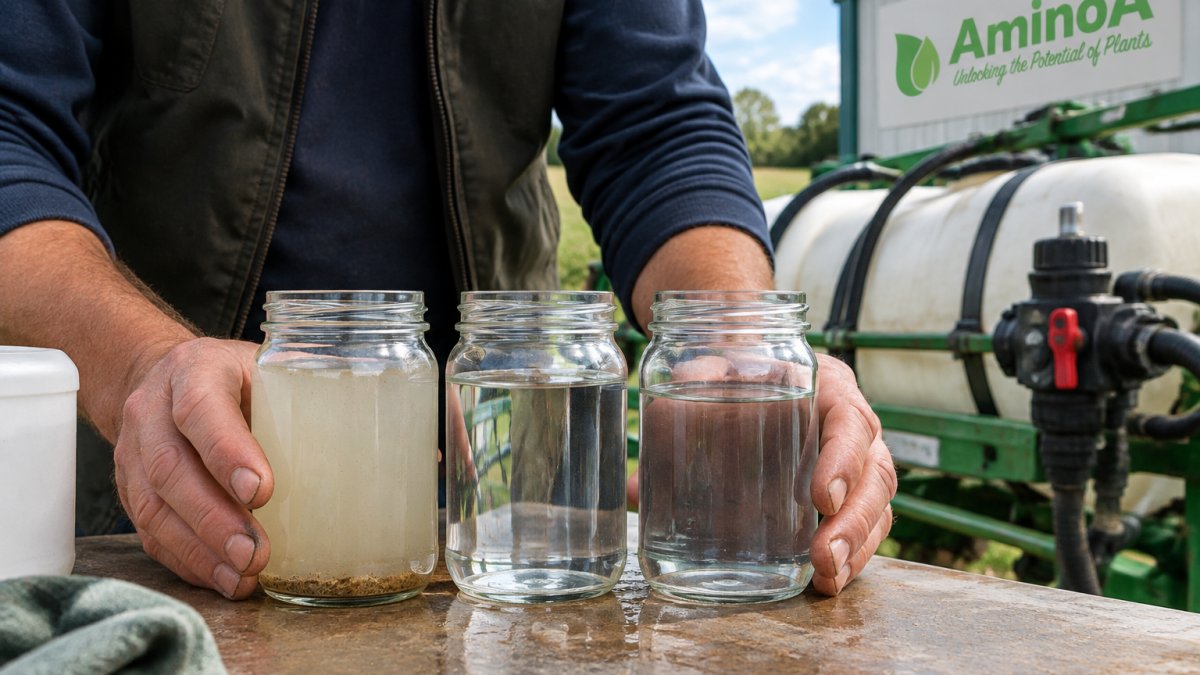
What you need: three clear glass jars of the same size, the same water you will spray with, a measuring jug or syringe marked in millilitres, a stirrer or spoon, a pH meter or narrow-range pH strips, and a notebook. Use the actual water from your sprayer tank, not tap water from the kitchen, because hardness and alkalinity drive much of what you are testing.
Proportions that scale correctly. Work to the same ratio as the field tank, scaled down.
The procedure.
- Fill each jar with the same volume of spray water, measured accurately. Note the water temperature.
- Add the fertiliser at the scaled field rate to jar one and stir until dissolved.
- Add the biostimulant at the scaled field rate to jar two and stir.
- Add both to jar three in your intended mixing order, stirring between additions exactly as you would in the tank.
- Stir each jar for the same length of time, then note appearance immediately.
- Leave all three jars undisturbed for 30 minutes and check again.
- Check a third time after 2 hours, and if you can, leave them overnight and inspect in the morning.
What to record. For each jar, note clarity, colour, any sediment or floc, any oil film or surface scum, any thickening, and any warming of the jar. A mix that heats noticeably on combining is reacting, not merely blending.
Expected result: jar three should look much like jars one and two, with no new sediment, no splitting and no thickening. If jar three clouds up, drops sediment that the single-product jars did not, forms a film or thickens, the mix is not compatible. Do not scale it up.
If it fails, do this next. Do not add more water or another product to the jar to see if it clears. Instead, repeat the test with the biostimulant added first and the fertiliser second, and with a higher water volume.
Physical compatibility is not the whole story. A jar test tells you whether the products stay together in the tank, not whether the combination is safe on the crop. Before broad application, spray a small strip and inspect after a couple of days.
Getting the biostimulant mixing order right
Biostimulant mixing order follows a simple rule: add products in the sequence the label states, and when in doubt, add the biostimulant before the high-salt fertiliser. Getting the sequence wrong is one of the most common causes of a spoiled tank.
The general sequence most agronomists use:
- Fill the tank partway with water
- Add powders and soluble products first, fully dissolved
- Add liquid biostimulants next
- Add liquid fertilizers last
- Top up with water under agitation
Keep agitation running throughout. A product that sits still can settle or separate even when it is technically compatible.
Watch out: adding a concentrated fertilizer to a nearly empty tank, then pouring in the biostimulant, is a classic way to create a localised reaction. Always start with plenty of water.
Our guide on integrating amino acid biostimulants goes further into how these products fit into a full programme, including mixing considerations.
Water quality, pH and measurable thresholds
Water quality decides more tank mixes than most growers realise. Hard water, high alkalinity and an awkward pH can push a mix out of balance before the products even meet.
Hardness is the dissolved calcium and magnesium content, usually reported in mg/l as calcium carbonate or in degrees of hardness (Water Hardness / Hard Water). These ions can react with phosphate, sulphate and some biostimulant components to form precipitates.
Alkalinity measures the water's capacity to resist pH change, and it is often a better predictor of trouble than hardness alone. High alkalinity can push a spray solution alkaline and hold it there, and some biostimulant formulations are less stable at higher pH.
pH should be measured with a meter or narrow-range strips, not guessed. Measure the water first, then measure again after the products are added, because the fertiliser itself can shift the pH. Aim for the range the product labels specify; if the labels differ, the tighter range governs.
How to measure. A basic water test from a laboratory or supplier gives you hardness, alkalinity and pH in numbers you can act on, and it is inexpensive relative to a spoiled tank.
The practical thresholds to watch:
Without these numbers you are guessing, and a guess is expensive when it costs you a tank.
Biostimulant and fertiliser application timing
Biostimulant and fertiliser application timing should be planned together, not separately. Applying them in the same pass saves a journey, but only when the mix is compatible and the crop stage suits both. The same principle applies when applying grub control and fertiliser together: check compatibility and timing before combining treatments in one pass.
Timing considerations that matter:
- Apply foliar biostimulants when the leaf is actively growing and the day is not too hot
- Avoid spraying in strong midday sun or ahead of rain
- Match the fertilizer timing to crop demand, not just convenience
- Keep a gap between a biostimulant and a pesticide unless the jar test proves otherwise
For a fuller picture, our articles on optimising fertilizer application timing and foliar feeding timing cover the detail behind these points.
A common mistake is timing the biostimulant to suit the sprayer schedule rather than the crop. The crop does not care about your calendar.
Troubleshooting an incompatible tank mix and choosing your next step
When a tank mix goes wrong, stop and diagnose before you act. The fix depends on what you are seeing.
- Cloudiness: often a sign of precipitation or an incompatible pairing. Do not spray.
- Sediment or settling: undissolved solids or a reaction. Let it settle and do not use the tank.
- Separation or oil film: the products are not staying together. Do not spray.
- Thickening: a chemical reaction is under way. Stop immediately.
If the mix is incompatible, your next step is to spray the products separately. Run each on its own pass, or find a compatible partner product.
Watch out: never try to rescue a spoiled tank by adding more water or another product. You risk making it worse and wasting more input.
The safest habit is the one we return to throughout: test small, then scale. A jar test costs ten minutes; a spoiled tank costs a day.
Getting biostimulant compatibility with fertilizers right is mostly about discipline: check the label, test the mix, follow the order, and watch your water. AminoA has spent ten years in the UK market supplying 100% L-α amino acid biostimulants produced through enzymatic hydrolysis. Our products are high in nitrogen, potassium, iron, and magnesium, and every essential amino acid is in the L form. Get started with AminoA and build a tank-mix routine that protects both your inputs and your crop.
Frequently Asked Questions
Can biostimulants be mixed with fertilisers?
Often yes, but biostimulant compatibility with fertilisers cannot be assumed. Liquid and soluble fertilisers are the usual partners for a tank mix, while high-analysis or poorly dissolved products raise the risk of precipitation. Always follow label directions for both products, confirm the biostimulant is cleared for tank mixing, and run a small-scale jar test at your intended dilution before committing a full sprayer load.
What is the correct order for mixing biostimulants and fertilisers?
Start with a part-filled tank of water, then add products in the sequence set out on the labels. A common order is water conditioners, then soluble powders, then liquid fertilisers, then the biostimulant, then adjuvants last. Add each product only when the previous one is fully dispersed, and keep agitation running. Never add a concentrated biostimulant to a tank already holding strong fertiliser without diluting it first, because localised high concentrations encourage flocculation.
What pH is suitable when mixing biostimulants with fertilisers?
Aim for the range stated on the product label, which for many amino acid biostimulants sits near neutral. Check the pH of your spray solution rather than your raw water, since fertilisers shift it. Hard water with high alkalinity is the usual culprit behind precipitation and reduced nutrient availability, so measure alkalinity as well as pH and use a water conditioner where the label allows. Record the readings so you can repeat a mix that worked.
What should you do if a tank mix forms sediment, flakes or a gel?
Stop and do not spray. Sediment, flakes, gel or separation in a jar test mean the mix is physically incompatible, and spraying it risks blocked nozzles, tank residue and phytotoxicity. Empty and flush the sprayer, then apply the biostimulant and fertiliser separately, spacing applications according to the label. If you need them together, ask the manufacturer for a compatible formulation or a proven tank-mix partner before trying again.