 How-to
Optimising Fertiliser Application Timing for Maximum Growth
Last Updated: November 4, 2026
Quick Summary
Optimising fertilizer application timing means splitting nitrogen across two or three in-season windows rather than front-loading it all early, so each dose matches the crop's growth stage demand. Feed the curve, not the calendar: apply only when soil temperature, moisture and forecast allow uptake, and size every dose to soil test results.
- Front-loading nitrogen wastes it to leaching, volatilisation and denitrification before crop demand peaks.
- Typical nitrogen requirements often reach 210-220 kg ha⁻¹, so wasted nitrogen is expensive.
- Apply autumn nitrogen only when soil temperatures sit consistently below 10°C.
- For combinable crops, use a base, a stem extension top-up and a flag leaf top-up.
- Never apply to saturated or frozen ground, and avoid spreading ahead of heavy rain.
Table of Contents
- Why Fertiliser Application Timing Decides Your Yield
- Step 1: Read Crop Growth Stage Nutrient Demand Before You Spread
- Step 2: Use Soil Testing and Weather Data to Set the Date
- Step 3: Split Nitrogen Application Benefits for In-Season Feeding
- Step 4: Liquid Biostimulants vs Granular Fertilisers at Each Timing Window
- Step 5: Protect Against Nutrient Loss, Leaching and Runoff
- Common Timing Mistakes That Cut Yield Potential
- Building Your Own Crop-Specific Application Calendar
- Frequently Asked Questions
Why Fertiliser Application Timing Decides Your Yield
Getting fertiliser application timing right is the single biggest lever on nitrogen efficiency most growers still underuse. Research in the American Journal of Agricultural Economics study on nitrogen timing found that front-loading nitrogen is suboptimal compared with split application. At AminoA, we see the same pattern in the field: nitrogen applied before the crop can use it is nitrogen you paid for and lost.
The cost of front-loading nitrogen
Front-loading means putting most or all of your nitrogen on early. It feels safe. It is not.
- Nitrogen sits in soil before roots can reach it
- Rain moves it below the root zone
- Cold soils slow plant metabolism, so uptake stalls
Typical nitrogen requirements often reach 210-220 kg ha⁻¹, according to ScienceDirect analysis of nitrogen fertiliser use. Wasting even part of that is expensive. For the deeper maths on setting rates, see our guide on how to optimise nitrogen application rates for crops.
Step 1: Read Crop Growth Stage Nutrient Demand Before You Spread
Crop growth stage nutrient demand is the amount of nutrition a plant can actually take up at each point in its life. Match supply to that curve and you get more from every kilogram.
Matching uptake curves to emergence, vegetative and reproductive stages
Plants do not eat evenly. Demand changes with stage.
- Emergence: small demand, roots shallow, placement matters most
- Vegetative stage: demand climbs fast as biomass accumulates
- V4-V6 growth stage: a key window for sidedressing nitrogen
Producers increasingly use nutrient uptake curves to line up applications with the fastest growth, according to Montana State University Extension on nutrient uptake timing. That is the whole game: feed the curve, not the calendar.
Step 2: Use Soil Testing and Weather Data to Set the Date
Soil testing tells you what is already there. Weather data tells you when the crop can use what you add. Together they set the date.

Test before you spread. It cannot tell you everything about deficiencies, which is why we explain what soil testing can and cannot reveal before you build a plan on it.
The 10°C soil temperature rule for autumn nitrogen
Autumn nitrogen is risky. Apply it only when soil temperatures sit consistently below 10°C, as CHS guidance on autumn nitrogen strategies sets out. Warmer soils keep nitrogen mobile and vulnerable to leaching before the crop can use it. Watch the forecast, not the date.
Step 3: Split Nitrogen Application Benefits for In-Season Feeding
Split nitrogen application benefits come down to one idea: feed the crop when it is hungry, in doses it can take up before rain or denitrification removes them. Instead of one large early dose, split the total across two or three windows so that less nitrogen sits unused in the soil at any one time.
Why splitting works, mechanically
A single early dose exposes the full rate to leaching, volatilisation and denitrification for weeks before the crop's demand peaks. Splitting reduces the residence time of mobile nitrogen in the soil and lines each dose up with an active root system.
A workable three-window pattern for combinable crops
For winter cereals and oilseed rape, a common pattern is:
- A modest base application at planting or in late winter, sized to the soil test and the field's nitrogen residue
- A first top-up at the start of rapid stem extension, when the crop's demand curve steepens
- A final top-up timed to flag leaf emergence, when demand peaks and the yield is largely set
For spring cereals and maize, the same logic compresses into two windows: a base at drilling and a sidedress at the V4-V6 growth stage, when the root system can reach the applied nitrogen and the crop is accumulating biomass fastest. A third liquid feed at flowering is worth considering where the crop is carrying a high yield potential and the soil has been slow to release nitrogen.
Rates, not just dates
Splitting only pays if each dose is sized to measured demand. The split matters as much as the total: front-loading 70% of that in February leaves the crop short at flag leaf and wastes the early nitrogen to winter rainfall. Match each dose to the growth stage it is feeding, and check the total against the field's soil nitrogen supply before you commit.
The trade-offs
Splitting costs passes, fuel and, in a wet season, the risk of not getting the final dose on in time. It also complicates tank planning when you are mixing with plant protection products.
Watch out: a split plan that assumes you can travel in March can fail in a wet spring, so keep a liquid foliar option in reserve for the final window rather than relying on a granular pass that may not happen.
For the deeper maths on setting the total rate, see our guide on how to optimise nitrogen application rates for crops.
Step 4: Liquid Biostimulants vs Granular Fertilisers at Each Timing Window
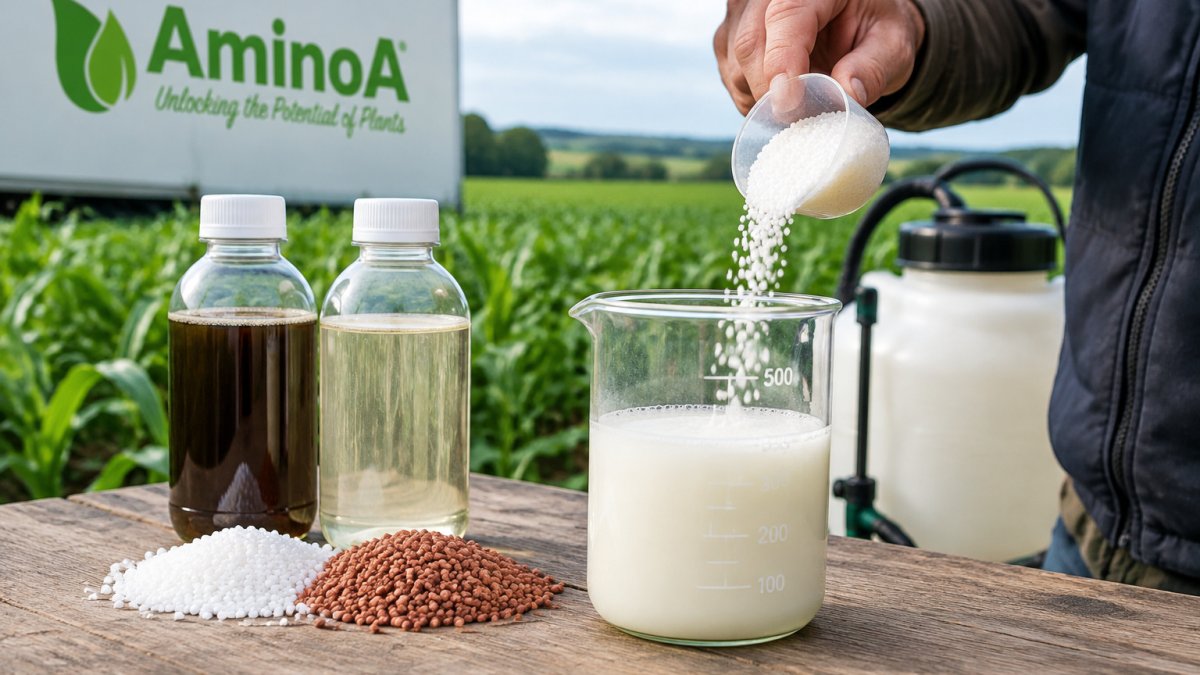
The liquid biostimulants vs granular fertilisers choice depends on the window. Granular suits base application: it releases slowly and stays put.
| Window | Best format | Why |
|---|---|---|
| Base application | Granular | Slow release, root-nutrient contact |
| Early spring growth | Liquid | Fast uptake into new tissue |
| V4-V6 sidedress | Liquid or granular | Match to soil moisture |
| Flowering and fruit set | Liquid biostimulant | Supports plant metabolism at peak demand |
For the full comparison, read our liquid vs granular fertiliser guide.
Step 5: Protect Against Nutrient Loss, Leaching and Runoff
Nutrient loss is where timing pays for itself. Three practical controls:
- Never apply to saturated or frozen ground
- Split applications to limit how much nitrogen is exposed at once
- Keep application rate matched to measured demand
Precision techniques that adjust timing to actual plant need cut the risk of over-fertilising, according to Frontiers in Agronomy review of precision techniques. Runoff also carries a compliance cost, so pair timing with the tactics in our guide on ways to reduce nitrogen runoff.
Common Timing Mistakes That Cut Yield Potential
- Spreading everything at planting. Front-loading wastes nitrogen.
- Ignoring soil temperature. Warm autumn soils leach.
- Skipping the test. You guess the rate and the date.
Watch out: applying nitrogen to waterlogged ground can send most of it straight past the root zone, and you will not get that spend back.
Building Your Own Crop-Specific Application Calendar
Most timing guides stop at 'match applications to growth stage'. That is not a calendar, and it is not actionable on a wet Tuesday in March. This section gives you a structured calendar for the main UK combinable and root crops, plus the weather triggers that should override it. Build the calendar around your crop's uptake curve, not a fixed date, and treat the dates below as windows to be adjusted by soil temperature, rainfall and soil test results.
The calendar by crop
Winter wheat and winter barley. Base nitrogen in late February to early March, once soils are draining and the crop is actively tillering.
Winter oilseed rape. Early nitrogen in late February to support canopy recovery, a second dose at stem extension in March, and a final dose at green bud to early flowering.
Spring barley and spring wheat. Base at drilling, then a single sidedress at V4-V6, usually four to six weeks after drilling depending on soil temperature. Avoid a late nitrogen dose after flag leaf, which risks lodging and delayed maturity.
Maize. Base at drilling, sidedress at the six-to-eight leaf stage, and a final dose at tasselling where the crop is behind. Maize responds strongly to soil temperature, so delay the base if soils are below 8°C at drilling.
Potatoes. Nitrogen is usually split between planting and the first earthing-up, with the balance at tuber initiation. Late nitrogen after tuber set risks excess haulm and poor skin set.
Weather triggers that override the calendar
A calendar is a plan, not a promise. Three triggers should make you delay or bring forward a pass:
- Soil temperature. Autumn nitrogen should go on only when soil temperatures sit consistently below 10°C, as CHS guidance on autumn nitrogen strategies sets out. In spring, wait for soils to reach 6-8°C and be draining before the base dose.
- Rainfall forecast. Do not apply to saturated or frozen ground, and avoid applying ahead of heavy rain forecasts. Nitrogen applied into a wet forecast is nitrogen you have paid for and lost.
- Drought. On dry soils, granular nitrogen sits unavailable and liquid foliar feeds are more reliable. Delay the granular pass until rain is forecast, or switch the window to a foliar product.
Integrating soil testing into the calendar
Soil testing should set the rate, not just the date. A test before the season shows nutrient availability, soil pH and soil organic matter, and it tells you whether the field's nitrogen residue lets you trim the base dose. It cannot tell you everything about in-season demand, which is why we explain what soil testing can and cannot reveal before you build a plan on it.
Reviewing the plan through the season
Review weather before every pass, and check each pass against the 4R rule: right rate, right place, right time, right product. For cereal crops, slot foliar nutrition into the same plan using our foliar nutrition timing guide.
Watch out: a calendar built on last year's dates will fail in a season with a late spring or a wet autumn, so rebuild the windows each year from soil temperature and the crop's actual growth stage.
Frequently Asked Questions
What are the critical growth stages for fertiliser application?
The stages that matter most are emergence, the V4-V6 vegetative window and the reproductive stage. Nitrogen demand climbs sharply as biomass accumulates, so aligning applications with these points beats a single early dose. Research in the American Journal of Agricultural Economics (2026) found front-loading is suboptimal compared with split timing, and growers commonly pair soil test results with nutrient uptake curves so nutrients are available at peak growth.
Can split nitrogen application benefits justify changing my whole programme?
In most cases yes, because the gains come from matching supply to demand rather than from applying more. A practical starting point is to consider a base rate at planting, with later applications timed to the crop's demand. Keep total nitrogen within your farm's nutrient budget and record each pass so you can compare fields next season.
How does soil temperature influence fertiliser efficiency?
Soil temperature governs how quickly nitrogen converts to forms the crop cannot readily use and how easily it leaches. Autumn nitrogen is generally best applied only when soil temperatures are consistently low, which limits losses before the crop can take it up. Warm, wet soils after application are the highest-risk combination. Check a soil thermometer at application depth rather than relying on air temperature, and avoid spreading ahead of heavy rain.
How do L-α amino acid biostimulants affect fertiliser application timing?
Amino acid biostimulants are not a substitute for nitrogen planning, but they change what a well-timed application achieves. Applying a 100% L-α amino acid product alongside a reduced or split programme is one way growers support root development. In Velcourt trials, adding AminoA FLO to reduced fungicide rates maintained yields and improved green leaf area in winter wheat. Treat them as a timed supplement to your base programme, not a replacement for soil testing.
Timing is the part of nutrition most growers still get wrong, and it is the part that pays fastest. AminoA makes L-α amino acid biostimulants for the in-season windows where uptake matters most, with every essential amino acid in the L form and a high content of nitrogen, potassium, iron and magnesium. Subscribe to our newsletter for timing guidance built around real growth stages.