 comparison
Liquid Biostimulants vs Granular Fertilisers: 2026 Guide
Table of Contents
- Liquid Biostimulants vs Granular Fertilisers: Key Differences at a Glance
- What Liquid Biostimulants Do and Where They Excel
- What Granular Fertilisers Do and Where They Excel
- How to Apply Liquid Biostimulants for Maximum Effect
- Biostimulant Application Timing: When to Use Each Input
- Choosing Between Liquid Biostimulants and Granular Fertilisers
- Conclusion
- Frequently Asked Questions
Last Updated: 30 August 2026
Liquid Biostimulants vs Granular Fertilisers: Key Differences at a Glance
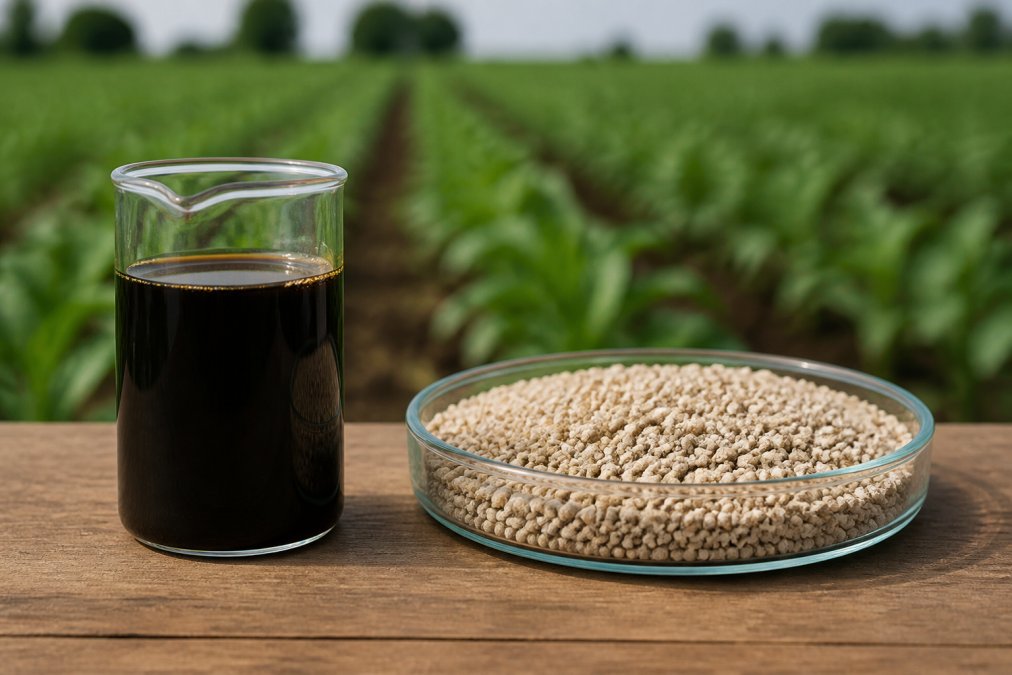
Growers comparing liquid biostimulants vs granular fertilisers are weighing two fundamentally different philosophies of crop nutrition. Liquid biostimulants are plant-active compounds, typically amino acids, seaweed extracts, or humic substances, that stimulate the plant's own physiological processes rather than simply supplying mineral nutrients. Granular fertilisers deliver concentrated macro- and micronutrients to the soil, where they dissolve and become available to the root system over time.
| Factor | Liquid Biostimulants | Granular Fertilisers |
|---|---|---|
| Primary function | Stimulate plant physiology | Supply macro/micronutrients |
| Application method | Foliar, fertigation, seed treatment | Soil broadcast or incorporation |
| Speed of action | Rapid (hours to days) | Slower (days to weeks) |
| Nutrient release | Low direct nutrient load | High nutrient load, sustained |
| Stress response | Directly addresses abiotic stress | Indirect, via plant nutrition |
| Organic certification | Eligible (product-dependent) | Restricted synthetic forms |
| Cost basis | Per-hectare input cost varies | Generally lower per kg nutrient |
| Best for | Targeted intervention, stress periods | Baseline nutrition programmes |
The key insight: these inputs are complementary, not competitive. The question is not which one to use, but when each earns its place in the programme.
What Liquid Biostimulants Do and Where They Excel
Liquid biostimulants work by interacting directly with plant metabolism, improving the efficiency of processes the plant is already running. A granular fertiliser supplies nutrients; a biostimulant changes how effectively the plant uses what it already has access to.

L-α amino acid products, seaweed-based extracts, and humic acid formulations each have distinct modes of action. Amino acid biostimulants are particularly valued for their direct role in protein synthesis, enzyme activation, and chelation of soil minerals. According to the European Commission's Joint Research Centre on biostimulants, plant biostimulants promote nutrient use efficiency, tolerance to abiotic stress, and quality traits, independent of their nutrient content.
Liquid formulations excel when speed matters. Foliar application bypasses the soil, delivering active compounds directly to leaf tissue within hours, ideal for stress intervention, post-emergence crop support, and periods when soil conditions limit root uptake.
Benefits of L-α Amino Acid Biostimulants for Crop Performance
L-α amino acids are the biologically active form that plants synthesise naturally; supplying them externally reduces the metabolic energy the plant must spend on biosynthesis, freeing resources for growth, reproduction, and stress defence.
Documented benefits include:
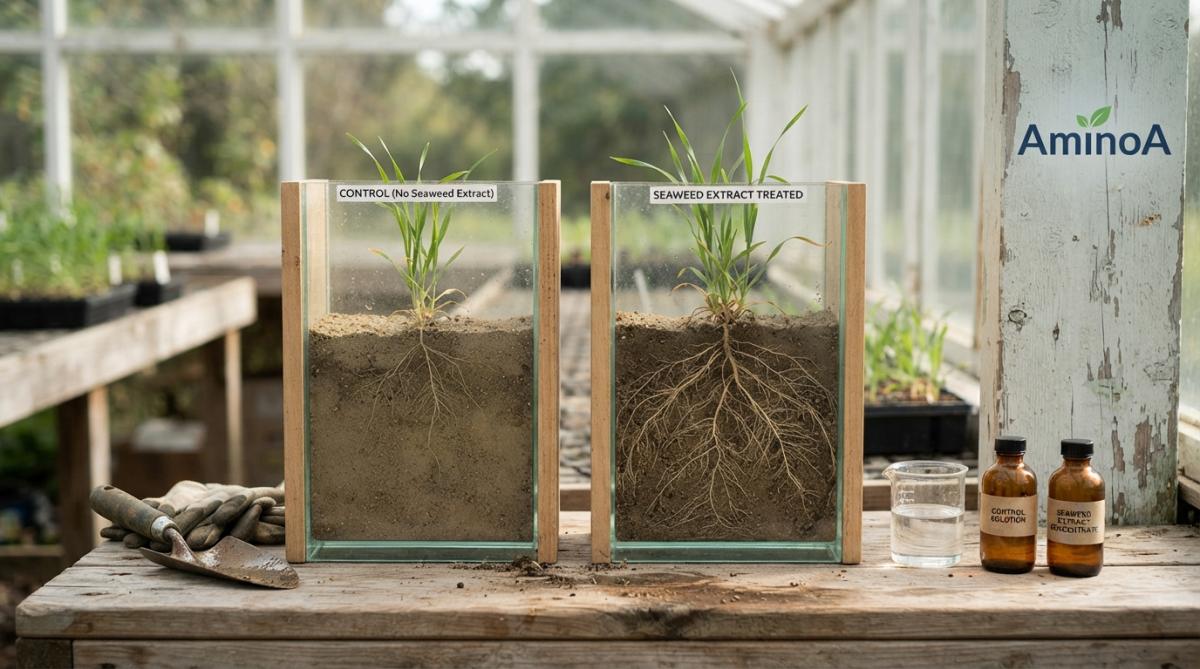
- Root and shoot development: Amino acids promote cell elongation and division, supporting stronger root architecture and more vigorous early growth.
- Stress resistance: L-α amino acids improve tolerance to cold, heat, drought, and agrochemical phytotoxicity, particularly relevant following herbicide or fungicide applications.
- Nutrient assimilation: Amino acids act as chelating agents, improving uptake and translocation of iron, magnesium, zinc, and manganese, nutrients often present in soil but locked in unavailable forms.
- Blossom and fruit set: Proline and hydroxyproline play a structural role in pollen viability and fruit formation, making amino acid applications timed around flowering particularly effective in horticultural crops.
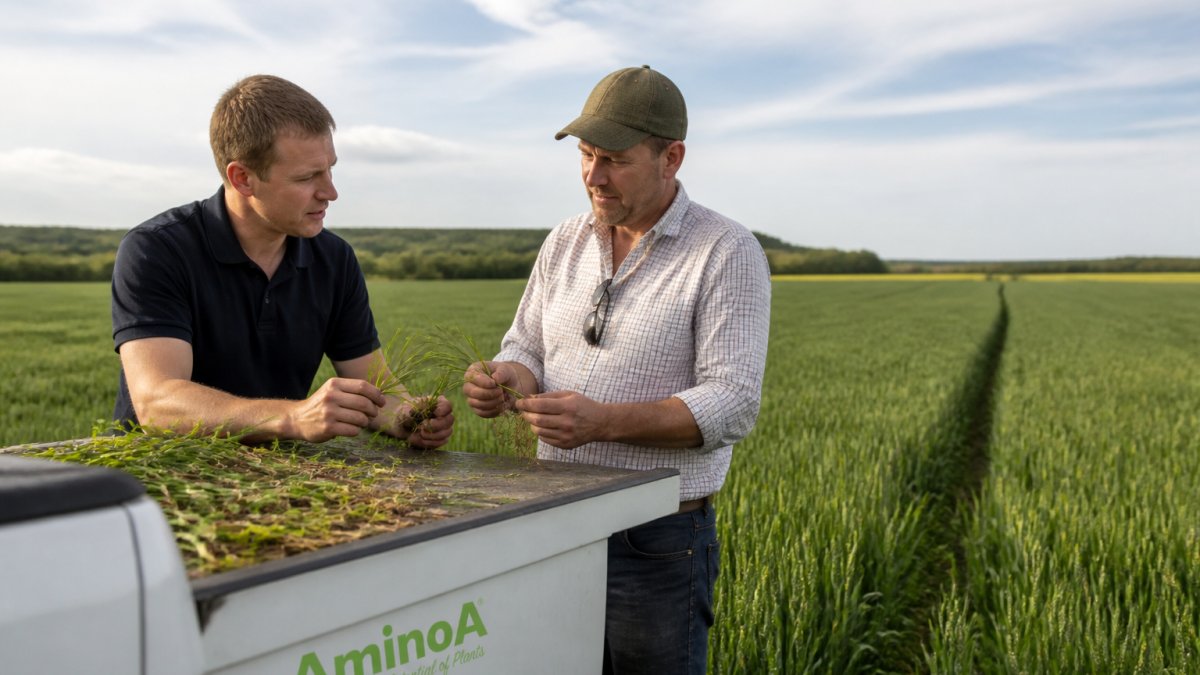
Velcourt trials found that adding AminoA FLO to reduced fungicide programmes maintained yields and improved green leaf area in winter wheat. AminoA FLO is produced through enzymatic hydrolysis of plant proteins, which preserves the L-α configuration of every amino acid, chemically hydrolysed alternatives often contain D-form amino acids that plants cannot use directly.
Drawbacks and Practical Limitations
Liquid biostimulants are not a substitute for sound baseline nutrition. A plant genuinely deficient in nitrogen, phosphorus, or potassium will not recover through biostimulant application alone.
Key limitations:
- Repeat applications are standard: Most programmes require two to four applications timed to crop growth stages.
- Efficacy depends on application conditions: Foliar uptake is reduced in high temperatures, low humidity, or on waxy leaf surfaces. Early morning application on crops with open stomata improves absorption significantly.
- Cost-per-hectare is higher than bulk NPK: ROI depends on yield response and crop value, stronger in high-value horticulture than low-margin combinable crops.
- Compatibility must be checked: Tank mixing with fungicides or insecticides requires verification. AminoA FLO is formulated to reduce agrochemical phytotoxicity, but growers should conduct a jar test before mixing.
What Granular Fertilisers Do and Where They Excel
Granular fertilisers are the backbone of most arable nutrition programmes. They deliver concentrated macro-nutrients, primarily nitrogen, phosphorus, and potassium, in a form that releases into the soil solution over time, providing sustained supply to the root zone throughout the growing season.
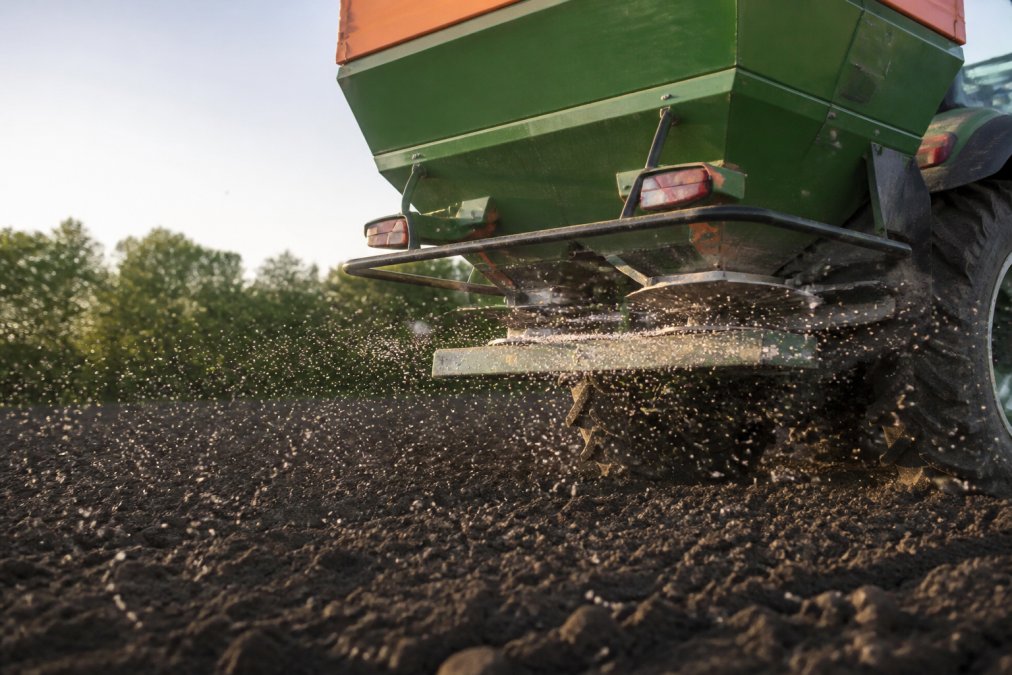
The practical advantage is simplicity and scalability. A single pre-drilling or post-emergence application can supply the bulk of a crop's seasonal nitrogen requirement, reducing field passes. According to AHDB's nutrient management guide (RB209), correct timing and rate of granular nitrogen application remains the single largest driver of cereal yield response in UK cropping systems.
Granular fertilisers suit baseline nitrogen, phosphorus, and potassium programmes across cereals, oilseed rape, and root crops; pre-drilling incorporation; large-scale applications; and slow-release formulations requiring extended nutrient availability.
Drawbacks and Practical Limitations
Limitations become apparent in difficult conditions. In dry springs, granular nitrogen can sit on the soil surface without dissolving, delaying uptake at the critical tillering stage. In waterlogged conditions, nitrate leaching can remove significant nitrogen before crop access.
Key limitations:
- Soil moisture dependency: Dissolution and uptake require adequate soil water. In drought, granular products may be physically present but biologically unavailable.
- Risk of leaching and volatilisation: Ammonium-based granular fertilisers are subject to ammonia volatilisation on warm, moist soils. Nitrate forms are vulnerable to leaching in high-rainfall periods.
- No stress response capability: Granular fertilisers supply nutrients but do not stimulate the plant's stress-defence mechanisms.
- Regulatory pressure is increasing: The Environment Agency's Farming Rules for Water place restrictions on granular nitrogen applications during closed periods.
How to Apply Liquid Biostimulants for Maximum Effect
Application technique determines whether active compounds reach their target tissue in a biologically useful state.
Application method options:
- Foliar spray: Apply through a conventional boom sprayer at 100-200 litres per hectare for most cereal crops. Higher volumes improve penetration in dense canopies.
- Fertigation: Liquid biostimulants can be applied through drip or overhead irrigation systems, standard in protected horticulture and increasingly used in field vegetable production.
- Seed treatment: Some amino acid formulations are approved for seed dressing, delivering a biostimulant dose at germination.
Practical checklist for foliar application:
- Check forecast: apply when temperatures are below 25°C and humidity is above 60%
- Verify tank mix compatibility with a jar test before field application
- Target application to early morning when stomata are open
- Calibrate boom pressure to achieve fine droplet size without drift
- Record application date, rate, growth stage, and weather conditions
- Plan follow-up application at the next key growth stage
AminoA FLO can be applied via foliar spray, fertigation, or seed treatment, giving growers flexibility to integrate it into existing spray programmes.
Biostimulant Application Timing: When to Use Each Input
Application timing is arguably more important than rate. The same product applied at the wrong growth stage delivers a fraction of the benefit it would achieve at the right moment.
| Growth Stage | Recommended Input | Rationale |
|---|---|---|
| Pre-germination / seed treatment | Amino acid biostimulant | Supports root establishment and early vigour |
| Tillering (GS21-25, cereals) | Liquid biostimulant + baseline granular N | Maximises tiller survival and biomass accumulation |
| Stem extension (GS30-32) | Liquid biostimulant | Supports canopy development during rapid growth |
| Flag leaf / booting (GS37-45) | Amino acid biostimulant | Critical for grain set and green leaf area retention |
| Post-stress recovery | Liquid biostimulant | Rapid intervention after frost, drought, or phytotoxicity |
| Flowering (horticulture) | Amino acid biostimulant | Improves pollination, fruit set, and early fruit development |
Granular fertilisers are most effective when applied before or during maximum nutrient demand, typically pre-drilling for phosphorus and potassium, and split nitrogen applications from early spring through flag leaf in cereals.
Choosing Between Liquid Biostimulants and Granular Fertilisers
The framing of liquid biostimulants vs granular fertilisers as a binary choice misrepresents how most high-performing programmes work. The more useful question is: what role does each input play in this specific system?
Soil Type and Crop System
Soil type directly affects how each input performs. On light, free-draining soils, granular nitrogen is at higher risk of leaching before crop uptake, strengthening the case for split applications and supplementary foliar inputs. On heavy clay soils with restricted drainage, granular applications during wet periods carry significant run-off risk, making foliar liquid inputs more attractive.
In high-value horticultural production, strawberries, tomatoes, protected salads, the per-hectare economics of liquid biostimulants are straightforward: measurable improvement in fruit quality or marketable yield easily justifies the input cost. In lower-margin combinable crops, the ROI calculation is tighter and depends on demonstrable yield response, stress event frequency, and the value of maintaining green leaf area through grain fill.
Organic systems present a clear case for liquid biostimulants. AminoA FLO is approved for use in organic farming systems by OF&G (Organic Farmers and Growers), making it one of the few inputs that bridges biological performance and certification compliance. As the Soil Association's organic standards guidance outlines, organic operators must source inputs from approved lists.
Budget, ROI, and Organic Certification
Liquid biostimulants cost more per hectare than bulk granular fertilisers on a straight input cost comparison. ROI rests on what the input delivers: improved nutrient use efficiency from existing fertiliser applications, stress event mitigation, yield protection at vulnerable growth stages, and in some systems, reduced fungicide or growth regulator requirements.
For organic operators, synthetic granular fertilisers are not available, making liquid amino acid biostimulants with OF&G approval a distinct and valuable position in that toolkit.
Growers new to biostimulants should request trial data relevant to their crop and region, and where possible, run small-scale on-farm comparisons before full-programme rollout. AminoA offers contact-based pricing reflecting variation in pack sizes, application volumes, and programme requirements. For current pricing and programme recommendations, contact AminoA directly through the website.
Conclusion
Choosing between liquid biostimulants and granular fertilisers is the wrong question; the right question is how to integrate both into a programme where each input does the job it is genuinely suited for. AminoA's L-α amino acid biostimulants, produced through enzymatic hydrolysis and approved for organic use by OF&G, are designed to complement existing nutrition programmes. Whether the priority is stress resilience in winter wheat, fruit quality in strawberries, or maintaining yield under a reduced-input programme, AminoA FLO provides a scientifically grounded, practically tested option. Subscribe to the AminoA newsletter for seasonal application guidance, trial results, and agronomic updates delivered directly to your inbox.
Frequently Asked Questions
What are the primary differences between liquid biostimulants and granular fertilisers?
Granular fertilisers supply macronutrients, nitrogen, phosphorus, and potassium, directly to the soil, feeding the plant through root uptake over days or weeks. Liquid biostimulants, particularly L-α amino acid products, work differently: they stimulate the plant's own physiological processes, improving nutrient assimilation, stress tolerance, and root development. The two are not interchangeable; granulars replace nutrient deficits while liquid biostimulants optimise how efficiently the plant uses what is already available.
Can liquid biostimulants be used alongside granular fertilisers?
Yes, and this is the approach most agronomists recommend. Liquid biostimulants complement granular fertiliser programmes by improving nutrient uptake efficiency, meaning the plant extracts more value from each kilogram of fertiliser applied. AminoA FLO, for example, enhances nutrient assimilation and translocation, which can allow growers to maintain yields even when fertiliser rates are reduced. Velcourt trials demonstrated that adding AminoA FLO to a reduced fungicide programme maintained yields and improved green leaf area in winter wheat.
How do L-α amino acid biostimulants improve plant stress resistance?
L-α amino acids are the biologically active form that plants incorporate directly into proteins without the energy cost of synthesis. Under abiotic stress, drought, frost, heat, or agrochemical phytotoxicity, plants divert energy away from growth. Supplying ready-made L-α amino acids reduces that metabolic burden, allowing the plant to maintain cell function and continue developing. AminoA FLO is approved by OF&G for organic systems and is specifically formulated to support crops through these stress periods.
Are liquid biostimulants more cost-effective than granular fertilisers for large-scale farming?
The comparison depends on what you are measuring. Granular fertilisers have a lower upfront cost per hectare for raw nutrient delivery. Liquid biostimulants carry a higher application cost but can reduce overall input spend by improving fertiliser use efficiency and reducing agrochemical reliance. For large-scale arable operations, the return on investment case rests on yield protection during stress events and maintaining output with lower input volumes. Contact AminoA directly for current pricing and to discuss trial options suited to your farm scale.
What are the environmental benefits of using biostimulants over synthetic granular fertilisers?
Synthetic granular fertilisers carry risks of nitrate leaching and soil acidification, both of which are subject to scrutiny under the Nitrates Directive as implemented in UK law. Liquid biostimulants, particularly those produced through enzymatic hydrolysis of plant proteins, have a lower environmental burden. They improve nutrient use efficiency, which means less surplus nitrogen in the soil, and products like AminoA FLO are certified for organic systems by OF&G, confirming their compatibility with environmentally focused farming standards.
This article was written using GrandRanker