 Ultimate guide
Choosing Amino Acid Biostimulants: A Grower's Guide
Last Updated: 4 November 2026
Quick Summary
To choose the best amino acid biostimulants, check the label for 100% L-α amino acid content, a declared concentration and enzymatic hydrolysis, then confirm trial data for your crop and region. Judge cost per hectare against the yield or input saving the product protects, and jar-test every tank mix before spraying.
- D-forms and racemic blends are cheaper to produce and largely wasted on the crop.
- Enzymatic hydrolysis preserves the L-form; harsh chemical hydrolysis does not always.
- Hydrolysates release amino acids gradually, while free L-α forms act faster around stress events.
- Spraying concentrated product above 25°C can cause leaf scorch on sensitive crops.
- Velcourt trials found AminoA FLO with reduced fungicide rates maintained yields and improved green leaf area in winter wheat.
Table of Contents
- What Amino Acid Biostimulants Actually Do in the Field
- Reading the Label: L-α Forms, Purity and Concentration
- Protein Hydrolysate vs Free Amino Acids: Which Form Fits Your Programme
- Amino Acid Biostimulant Application Rates and Timing
- Biostimulant Compatibility with Agrochemicals and Tank Mixes
- Cost per Hectare, Soil Microbiome Effects and Climate Fit
- Building Your Selection Checklist Before You Buy
- Frequently Asked Questions
What Amino Acid Biostimulants Actually Do in the Field
Amino acid biostimulants are formulated products that supply plants with L-α amino acids and peptides to support metabolism, nutrient uptake and stress tolerance rather than to deliver bulk nitrogen. Research published through the National Library of Medicine review of amino acid biostimulants and protein hydrolysates documents 234 citations on their efficacy, with specific treatments of tyrosine, methionine, proline and phenylalanine producing measurable gains in dry weight, fresh weight and shoot length.
That is the practical case for how to choose the best amino acid biostimulants: you are buying physiological support, not a fertiliser replacement.
At AminoA, we manufacture 100% L-α amino acid products through enzymatic hydrolysis. Growers who understand the mechanism are better placed to select suitable products than those who shop on price per litre. ResearchGate's review of amino acids as biostimulants confirms these roles in plant growth, nutrition and stress tolerance.
If you are new to the category, start with the yield benefits of amino acid biostimulants before comparing labels.
Reading the Label: L-α Forms, Purity and Concentration
The label decides everything. L-α amino acids are the biologically active stereoisomers that plants recognise and metabolise; D-forms and racemic blends are cheaper to produce and largely wasted on the crop.
Three numbers matter more than the marketing copy:
- Total amino acid content as a percentage of the formulation, not "amino acid complex" with no figure
- Free amino acid versus peptide-bound share, which tells you how quickly the product is available
- Declared micronutrients such as nitrogen, potassium, iron and magnesium, which indicate chelated co-factors rather than filler
Industry guidance from ICL Growing Solutions on amino acids in fertilisers programmes stresses selecting products against specific crop needs rather than catalogue claims. Citymax Group's 2024 commentary goes further, warning that some offerings contain fillers or lack the purity required for field performance. Ask any supplier for the manufacturing method. Enzymatic hydrolysis preserves the L-form; harsh chemical hydrolysis does not always.
Protein Hydrolysate vs Free Amino Acids: Which Form Fits Your Programme
Protein hydrolysates are mixtures of peptides and free amino acids derived from plant or animal protein, while free amino acid products supply single or blended L-forms with no peptide chains. The distinction changes absorption speed, persistence and cost.
Hydrolysates release amino acids gradually as peptide chains break down, which suits programmes built around steady metabolic support through vegetative growth. Free L-α forms act faster, which helps around stress events and during rapid root or fruit development. Neither is universally better. A common mistake is buying a hydrolysate for a rescue application and expecting immediate stomatal response.
Bioavailability, concentration rates and the balance of essential versus non-essential amino acids all shift the decision. For a practical walkthrough of fitting either form into a spray or fertigation plan, see our grower's guide to integrating amino acid biostimulants.
Amino Acid Biostimulant Application Rates and Timing
Application rates depend on formulation concentration, crop and delivery method, so always follow the manufacturer's label rather than a generic figure. Foliar application typically uses lower concentrations than fertigation, and cereal programmes differ from high-value horticulture. Always follow the product label and your agronomist's advice for rates and water volumes.
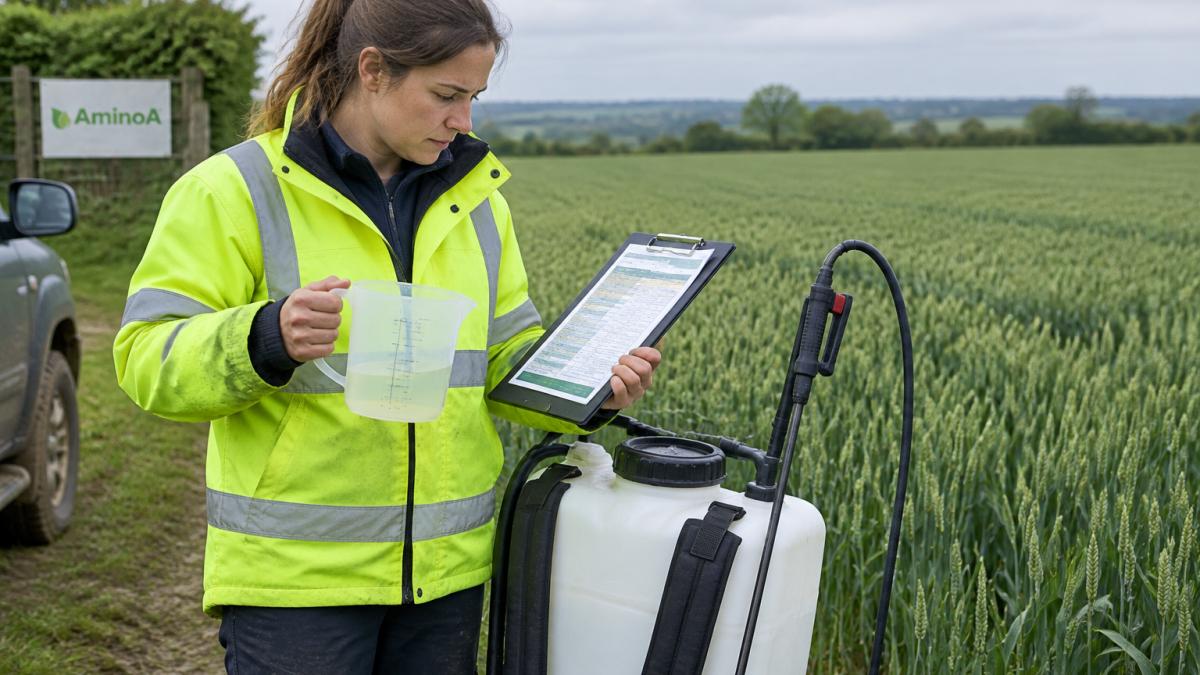
Timing carries as much weight as dose. The windows that consistently deliver are early root establishment, rapid vegetative growth, and the period immediately before or after a known stress event such as cold, drought or a herbicide application. Foliar sprays work best on active leaves with open stomata, so early morning or evening beats midday heat.
Watch out: applying a concentrated amino acid product in full midday sun or at temperatures above 25°C can cause leaf scorch, especially on sensitive horticultural crops, always spray in cooler conditions and never exceed the label rate. Maintaining this level of caution ensures that your nutrient programme remains effective, particularly when integrating organic fertilizers for crops into a broader greenhouse management strategy.
For wheat-specific figures, our reference on liquid biostimulant application rates for wheat sets out concentrations and spray timings you can adapt to your own programme. The key is to match the rate to the delivery method: a knapsack sprayer on a small plot needs a different dilution from a trailed boom on 20 hectares, and fertigation through drip lines requires flushing to avoid clogging.
Biostimulant Compatibility with Agrochemicals and Tank Mixes
Tank mix compatibility is where good programmes fail. Amino acid biostimulants are generally compatible with many agrochemicals, but chelating agents, adjuvants and high-load formulations can react unpredictably in the spray tank.
Watch out: mixing a concentrated amino acid product directly with a strong fungicide or insecticide without a jar test can cause precipitation, blocked filters and phytotoxicity that shows up as leaf scorch days later.
Our rule is simple. Jar-test every new combination at the intended concentration ratios, add products in the correct order, and never mix more than you will spray that day. Keep records of every combination so a bad batch can be traced.
Cost per Hectare, Soil Microbiome Effects and Climate Fit
Cost per hectare should be judged against the value it protects, not against the price of extra nitrogen. A biostimulant programme earns its place when it maintains yield at reduced agrochemical rates, improves green leaf area, or carries a crop through a stress event that would otherwise cost more than the product. To make that judgement concrete, use a simple cost-benefit framework: calculate the total product cost per hectare (litres per hectare multiplied by price per litre), then compare it against the value of the input it replaces or the yield loss it prevents. Velcourt trials found that adding AminoA FLO to reduced fungicide rates maintained yields and improved green leaf area in winter wheat.
Soil microbiome interaction is the angle most buyers miss. Amino acid applications feed the rhizosphere as well as the leaf, supporting microbial activity that underpins soil fertility over successive seasons. That is why a cost-benefit analysis should account for multi-season soil benefits, not just the immediate crop.
Climate fit matters too. Cold, drought and heat stress each change which amino acids earn their keep, so a programme built for one region will not transfer unchanged to another. A programme built for one climate will not necessarily transfer unchanged to another, so ask suppliers for trial data from your region and soil type. For a full cost-benefit view, read whether a biostimulant programme is worth the cost.
Building Your Selection Checklist Before You Buy
Work through this checklist before committing to any product:
- Confirm 100% L-α amino acid content and the declared concentration
- Verify the manufacturing method, preferably enzymatic hydrolysis
- Check declared nitrogen, potassium, iron and magnesium levels
- Ask for trial data on your crop and region, not generic results
- Confirm tank mix compatibility with your current spray programme
- Establish the cost per hectare against the yield or input saving it protects
- Confirm organic certification status if your system requires it
- Request a small pack or trial programme before a full-season order
That last point matters. A trial on your own land answers more than any brochure. For a structured approach to matching product to soil, see how to choose the right biostimulant for soil health.
Work through these checks before committing to any amino acid biostimulant product.
| Check | What to confirm |
|---|---|
| Amino acid content | 100% L-α content and declared concentration |
| Manufacturing method | Preferably enzymatic hydrolysis |
| Declared nutrients | Nitrogen, potassium, iron and magnesium levels |
| Trial data | Results on your crop and region, not generic |
| Tank mix compatibility | Compatibility with your current spray programme |
| Cost per hectare | Weighed against yield or input saving protected |
| Organic certification | Status confirmed if your system requires it |
| Trial order | Small pack or trial programme before full-season order |
Frequently Asked Questions
What are the benefits of using L-α amino acids in agriculture?
L-α amino acids are the form plants can take up and use directly, so they support nutrient uptake, osmo-protection and stress recovery rather than waiting on soil breakdown. A 2024 review in PMC notes amino acids work as biostimulants by chelating metals, improving nutrient availability and mitigating reactive oxygen species.
How do amino acid biostimulants improve crop stress resistance?
They support the plant's own defence chemistry rather than replacing it. Amino acids contribute to osmotic adjustment, stomata regulation and the scavenging of reactive oxygen species produced under abiotic stress. Proline in particular accumulates during drought and cold, and applied amino acids can top up the pool the plant draws on.
Are amino acid biostimulants compatible with standard fertilisers programmes?
Most are, but check before you tank mix. Free amino acids and protein hydrolysates can be applied by foliar spray or fertigation alongside many fertilisers programmes. The risk sits in high-concentration tank mixes and strongly reactive products. Run a jar test on any new combination, keep to the label concentration rates and apply to a small strip first. If you have had phytotoxicity from a tank mix before, test the amino acid with your exact fungicide and insecticide combination before committing a whole field.
What is the difference between protein hydrolysates and free amino acids?
Protein hydrolysates are peptide chains of varying length produced by enzymatic or chemical breakdown of protein sources, while free amino acid products contain individual amino acids already split apart. Free forms are taken up faster and are easier to dose precisely; hydrolysates release amino acids more gradually and can also feed soil biology. The choice depends on your aim: a fast foliar response before a stress event favours free L-α amino acids, while a soil programme may suit a hydrolysate. Check the label for the breakdown, not just the total amino acid percentage.
Choosing well comes down to one discipline: buy on verified L-α content, hydrolysis method and crop-specific evidence, not on price per litre. AminoA manufactures 100% L-α amino acid biostimulants through enzymatic hydrolysis, with declared nitrogen, potassium, iron and magnesium and every essential amino acid in the L form. If you want product updates, trial results and practical application guidance, subscribe to our newsletter and get the next set of findings straight to your inbox.