 Ultimate guide
The Long-Term Economic Impact of Sustainable Soil Practices
Last Updated: November 7, 2026
Quick Summary
The long term economic impact of sustainable soil practices comes from compounding gains in yield stability, reduced input spend and lower risk rather than first-season returns. Soil organic matter and structure build slowly, so judge any investment over a rotation, not a single harvest.
- Soil health return on investment sums yield stability, reduced input spend and lower risk across several seasons.
- Nitrogen use efficiency is the single largest cost lever in most arable budgets.
- Cover crops rarely pay back in year one, with early wins in workability and water management.
- Choose two or three practices maximum and keep a control strip to prove the difference.
- Set a stop rule: if a measure has not moved by season three, change approach.
Table of Contents
- Why Sustainable Soil Practices Pay Off Over Years, Not Seasons
- Measuring Soil Health Return on Investment
- Nitrogen Use Efficiency on Farm: The Biggest Cost Lever
- Soil Testing and Fertiliser Efficiency: Spend Where It Works
- Cover Crops and Farm Economics: The Long Game
- Where Biostimulants Fit in the Sustainable Soil Practices Budget
- The Costs and Risks Nobody Puts in the Brochure
- Building Your Own Soil Investment Plan Before Next Season
- Frequently Asked Questions
Why Sustainable Soil Practices Pay Off Over Years, Not Seasons
The long term economic impact of sustainable soil practices rarely shows up in the first harvest. That is the central tension in this whole subject, and it is where most farm budgets go wrong. Growers often judge a soil investment against a single season's gross margin, then abandon it before the compounding benefits arrive.
Soil organic matter builds slowly. Structure improves slowly. Water-holding capacity and nutrient cycling respond over rotations, not weeks. The AHDB guidance on soil management and health makes the same point: soil is a long-term asset, and treating it as a seasonal input is a category error.
Below, we break down where the money actually comes from, what to count beyond yield, and how to build an investment plan you can defend to your bank manager.
Measuring Soil Health Return on Investment
Soil health return on investment is the measure of what improved soil delivers back to the business over time, set against what it cost to build. It is not a single number. It is the sum of yield stability, reduced input spend, and lower risk, tracked across several seasons.
Most growers count only yield. That is the mistake. A field that yields the same but needs less nitrogen, holds more moisture in a dry June, and survives a wet autumn with better structure is quietly more profitable.
What to Count Beyond Yield
- Reduced fertiliser spend per tonne
- Lower fuel and passes from better workability
- Yield stability across a bad year, not just a good one
- Reduced erosion and nutrient runoff losses
- Improved water infiltration, cutting irrigation or drainage costs
If you want a worked example of how to model these returns against cost, our guide to the cost benefit analysis of organic soil amendments walks through the arithmetic.
Soil health return on investment counts more than yield, so here is what the article says to track beyond the combine.
| What to count | How it shows up |
|---|---|
| Reduced fertiliser spend | Lower spend per tonne |
| Lower fuel and passes | Better workability |
| Yield stability | Holds up across a bad year |
| Reduced erosion and runoff | Fewer nutrient losses |
| Improved water infiltration | Cuts irrigation or drainage costs |
Nitrogen Use Efficiency on Farm: The Biggest Cost Lever
Nitrogen use efficiency on farm is the proportion of applied nitrogen that ends up in the crop rather than lost to leaching, volatilisation or lock-up. It is the single largest cost lever in most arable budgets, because nitrogen is usually the biggest input line and the most easily wasted.
Improving efficiency is not about applying less for its own sake. It is about getting more of what you apply into the plant. Split applications, correct timing, and matching rate to crop demand all matter. So does soil biology: a healthy soil cycles nitrogen better and loses less.
A common mistake is chasing yield with extra nitrogen when the real problem is uptake. Pushing rate on a soil that cannot hold or cycle nutrients wastes money and increases leaching risk.
For practical rate-setting, see our guidance on optimising nitrogen application rates for crops.
Soil Testing and Fertiliser Efficiency: Spend Where It Works
Soil testing and fertiliser efficiency are linked because testing tells you where spending is justified and where it is waste. Testing is not a ritual. It is a decision tool, and it only pays if you act on the results.
What testing reveals well: pH, phosphate and potash indices, magnesium, organic matter, and structural indicators. What it reveals less reliably: the fine detail of biological nitrogen supply and micronutrient availability, which shift through the season. Because these seasonal uncertainties make long-term soil decisions dependent on more than test results alone, agricultural sustainability also rests on managing energy use alongside soil health.
Watch out: testing the same way every year and filing the result is worse than not testing, because it creates false confidence. Sample consistently, at the same time of year, and compare trends rather than single readings.
Before you commit budget, read does soil testing show crop nutrient deficiencies to understand the limits as well as the strengths.
Cover Crops and Farm Economics: The Long Game
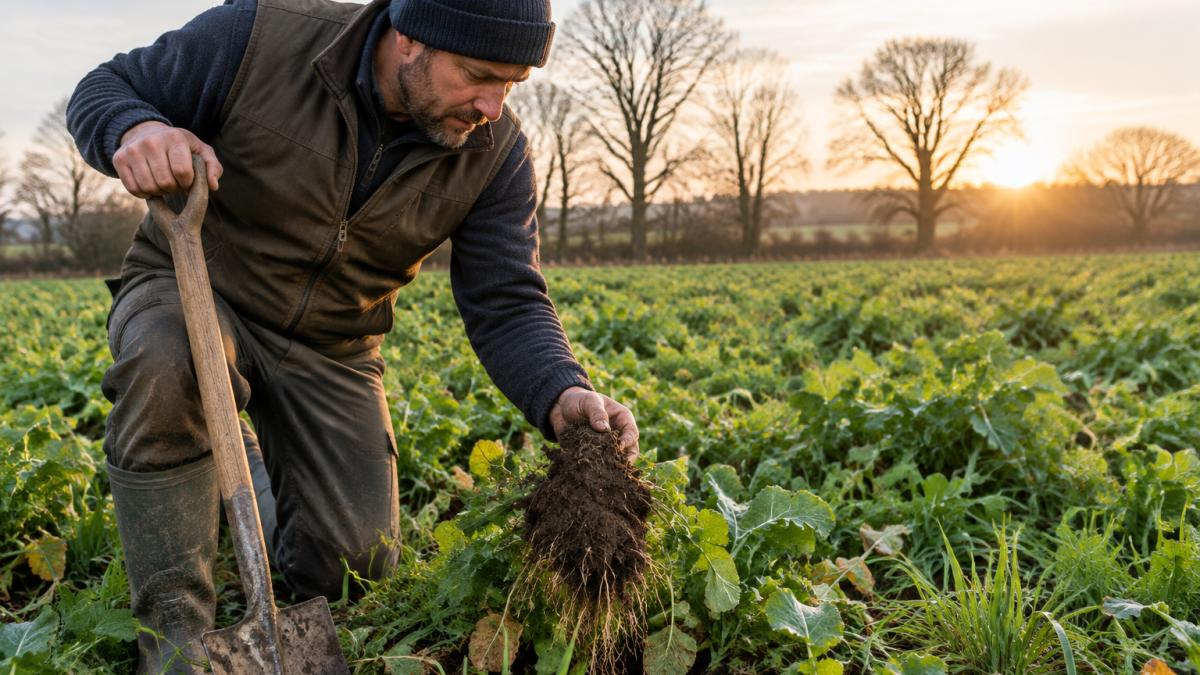
Cover crops and farm economics are a long game, and the payback is real but delayed. The costs are upfront and visible: seed, establishment, and the loss of a cash-crop window. The returns arrive as improved structure, reduced erosion, better infiltration, and, over time, some nitrogen contribution.
The honest position: cover crops rarely pay back in year one. They pay back as the soil improves and as you avoid the cost of decline, compaction, and runoff. Many growers find the biggest early win is workability and water management, not yield.
If nitrogen fixation is your goal, our detail on using cover crops to fix nitrogen in farming explains which species deliver and over what timeframe.
Where Biostimulants Fit in the Sustainable Soil Practices Budget
Sustainable soil practices cover a spectrum: organic matter, structure, biology, and inputs. Biostimulants sit at the input end, and they earn their place only when they solve a specific problem, such as stress recovery or nutrient uptake.
Our L-α amino acid biostimulants are manufactured through enzymatic hydrolysis, delivering every essential amino acid in the L form, with nitrogen, potassium, iron and magnesium content. Velcourt trials found that adding AminoA FLO to reduced fungicide rates maintained yields and improved green leaf area in winter wheat.
That said, a biostimulant is not a substitute for fixing structure or organic matter. It is a targeted tool, not a foundation.
For a straight verdict, read is a biostimulant programme worth the cost.
The Costs and Risks Nobody Puts in the Brochure
The brochure never mentions the awkward parts. Sustainable soil practices carry real costs and risks, and pretending otherwise loses trust.
- Transition drag. Yield or margin can dip while soil biology and structure adjust.
- Cash-flow timing. Costs land now; benefits land later, which strains the overdraft.
- Seasonal risk. A drought or wet autumn can mask or reverse early gains.
- Overcommitment. Trying too many practices at once makes it impossible to know what worked.
- Measurement gaps. Without baseline data, you cannot prove return.
The Environment Agency guidance on farming and water quality is worth reading on runoff and nutrient loss, because avoiding those losses is part of the return.
Building Your Own Soil Investment Plan Before Next Season
A defensible soil investment plan starts with a baseline and ends with a decision rule. Use this checklist before you commit spend:
- Record baseline: organic matter, pH, P and K indices, structure, and last three years' margins
- Choose two or three practices maximum, not ten
- Cost each practice per hectare, including establishment and lost window
- Define what success looks like and when you will judge it
- Set a stop rule: if X has not moved by season three, change approach
- Protect cash flow: phase spend so no single season carries the whole cost
- Keep a control strip so you can prove the difference
Judge the plan over a rotation, not a season. That is the discipline the long term economic impact of sustainable soil practices actually rewards.
The hardest part is not choosing practices. It is holding your nerve through the seasons when the returns have not yet arrived. If you want to support crops through that transition with a targeted input, AminoA's L-α amino acid biostimulants help improve root development, stress resistance, and yield and quality, backed by a decade serving growers. Get started with AminoA and build a soil investment you can defend over the long term.
Frequently Asked Questions
What are the long-term economic benefits of sustainable soil practices?
The gains build in layers rather than arriving as one lump sum. Organic matter improves water-holding capacity, which cushions drought years. Structure improves infiltration, cutting runoff and erosion losses. Nutrient cycling becomes more reliable, so bought-in fertiliser goes further. Treat it as a capital improvement, not an input cost.
How long does it take to see financial returns from improving soil health?
Changes in soil structure and biology take time to appear, and the financial picture usually takes longer to shift. Reduced cultivation passes and lower fertiliser rates often show up before yield gains do. Plan your budget over a multi-year horizon rather than a single season.
Can better soil health reduce fertiliser and other input costs?
It can, but the reduction comes from precision rather than blanket cuts. Soil testing and fertiliser efficiency work together: once you know what is actually available in the soil, you stop paying for nutrients that are already there or locked up. Nitrogen use efficiency on farm improves when organic matter and biology support better uptake, meaning less leaching and volatilisation loss. The saving is real but gradual.
Do cover crops and reduced tillage improve farm returns?
Cover crops and farm economics are closely linked, but the return is not immediate. Establishment costs, seed and destruction all hit the budget in year one, while the benefits, such as reduced erosion, improved infiltration, weed suppression and nitrogen capture, accumulate over subsequent seasons. Reduced tillage saves fuel and labour per pass and protects the soil structure cover crops help build. The combination tends to work best when planned together rather than introduced piecemeal, and when the cover crop species are chosen for the following cash crop.