 blog
blog
Cost Benefit Analysis of Organic Soil Amendments
Table of Contents
- Why Organic Soil Amendments Need a Real Cost Benefit Analysis
- Organic Soil Amendments Cost Per Hectare: What Actually Drives the Figure
- Compost Versus Manure for Soil Improvement: The Economics Compared
- Where Amino Acid Biostimulants Sit in the Amendment Portfolio
- Building a Soil Amendment Cost Benefit Analysis Template
- Long-Term Benefits of Organic Soil Amendments Beyond the First Harvest
- Common Mistakes When Comparing Amendment Costs
- Conclusion: Running the Numbers That Matter
- Frequently Asked Questions
Last Updated: October 6, 2026
Why Organic Soil Amendments Need a Real Cost Benefit Analysis
A cost benefit analysis of organic soil amendments is the practice of weighing every input cost against the measurable return in yield, soil function and reduced synthetic inputs over a defined period. Many growers judge amendments on bag price alone, which hides the true economics. AminoA has spent ten years helping growers see past that first invoice.
Most buying decisions in this category are made on price per tonne. That is the wrong number.
The right number is cost per hectare per season, adjusted for nutrient density, application labour and how long the material keeps working in the soil. A cheap product that needs three passes and delivers half the nutrient value is rarely cheap at all.
This guide breaks down what actually drives the figures, compares compost and manure on economics, and shows where amino acid biostimulants fit the portfolio. You will also get a template you can apply to your own farm accounts.
Organic Soil Amendments Cost Per Hectare: What Actually Drives the Figure
The cost per hectare for any organic soil amendment is the sum of the product price, the application cost, and the hidden costs of storage, handling and timing. Product price is usually the smallest of the three.
A grower comparing two materials on price per tonne is comparing the least important variable.
Product Cost Versus Application Cost
Application cost scales with bulk, not with value. A material applied at 20 tonnes per hectare costs far more to spread than one applied at 2 litres per hectare, even if the product price looks lower per unit.
Machinery passes, fuel, operator time and, on some farms, contractor rates all sit in this column. Fewer passes with a more concentrated product usually win on total cost.
Hidden Costs That Distort the Comparison
The costs that get left out of most spreadsheets:
- Storage under cover to prevent nutrient loss and runoff
- Analysis and testing to confirm nutrient content before spreading
- Delayed availability, where nutrients lock up for a season before the crop can use them
- Compliance and record-keeping time for organic certification
AHDB nutrient management guidance sets out how nutrient planning affects both cost and compliance, and it is worth building those figures into any comparison.
Compost Versus Manure for Soil Improvement: The Economics Compared
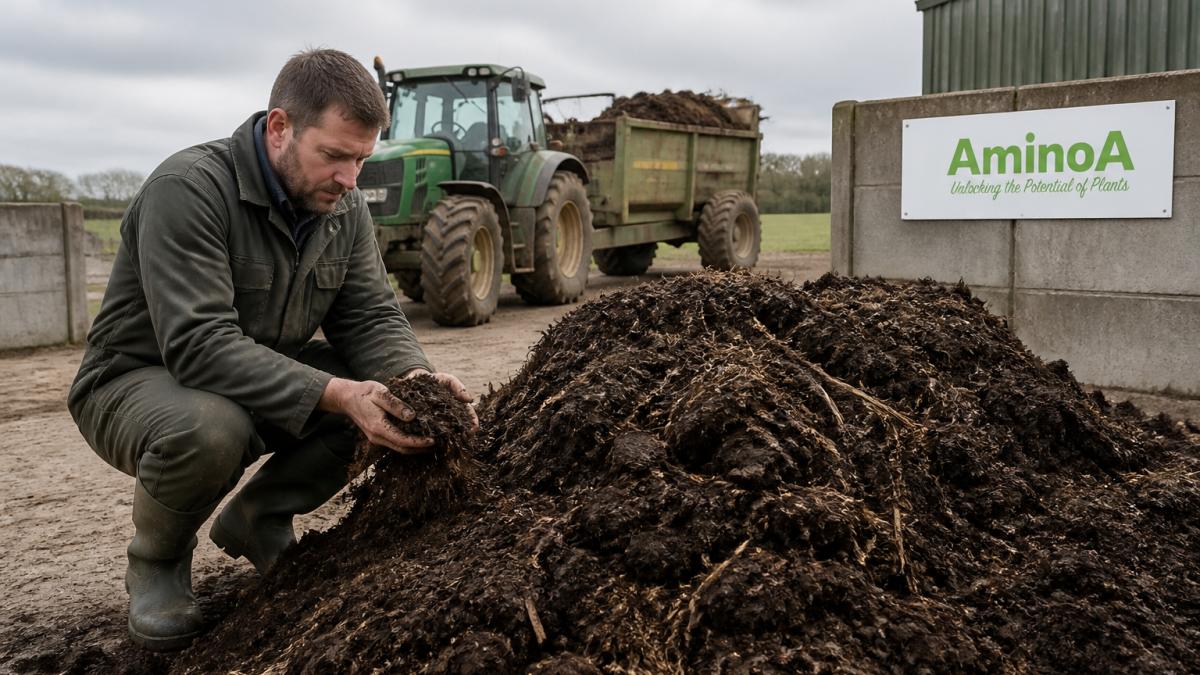
Compost and manure differ less in nutrient content than in logistics. Compost is more stable and easier to store; manure is often cheaper at the gate but heavier to handle and more variable in quality.
Nutrient Density and Application Rates
Manure typically carries lower available nutrient density per tonne than well-made compost, so it needs higher application rates to deliver the same plant-available nutrition. That raises haulage and spreading costs per hectare.
Compost costs more per tonne in most markets but goes on at lower rates and holds its structure longer. Over a rotation, the gap narrows considerably.
Handling, Storage and Spreading Costs
| Factor | Compost | Manure |
|---|---|---|
| Storage needs | Covered, stable | Covered, faster nutrient loss |
| Application rate | Lower per hectare | Higher per hectare |
| Spreading cost | Fewer passes | More passes |
| Nutrient consistency | More predictable | Variable by batch |
| Best for | Building soil structure | Bulk organic matter quickly |
The honest verdict: manure wins on gate price, compost wins on predictability. Neither resolves a nitrogen shortfall in the growing crop, which is where a foliar amino acid fits.
Where Amino Acid Biostimulants Sit in the Amendment Portfolio
Amino acid biostimulants are not a replacement for bulk organic matter. They are a precision tool applied at low rates to support the crop when it is under stress or working hard.
AminoA manufactures 100% L-α amino acid biostimulants through enzymatic hydrolysis, with a high content of nitrogen, potassium, iron and magnesium. Because every essential amino acid is supplied in the L form, the plant can take them up directly rather than converting them first.
That matters for the cost benefit analysis of organic soil amendments because it changes the application economics. These products go on at litres per hectare, not tonnes, so machinery passes and storage costs are minimal.
Velcourt trials found that adding AminoA FLO to reduced fungicide rates maintained yields and improved green leaf area in winter wheat. For growers weighing up where to spend the next pound, that is the kind of result worth modelling in your own figures.
Building a Soil Amendment Cost Benefit Analysis Template
A soil amendment cost benefit analysis template does not need to be complicated. It needs four columns: total cost, expected yield effect, timeframe, and confidence level.
Here is a working structure you can copy into a spreadsheet.
- Total cost per hectare: product, delivery, storage, application labour, machinery
- Expected yield effect: percentage or tonnes, based on your own trial strips or published trial data
- Timeframe to effect: same season, next season, or multi-year soil building
- Confidence level: high, medium or low, based on how close the trial conditions match your farm
- Risk adjustment: what happens to the return if the season turns wet, dry or cold
- Compliance cost: certification paperwork and testing time
Run each candidate amendment through all six rows. The material with the best risk-adjusted return over your rotation is the one to buy, not the one with the lowest price per tonne.
Long-Term Benefits of Organic Soil Amendments Beyond the First Harvest
The long-term benefits of organic soil amendments show up in the second, third and fourth seasons, not the first. Organic matter builds soil structure, improves water-holding capacity and supports the microbial activity that releases nutrients slowly.
Those gains are real but hard to price in year one. A fair analysis spreads the cost of a bulk amendment across the rotation rather than charging it all to the crop it was spread before.
Biostimulants work differently. Their return is measured in the season applied, through better root development, stronger stress resistance and improved fruit set. That makes them easier to justify on a single-year budget, which matters when cash flow is tight.
UK soil health and organic matter guidance explains how soil organic matter supports long-term productivity, and it is a useful reference when building the multi-year side of your model.
Common Mistakes When Comparing Amendment Costs
Five errors come up again and again when growers run the numbers.
- Comparing price per tonne instead of cost per hectare. Bulk products look cheap until haulage and spreading are added.
- Ignoring application passes. Every extra machinery pass carries fuel, labour and soil compaction costs.
- Assuming nutrients are immediately available. Much of what bulk amendments supply is released over months, not weeks.
- Leaving out compliance time. Organic certification record-keeping is a real cost, even when it is not invoiced.
- Testing on too small a strip. Small plots rarely reflect field-scale variability, so results mislead.
The fix for all five is the same: build the full cost picture first, then judge.
Conclusion: Running the Numbers That Matter
Getting the economics right on soil amendments is genuinely difficult, because the costs and the returns arrive on different schedules. That is exactly why a structured cost benefit analysis of organic soil amendments pays for itself before you buy anything.
If you want a low-rate input that shows its return in the season you apply it, our L-α amino acid biostimulants are built for that job. They support root and leaf development, improve resistance to cold, heat and drought, and fit easily into an existing spray programme.
Subscribe to our newsletter for trial results and practical guidance on getting more from every hectare.
Frequently Asked Questions
How do you calculate the cost benefit of an organic soil amendment?
Start with the full cost per hectare: product, haulage, storage and spreading. Then estimate the value of what it replaces or adds, such as reduced fertiliser rates, yield uplift or improved crop quality. Divide the net gain by the total cost to get a return figure. Run it over at least three seasons, because organic soil amendments build soil organic matter slowly and the first year rarely tells the full story.
Are organic soil amendments cost-effective for commercial farms?
It depends on the amendment and the system. Bulky materials such as compost and manure are cheap per tonne but expensive to transport and spread, so their value falls sharply as distance from the source increases. Concentrated products such as amino acid biostimulants cost more per litre but are applied at low rates, which changes the economics. Velcourt trials found that adding AminoA FLO to reduced fungicide rates maintained yields and improved green leaf area in winter wheat.
What costs should be included when comparing soil amendments?
Include the purchase price, delivery, storage, labour, machinery wear and the fuel used in spreading. Add any analysis or certification fees. Then subtract what the amendment saves, such as lower bagged fertiliser or reduced passes over the field. A soil amendment cost benefit analysis template that ignores haulage and spreading will almost always favour bulky materials, even when the delivered cost per hectare is higher than expected.
Are organic soil amendments more economical than synthetic fertilisers over time?
Synthetic fertilisers give a predictable, immediate nutrient hit, which is easy to cost. Organic amendments work more slowly but can reduce the amount of synthetic input needed over several seasons by improving soil structure, water retention and biological activity. The long-term benefits of organic soil amendments show up as fewer drought-stressed crops and steadier yields. Whether that outweighs the higher upfront cost depends on your soil type, rotation and how long you plan to farm the land.