 ultimate-guide
Benefits of Amino Acid Biostimulants for Crop Yield
Table of Contents
- How Amino Acid Biostimulants Improve Crop Yield
- Foliar Application of Amino Acids: Getting Timing Right
- Abiotic Stress Resistance in Crops: What Amino Acids Actually Do
- Improving Nutrient Use Efficiency in Agriculture
- Crop-Specific Yield Responses: What to Expect
- Limitations, Costs, and Realistic ROI
- Frequently Asked Questions
Last Updated: September 21, 2026
How Amino Acid Biostimulants Improve Crop Yield
Amino acid biostimulants are natural compounds that supply plants with the building blocks needed for protein synthesis, hormone production and stress defence. In practice, these products work best when they deliver amino acids in the L-alpha form, the only configuration plants can metabolise directly. At AminoA, ten years of manufacturing experience has centred on exactly this distinction.
The benefits of amino acid biostimulants for crop yield come down to one thing: giving the plant usable nitrogen and carbon skeletons at the precise moment it needs them. Unlike conventional fertilisers that must be converted before uptake, L-alpha amino acids are absorbed and metabolised immediately.
That speed matters most during rapid growth phases, transplanting, or when cold, heat or drought slows a crop's own metabolism. The plant gets a direct energy source instead of waiting for soil processes to catch up.
The L-alpha difference: why form matters
Amino acids exist in two mirror-image forms: L and D. Only the L form occurs naturally in plant metabolism. Many cheaper products contain a mix, or rely on D forms that plants cannot use efficiently.
AminoA manufactures 100% L-alpha amino acids through enzymatic hydrolysis, a process that preserves the natural configuration rather than degrading it with harsh chemicals. This means every gram delivers usable nutrition. A product with 50% D-isomers effectively delivers half the active content, regardless of what the label claims.
From root to grain: what changes in the plant
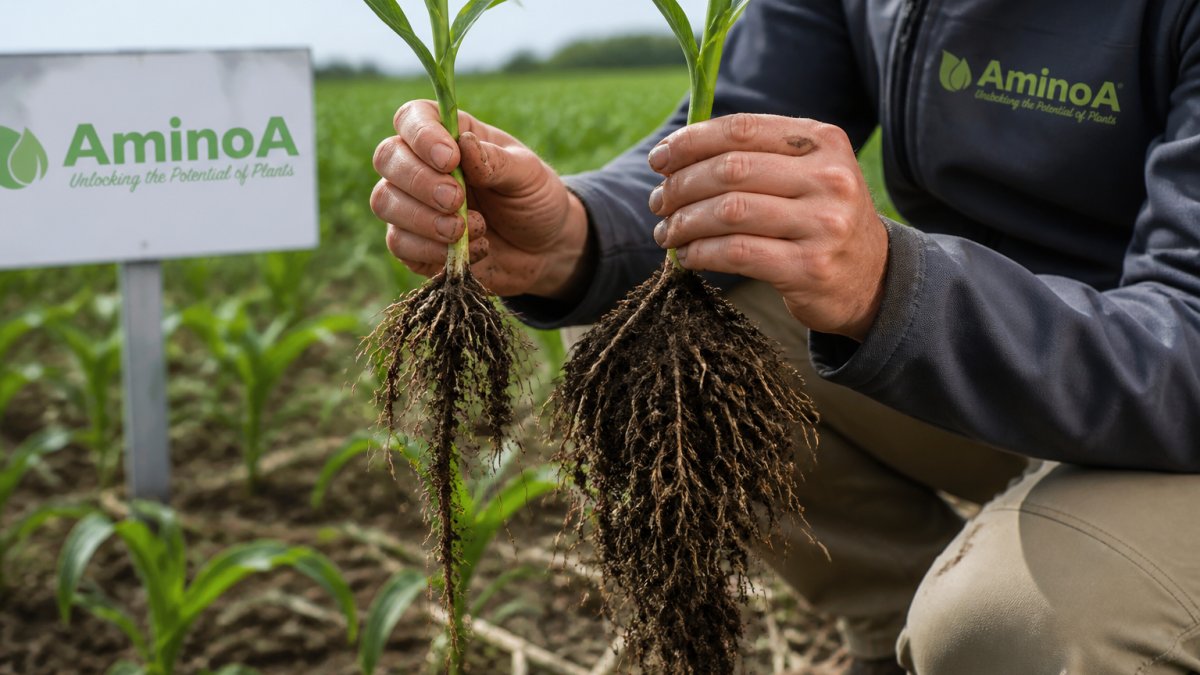
When a plant takes up L-alpha amino acids, several processes accelerate at once. Root hairs extend faster, improving access to water and nutrients. Chlorophyll production increases, supporting photosynthesis through the grain-fill period. Blossom retention improves in fruiting crops, which translates directly into marketable yield.
The effect compounds. Healthier roots support stronger vegetative growth, which supports better flowering and grain set. That is why timing matters as much as the product itself.
Foliar Application of Amino Acids: Getting Timing Right
Foliar application of amino acids delivers the product directly to leaf tissue, bypassing soil variability entirely. The best results come from applying at specific growth stages rather than on a fixed calendar. The table below summarises the key windows.
| Crop | Best Application Window | Typical Frequency |
|---|---|---|
| Winter wheat | Early stem extension, flag leaf | 2-3 sprays |
| Winter barley | Tillering, stem extension | 2 sprays |
| Oilseed rape | Green bud, early flowering | 2 sprays |
| Strawberries | First flower, fruit swell | 3-4 sprays |
| Tomatoes | Transplant, flowering, fruit set | 3-4 sprays |

Best growth stages for wheat, oilseed rape, and horticultural crops
For wheat and barley, the highest-return applications land at early stem extension and flag leaf emergence. These are the stages when the plant's nitrogen demand peaks and its own amino acid production struggles to keep pace.
Oilseed rape responds well to sprays at green bud and early flowering, where improved blossom retention supports pod set. Horticultural crops are more forgiving on timing but reward frequency: strawberries and tomatoes benefit from applications at transplant, flowering and fruit swell.
Tank-mix compatibility and avoiding phytotoxicity
A common mistake is mixing amino acid biostimulants with incompatible agrochemicals and applying in high heat. The result is leaf burn that costs more yield than the spray adds.
Always jar-test new tank mixes before committing to a full sprayer load. Apply in cooler parts of the day, avoid spraying when temperatures exceed 25°C, and check product labels for pH restrictions. AminoA formulations are designed for tank-mix flexibility, but no biostimulant is universally compatible.
Abiotic Stress Resistance in Crops: What Amino Acids Actually Do
Abiotic stress resistance in crops improves when plants have a ready supply of amino acids to build protective compounds. Proline, for example, acts as an osmolyte that helps cells retain water under drought (pubmed.ncbi.nlm.nih.gov). Other amino acids support the antioxidant systems that protect tissue from heat and cold damage.
The mechanism is straightforward: stressed plants redirect energy away from growth and into survival. If amino acids are already available, the plant spends less energy manufacturing them and more on maintaining yield potential.
Frost events, heatwaves and drought all trigger the same response. Crops with adequate amino acid reserves recover faster and lose less yield. This is why applications timed ahead of forecast stress events outperform reactive sprays.
Improving Nutrient Use Efficiency in Agriculture
Improving nutrient use efficiency in agriculture starts with recognising that applied nitrogen is often wasted. Leaching, volatilisation and soil lock-up mean a significant share of conventional fertiliser never reaches the crop.
Amino acid biostimulants improve efficiency in two ways. First, they chelate micronutrients like iron, magnesium and potassium, keeping them available for uptake. Second, they support root development, so the plant explores more soil and intercepts more of what is already there.
For growers looking to reduce reliance on synthetic inputs, this is where the practical case sits. Trials conducted by Velcourt found that adding AminoA FLO to reduced fungicide rates maintained yields and improved green leaf area in winter wheat. That is a genuine reduction in chemical load without a yield penalty.
Crop-Specific Yield Responses: What to Expect
Yield responses vary by crop, season and baseline nutrition. The realistic framing is that amino acid biostimulants improve consistency rather than delivering dramatic one-off gains.
Cereals: wheat and barley
In wheat and barley, the most reliable responses show up in grain fill and green leaf area retention. Crops under stress see the largest gains. In a good season with adequate nutrition, expect smaller but still measurable improvements.
Horticultural and high-value crops
High-value crops respond more visibly. Strawberries show improved fruit set and uniformity. Tomatoes benefit from better fruit sizing and reduced blossom-end issues. For growers selling on quality, the premium captured often outweighs the input cost.
Limitations, Costs, and Realistic ROI
Amino acid biostimulants are not a replacement for balanced nutrition. They amplify what is already working. If soil pH is wrong or base fertility is poor, no biostimulant fixes that.
Cost per hectare sits above pushing extra NPK, and the ROI depends on crop value and stress pressure. Organic growers should confirm certification status before purchase; Organic growers should confirm certification status before purchase; always verify against your certifier's specific requirements.
Frequently Asked Questions
How do amino acid biostimulants improve crop yield?
They supply L-alpha amino acids that plants can use directly for protein synthesis, enzyme production and hormone precursors. This supports root development, chlorophyll formation and nutrient uptake, so the crop grows more efficiently. Many amino acids also act as chelators, helping micronutrients like iron and zinc move into the plant. The result is better establishment, stronger stress tolerance and more consistent yield, especially where abiotic stress would otherwise limit performance.
Can amino acid biostimulants help crops recover from abiotic stress?
Yes. Abiotic stress resistance in crops is one of the main reasons growers use them. Amino acids such as proline and glycine betaine act as osmoprotectants, helping cells retain water during drought or heat. They also support the plant's antioxidant systems, which reduce damage from cold, salinity and agrochemical phytotoxicity. Applying them before a forecast stress event, or soon after, gives the crop the building blocks it needs to recover faster and keep filling grain or fruit.
What is the best timing for foliar application of amino acid biostimulants?
Timing depends on the crop. For winter wheat, early stem extension and flag leaf emergence are key windows. Oilseed rape benefits from application at green bud and early flowering. Horticultural crops respond well at transplant establishment, fruit set and during fruit sizing. Foliar application of amino acids works best when the canopy is actively growing and temperatures are between 10°C and 25°C, ideally early morning or late evening to avoid leaf scorch and improve uptake.
How do amino acids differ from traditional synthetic fertilisers?
Synthetic fertilisers deliver mineral nutrients like nitrogen, phosphorus and potassium in salt form. Amino acid biostimulants deliver organic nitrogen already bound in L-alpha amino acids, which plants can take up and use with less energy. They also stimulate root growth and microbial activity, improving nutrient use efficiency in agriculture. The two are not mutually exclusive: many growers use biostimulants alongside reduced fertiliser rates to maintain yield while lowering total inputs.
Yield is decided by dozens of small decisions, and stress timing is one of the most controllable. AminoA manufactures 100% L-alpha amino acid biostimulants through enzymatic hydrolysis, with every essential amino acid in the form plants actually use. Our formulations support root development, improve stress resistance and help maintain green leaf area through grain fill. Subscribe to the AminoA newsletter for trial updates and application guidance tailored to your rotation.