 blog
blog
Best Organic Soil Conditioners for Industrial Agriculture
Table of Contents
- Why Organic Soil Conditioners Matter for Industrial Agriculture
- Quick Comparison: Organic Soil Conditioners for Commercial Farms
- Soil Testing for Commercial Farms: What to Measure Before You Buy
- Compost for Agricultural Soil Improvement: Bulk Options and Limitations
- Soil Amendment Application Rates: Getting the Dose Right at Scale
- Organic Fertiliser Costs and Farm Economics: Calculating Real ROI
- Amino Acid Biostimulants: A Targeted Organic Soil Conditioner
- Frequently Asked Questions
Last Updated: 6 October 2026
Why Organic Soil Conditioners Matter for Industrial Agriculture
At AminoA, we have spent a decade watching growers across the country wrestle with the same problem: how to keep heavy arable land productive without pushing synthetic inputs to the point where soil biology collapses. Organic soil conditioners are materials applied to soil to improve its physical, chemical or biological condition, and they sit at the centre of that balancing act. For industrial agriculture, they are less a nice-to-have and more a long-term risk management tool.
The pressure is real. Continuous cereal cropping, heavy machinery traffic and high nitrogen use all degrade soil structure over time. Many agronomists now report that organic matter levels on intensively farmed land are drifting downwards, which reduces water-holding capacity and makes crops more vulnerable to drought and heat stress. That is why the best organic soil conditioners for industrial agriculture are judged on measurable soil outcomes, not marketing claims.
This guide from AminoA breaks down what to test before you buy, how bulk compost and biostimulants differ, how to get application rates right at scale, and how to calculate whether any of it actually pays.
Quick Comparison: Organic Soil Conditioners for Commercial Farms
Choosing between conditioner types comes down to what your soil is actually short of. Bulk organic matter fixes structure and biology slowly. Targeted biostimulants fix specific stress or nutrient-uptake problems quickly. Most commercial farms end up using both, at different points in the rotation.
| Conditioner Type | Primary Job | Typical Timing | Main Limitation |
|---|---|---|---|
| Bulk compost | Build organic matter, structure | Autumn, pre-drilling | High volume, haulage cost |
| Green waste compost | Cheap organic matter source | Autumn | Variable quality, contamination risk |
| Amino acid biostimulants | Root growth, stress recovery | Foliar or soil, in-season | Does not replace base nutrition |
| Seaweed and humic products | Soil biology support | Spring, in-season | Inconsistent field response |
The table is a starting point, not a prescription. Soil testing should decide which row applies to you.
Soil Testing for Commercial Farms: What to Measure Before You Buy
Soil testing for commercial farms is the step that separates a sound purchase from an expensive guess. Before spending on any conditioner, establish a baseline for organic matter, pH, and the key macro and micronutrients. Without that baseline you have no way of knowing whether a product worked or whether the season simply flattered you.
Key Metrics That Determine Conditioner Choice
- Organic matter percentage: below roughly two percent on arable land usually points to a structural problem that bulk compost addresses better than a foliar product.
- pH and lime requirement: correcting acidity often does more for yield than any conditioner.
- Phosphorus, potassium and magnesium indices: these tell you whether you need bulk nutrition or a targeted supplement.
- Soil structure and compaction layers: a spade and a penetrometer still beat a lab report here.
A common mistake is testing only the topsoil. On land that has been min-tilled for years, compaction at depth limits rooting, and no surface-applied conditioner will fix that on its own. Sample by management zone rather than by field, and keep the same lab and method year on year so the numbers stay comparable.
Compost for Agricultural Soil Improvement: Bulk Options and Limitations
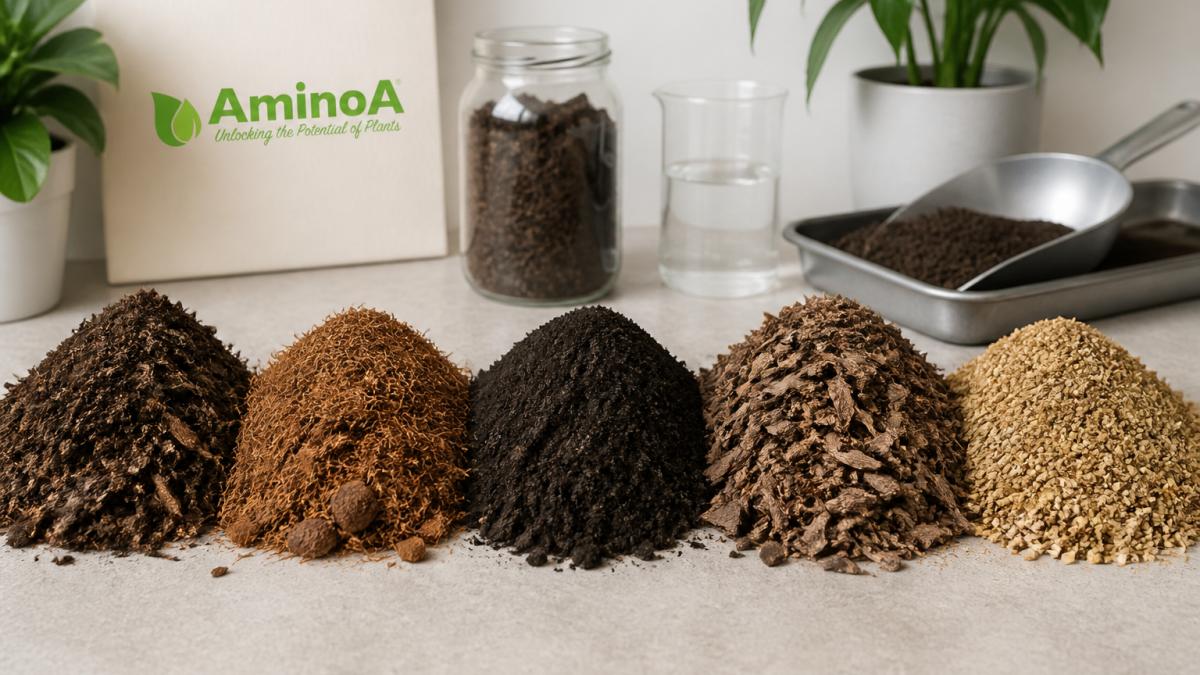
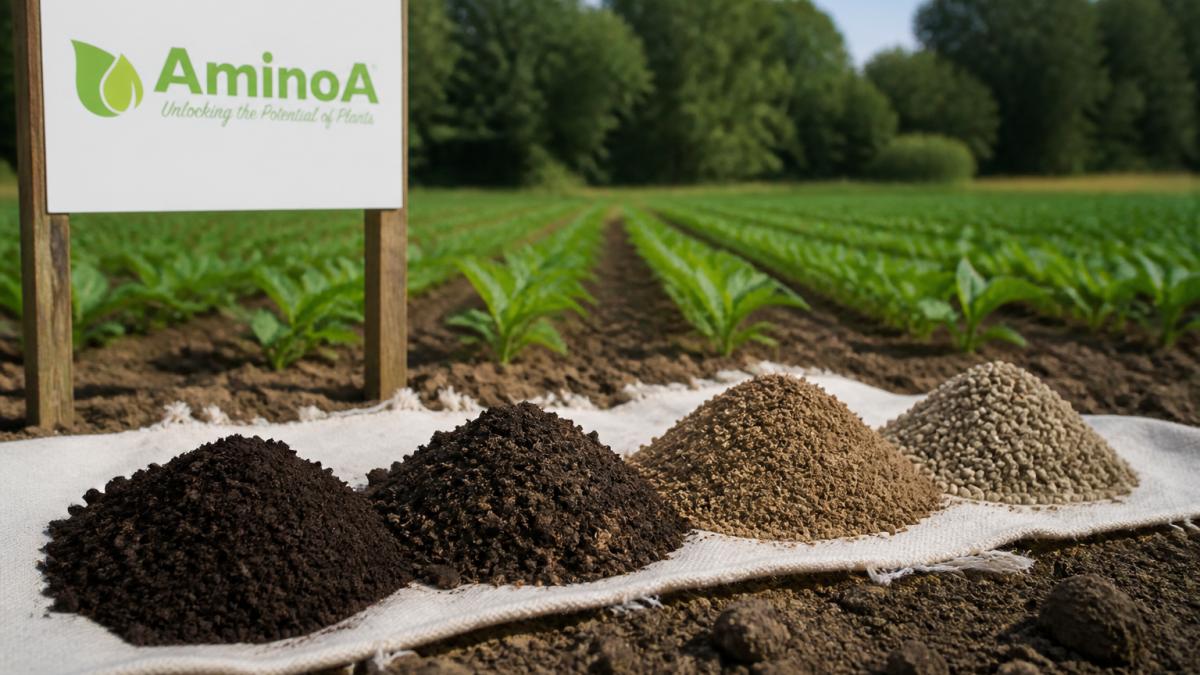
Compost for agricultural soil improvement does one job extremely well: it adds stable organic matter in volume. That improves water infiltration, aggregation and microbial activity, which is exactly what degraded arable land needs. The catch is logistics. Transporting such bulk material across vast acreages often necessitates a strategic approach to site preparation, where modern land clearing techniques ensure that the soil structure remains intact for subsequent amendment.
At commercial scale, compost means hundreds of tonnes per field, not a few bags. Green waste compost is the most widely available bulk source, but quality varies enormously between suppliers. Contamination with plastics and traces of herbicides that survive composting remain genuine concerns, so always ask for the supplier's analysis and PAS 100 certification. PAS 100 is the British standard for composted materials, and it is the minimum you should accept.
The second limitation is nutrient balance. Compost is not a substitute for a fertiliser programme. It releases nitrogen slowly and unpredictably, so you still need to account for the crop's nitrogen requirement separately. Where compost wins is on fields you intend to keep in arable production for the next decade, not on a single-season fix.
Soil Amendment Application Rates: Getting the Dose Right at Scale
Soil amendment application rates are where most plans fall apart. The correct rate depends on your soil test result, the product's analysis, and the crop's requirement, so there is no universal figure. What matters is the method.
Work from the soil test, not from a bag. If a lab recommends raising organic matter, translate that into tonnes of dry matter per hectare and check whether your spreader can apply it evenly at that rate. Uneven application creates yield variation that persists for years.
For liquid biostimulants, the calculation is different. Rates are set per hectare and per application timing, and they are far smaller than bulk compost volumes. The risk here is not over-application but mistiming: applying a stress-response product after the stress has already done its damage wastes the spend.
- Confirm the soil test result that justifies the application
- Check the product analysis against your crop's requirement
- Verify spreader or sprayer calibration before the first pass
- Record the rate, date and field so you can compare next season
- Leave an untreated strip as a comparison
That last point matters more than most growers admit. Without an untreated strip, you cannot tell whether a conditioner earned its place in the rotation.
Organic Fertiliser Costs and Farm Economics: Calculating Real ROI
Organic fertiliser costs and farm economics come down to one question: does the spend return more than it costs over the rotation, not just the season? Bulk compost carries a low material cost but a high haulage and spreading cost. Biostimulants carry a higher cost per hectare but a much lower application cost.
To judge either, build a simple calculation:
- Total cost = material + haulage + spreading or spraying + your time
- Expected benefit = yield uplift or input saving, valued at your contract price
- Payback period = how many seasons before the benefit exceeds the cost
A conditioner that costs more per hectare but lets you maintain yield with a reduced fungicide programme can pay back faster than a cheap bulk product that needs three seasons to show any effect. This is where trial data matters. Velcourt trials found that adding AminoA FLO to reduced fungicide rates maintained yields and improved green leaf area in winter wheat, which is exactly the kind of input-saving evidence worth building a calculation around.
Where we would push back on common practice: treating biostimulants as a direct substitute for base nutrition. They are not. They support root development, stress resistance and nutrient uptake. The base fertiliser programme still has to be right.
Amino Acid Biostimulants: A Targeted Organic Soil Conditioner
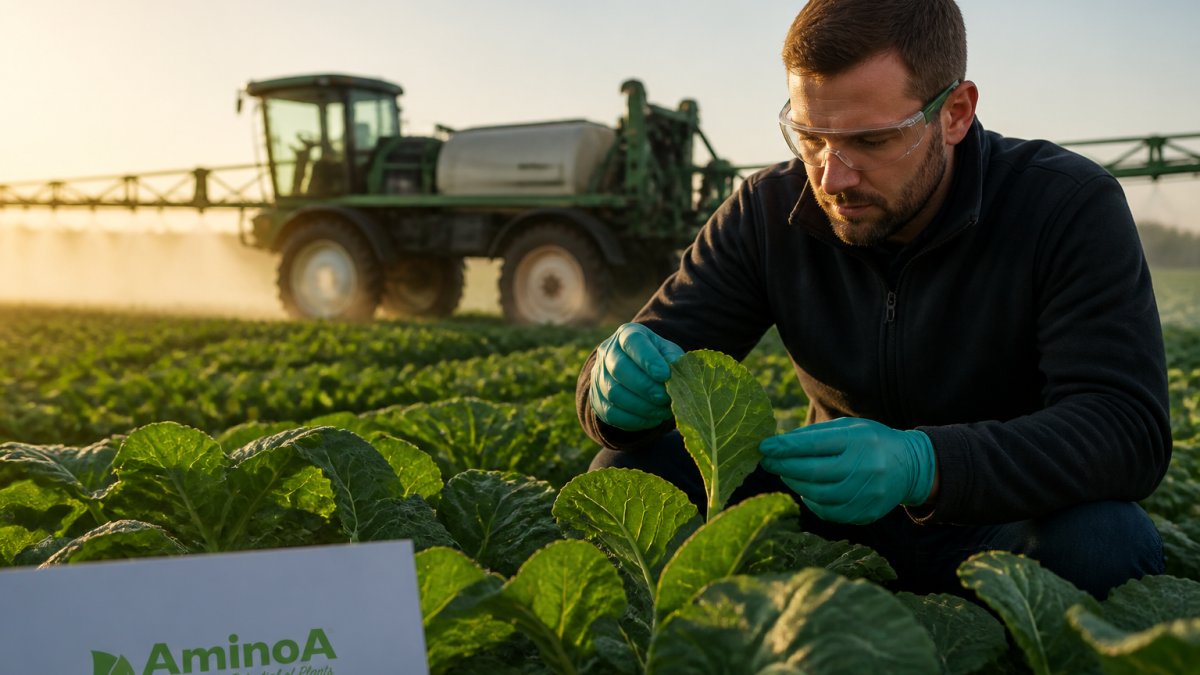
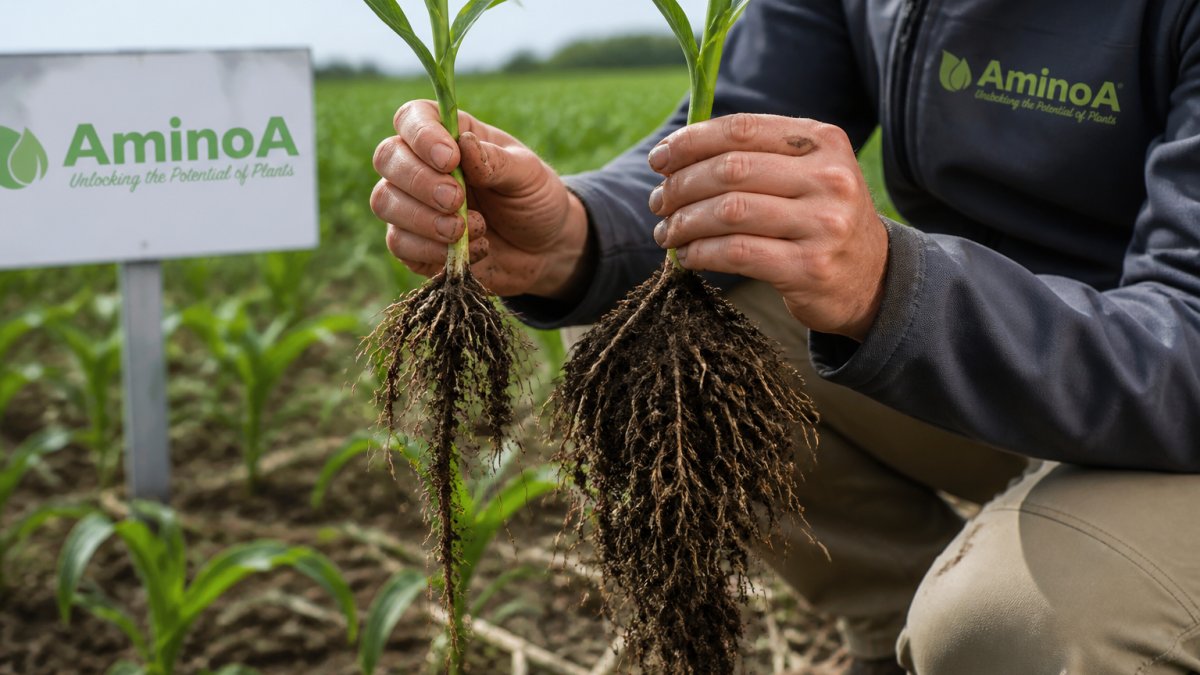
Amino acid biostimulants are a targeted organic soil conditioner that supports root development, stress resistance and nutrient uptake rather than adding bulk organic matter. They work differently from compost: instead of rebuilding soil structure over years, they give the plant readily available building blocks at the point it needs them most.
AminoA manufactures 100% L-α amino acid biostimulants through enzymatic hydrolysis, with a high content of nitrogen, potassium, iron and magnesium. Every essential amino acid is supplied in the L form, which is the form plants can actually use. In practice, that means the product supports root, leaf and bud development, helps stimulate blossom and fruit formation, and improves resistance to cold, heat and drought stress.
For organic-certified holdings, the certification question is the first one to settle. Ask your certifier to confirm the product against your scheme before you commit, and keep the documentation on file.
Where amino acid products fit best is on high-value crops and on land under stress, whether that is drought, heat or the after-effects of a herbicide or fungicide application. They are not a replacement for compost on structurally poor ground, and they are not a replacement for lime on acidic ground. Used in the right place, they are the most targeted tool in the box.
Soil degradation is a slow problem that punishes growers who wait for a bad season to act. AminoA supplies 100% L-α amino acid biostimulants made by enzymatic hydrolysis, with a high content of nitrogen, potassium, iron and magnesium, to support root development, stress resistance and yield in commercial arable systems. We have worked in this market for ten years, and we are happy to talk through how our products fit your rotation and soil test results. Get started with AminoA and build a nutrition programme that holds up in a difficult season.
Frequently Asked Questions
What are the best organic soil conditioners for commercial farms?
The best choice depends on your soil test results and crop system. Compost and green manures suit broad structural improvement, while amino acid biostimulants like AminoA target specific growth stages and stress resistance. For industrial-scale arable farms, combining bulk organic matter with a concentrated biostimulant often delivers the most consistent return. Always start with soil testing to identify whether you need organic matter, microbial support, or a targeted nutrient boost before committing to a product.
Can organic soil conditioners reduce reliance on synthetic fertilisers?
They can reduce it, but not eliminate it overnight. Velcourt trials found that adding AminoA FLO to reduced fungicide rates maintained yields and improved green leaf area in winter wheat. That suggests biostimulants can support a gradual reduction in agrochemical inputs when integrated into an existing programme. The realistic approach is to cut back in stages, monitor crop performance each season, and adjust based on soil test data and visual assessments rather than removing synthetic inputs all at once.
What soil tests should be carried out before applying an organic conditioner?
At minimum, test for organic matter content, pH, available phosphorus and potassium, and soil structure. For industrial agriculture, also assess microbial biomass and cation exchange capacity. These results tell you whether your soil needs bulk organic matter, a specific nutrient correction, or a biostimulant to improve root development and stress tolerance. Repeat testing every two to three years to track changes and justify the investment to yourself and any advisers.
How do you assess the cost-effectiveness of soil amendments?
Compare the total cost per hectare against measurable changes in yield, crop quality, and input savings over at least one full rotation. Organic fertiliser costs and farm economics vary widely by product type and application rate. Factor in reduced fungicide or fertiliser spend where trials support it, and track green leaf area, root depth, and stress recovery as leading indicators before harvest data confirms the financial picture.