 Ultimate guide
Benefits of Seaweed Extract for Soil Health on Farm
Last Updated: November 18, 2026
Quick Summary
Seaweed extract benefits soil health mainly by feeding the biology that builds structure and cycles nutrients, thanks to bioactive compounds and trace elements rather than bulk nitrogen, phosphorus or potassium. It improves soil structure indirectly by encouraging aggregation and root growth, so changes are slow and cumulative rather than visible in a single season.
- Extract is made by alkaline hydrolysis, water extraction or cell-burst processing, often from brown algae such as Ascophyllum nodosum.
- Polysaccharides and alginates in the extract act as binding agents that help soil particles form aggregates.
- Track soil organic matter, infiltration rate, water-holding capacity, aggregate stability and microbial activity before you start.
- Apply as a soil drench to moist soil, ideally early morning or evening, and jar-test any tank mix first.
- Ask for the species, extraction method and a certificate of analysis before buying any product.
Table of Contents
- What Seaweed Extract Does for Soil Health
- Seaweed Extract and Soil Microbes: Feeding the Biology Below Ground
- Soil Structure, Water Retention and Root Development
- How to Use Seaweed Extract: Application Methods Step by Step
- Seaweed Extract Application Rate by Crop and Soil
- Seaweed Extract vs Fertiliser: What Each One Actually Does
- Evidence, Limitations and Responsible Sourcing
- Choosing a Biostimulant Programme for Your Farm
- Frequently Asked Questions
What Seaweed Extract Does for Soil Health
Seaweed extract is a liquid or soluble biostimulant made from marine algae, and its main contribution to soil health is feeding the biology that builds structure and cycles nutrients. The benefits of using seaweed extract for soil health come mostly from bioactive compounds and trace elements rather than bulk nitrogen, phosphorus or potassium. Below, we cover how seaweed extract works, how to apply it, and where the evidence stops.
How Seaweed Extract Is Made and What It Contains
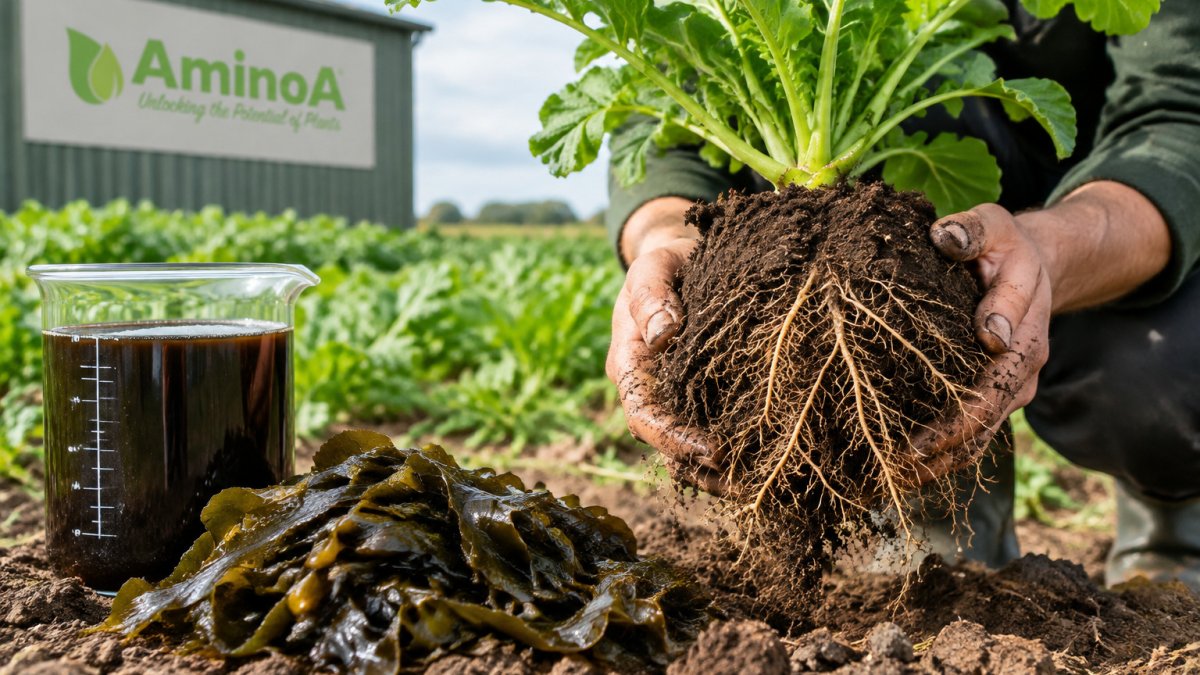
Commercial seaweed extract is produced by several methods, including alkaline hydrolysis, water extraction, or cell-burst processing, typically from brown algae such as Ascophyllum nodosum. The extraction method matters, because harsh processing can degrade the bioactive compounds that make the product useful.
What ends up in the bottle varies by species and process, but typically includes:
- Bioactive compounds such as polysaccharides, betaines and plant hormones
- Trace elements and micronutrients, including iron and magnesium
- Potassium in meaningful quantities, with modest nitrogen
- Alginates, which help bind soil particles
The distinction between seaweed extract and seaweed meal is worth knowing. Meal is dried, milled seaweed applied as a bulky soil improver; extract is concentrated and applied diluted. They are not interchangeable, and neither is a substitute for a balanced fertiliser programme.
Seaweed Extract and Soil Microbes: Feeding the Biology Below Ground
Seaweed extract supports soil biology by supplying carbon-rich polysaccharides and trace elements that soil bacteria and fungi can use. A World Bank document on seaweed biostimulants in agriculture notes that biostimulants may support soil health by engaging soil microbial communities. That is a reasonable description of the mechanism: you are feeding the organisms that mineralise nutrients and build aggregates.
What most guides miss is that this is a slow, cumulative effect, not a switch you flip. Microbial activity responds to repeated applications and to the food sources already in the soil. If you want practical ways to build diversity alongside extract applications, see our guide on how to improve soil microbial diversity.

Soil Structure, Water Retention and Root Development
Seaweed extract improves soil structure indirectly, by encouraging aggregation and root growth rather than by physically changing the soil. The mechanism is worth understanding because it explains why results are slow and cumulative. Polysaccharides and alginates in the extract act as binding agents, helping soil particles stick together into aggregates. Well-aggregated soil has more pore space, which improves aeration, drainage and root penetration.
The soil-porosity and aeration benefits follow the same logic. Aggregated soil holds more air and drains better, and it resists capping. If you want the deeper evidence on whether seaweed extract genuinely earns its place for root development, our breakdown of seaweed extract for root development covers what trials actually show.
What most guides miss is how to tell whether the soil is actually changing. Rather than relying on impressions, measure a small set of practical indicators before you start and at the end of each season. Soil organic matter is the slowest-moving but most meaningful indicator of structural improvement. Infiltration rate, measured with a simple ring infiltrometer, shows whether water is entering the soil rather than running off.
Structural benefits are more likely where repeated applications over several seasons are combined with attention to compaction, organic matter and drainage. Seaweed extract is not a substitute for those fundamentals. On a compacted headland or a poorly drained field, no biostimulant will fix the problem. Use extract as one input in a soil-health programme, and use the indicators above to check whether it is earning its place.
How to Use Seaweed Extract: Application Methods Step by Step
Seaweed extract can be applied as a soil drench, a foliar spray, or through fertigation, and the method should match the outcome you want. Soil drench targets soil biology and root development; foliar application targets plant stress responses and nutrient uptake.
Liquid extracts are the most common form. They are concentrated and diluted before use, which makes them easy to mix and apply through standard sprayers and fertigation systems. Quality varies widely, and production methods differ between manufacturers. Harsh processing can degrade bioactive compounds, so ask the supplier how the extract was made.
Powders are dried extracts, often spray-dried or freeze-dried. They are more concentrated by weight, which reduces storage and transport costs, and they have a longer shelf life if kept dry.
Seaweed meal is dried, milled seaweed applied as a bulky soil improver. It is not an extract: it releases nutrients slowly as it breaks down, adds organic matter, and conditions soil physically.
Whichever form you choose, the label concentration is the starting point, not a suggestion. Products vary widely, and a rate written for one product is wrong for another. Mix with clean water at the stated dilution, stirring rather than agitating violently.
Watch out: the most common cause of phytotoxicity in biostimulant programmes is a tank mix that was never jar-tested. Mix a small sample of your intended combination in a clear jar, leave it for an hour, and check for separation, sludge or heat.
A final point on quality: ask for the species, the extraction method and a certificate of analysis before you buy. If a supplier cannot tell you how the product was made, that tells you something.
Seaweed Extract Application Rate by Crop and Soil
There is no single application rate for seaweed extract, because the correct rate depends on product concentration, crop, soil type and whether you are applying to soil or leaf. A light, sandy soil with low organic matter typically needs more frequent, smaller applications than a heavy clay. High-value horticultural crops justify a more intensive programme than extensive cereals.
| Situation | Typical Approach | Frequency |
|---|---|---|
| Cereals, arable | Foliar at label rate, timed to stress periods | 2-3 per season |
| Horticulture, high value | Soil drench plus foliar | Every 3-4 weeks |
| Light, sandy soil | Split applications, lower rate | More frequent |
| Heavy clay | Fewer, higher-volume drenches | 2-3 per season |
| Organic systems | Certified product only | Per certification rules |
Always start at the label rate and adjust based on what you observe. For a cost-benefit view of how seaweed extract fits alongside synthetic inputs, read our comparison of biostimulants versus synthetic fertilisers.
Seaweed Extract vs Fertiliser: What Each One Actually Does
Seaweed extract and fertiliser do different jobs, and treating them as alternatives is the most common mistake we see. Fertiliser supplies macronutrients, primarily nitrogen, phosphorus and potassium, in quantities the crop needs. Seaweed extract supplies bioactive compounds and trace elements that support soil biology, root growth and stress tolerance.
The nutrient content of extract is modest. If your soil is short of nitrogen, seaweed extract alone is unlikely to correct the deficiency. What extract can do is improve nutrient availability and uptake efficiency, which is why the James Hutton Institute is exploring whether seaweed-derived supplements could improve nutrient-use efficiency and enrich soil fertility. That framing, extract as an efficiency aid rather than a replacement, is the honest one.
Evidence, Limitations and Responsible Sourcing
The evidence for seaweed extract is promising but uneven, and anyone selling you certainty is overselling. A Washington State University extension publication on seaweed extracts cautions that claims about seaweed extracts as soil conditioners, disease suppressants and stress reducers should be treated carefully, because sales literature often runs ahead of the research.
Keep these limits in mind:
- Effect sizes are often unquantified in published reviews
- Products differ enormously, so results do not transfer between brands
- Soil effects are slow and hard to isolate from other management changes
- Sourcing matters: harvest method and extraction process affect quality
Responsible sourcing means asking for the species, extraction method and a certificate of analysis. If a supplier cannot tell you how the product was made, that tells you something. If you are weighing whether a programme is worth the investment, our analysis of whether a biostimulant programme is worth the cost sets out the calculation.
Choosing a Biostimulant Programme for Your Farm
Choosing a programme comes down to matching inputs to your soil, your crops and your budget, then measuring what changes. Start with soil testing so you know what you are actually short of, then build a programme that addresses it.
- Soil test results for organic matter, pH and major nutrients
- Clear objective per field: structure, rooting, stress tolerance or yield
- Product specification: species, extraction method, analysis
- Certification status if you are organic
- A measurement plan: what you will record and when
- A trial area before whole-farm commitment
Our structured guide on how to choose the right biostimulant for soil health walks through this selection process in detail. Velcourt trials found that adding AminoA FLO to reduced fungicide rates maintained yields and improved green leaf area in winter wheat, which is the kind of measured outcome worth asking any supplier for.
The challenge is that biostimulant claims are easy to make and hard to verify, so measuring results is worthwhile. AminoA supplies 100% L-α amino acid biostimulants produced through enzymatic hydrolysis, with a high content of nitrogen, potassium, iron and magnesium, to support root development, stress resistance and crop quality. For current prices or a quote, visit the AminoA website.
Frequently Asked Questions
Is seaweed extract a fertiliser or a biostimulant?
Seaweed extract is a biostimulant, not a fertiliser in the conventional sense. It contains small amounts of nitrogen, potassium and trace elements, but the main value comes from bioactive compounds that support soil biology, root development and the plant's ability to take up nutrients already present in the soil. A 2026 review in ScienceDirect notes that seaweed extracts improve soil quality and promote plant growth, but they do not replace the bulk nutrition a crop needs. Use seaweed extract alongside your existing fertiliser programme rather than instead of it.
Can seaweed extract help beneficial soil microbes?
Evidence suggests this is one of the more credible claims. Seaweed extract and soil microbes interact in ways that support microbial activity: the organic matter and bioactive compounds in the extract feed soil bacteria and other soil organisms, and a World Bank document on seaweed biostimulants notes that biostimulants may support soil health by engaging soil microbial communities. A 2025 Frontiers in Soil Science review also reports support for soil health and plant growth. The effect builds over seasons, so treat it as a long-term soil improver rather than a quick fix.
How often should you use seaweed extract on plants?
Most programmes apply seaweed extract two to four times across the season, timed to key growth stages such as early establishment, rapid vegetative growth and grain or fruit fill. Frequent low-dose applications generally work better than one large dose. Always follow the product label for the specific concentration, since extracts vary widely in strength and dilution. If you are tank-mixing with fungicides or insecticides, check compatibility first, particularly if you have had phytotoxicity from a tank mix before.
Are there any disadvantages to using seaweed extract?
The main drawbacks are cost per hectare and inconsistent evidence. A Washington State University extension publication cautions that claims about seaweed extracts as soil conditioners, disease suppressants and stress reducers are promoted widely in sales literature but are not consistently supported by research. Product quality also varies with extraction method and source material, so buy from a manufacturer that states its composition clearly. Responsible sourcing matters too, as wild seaweed harvesting is regulated and supply can be seasonal.