 How-to
How to Manage Crop Rotation for Soil Microbiome Health
Quick Summary
Manage crop rotation for soil microbiome health by growing diverse crops in sequence, keeping living roots in the ground through cover crops, and reducing tillage. Rotation changes the balance of bacteria and fungi, which supports nutrient cycling and disease suppression. Benefits build over several seasons, so measure soil biology against a baseline each year.
- A meta-analysis found fungal richness up by 25.35% in rotated systems compared with monoculture.
- A review of 148 global studies confirms that rotation raises bacterial species richness.
- Vary root depths and families, for example cereal, then legume, then brassica.
- Sow cover crops soon after harvest so roots stay active through autumn.
- Cut cultivator passes to the minimum, since tillage damages fungal networks.
Table of Contents
- Why Crop Rotation Matters for the Soil Microbiome
- Benefits of Rhizosphere Health for Crop Yield
- Step 1: Audit Your Current Rotation and Soil Biology
- Step 2: Plan a Diverse Sequence with Living Roots
- Soil Microbiome Restoration Techniques for Rotated Fields
- Best Practices for Regenerative Crop Rotation
- Monitoring Soil Biology and Adjusting Your Rotation Plan
- Book a Trial and Plan Your Next Rotation with AminoA
- Frequently Asked Questions
Why Crop Rotation Matters for the Soil Microbiome
Crop rotation is the practice of growing different crops in the same field in sequence rather than repeating one crop year after year. The soil microbiome is the community of bacteria, fungi and other microbes living in that soil, and each crop feeds and shapes it differently.
Monoculture tends to narrow that community. A large body of work shows that rotation changes it for the better. meta-analysis of microbial network complexity in rotated crops found fungal richness up by 25.35% in rotated systems compared with monoculture.
Bacteria respond too. review of 148 global studies on soil microbiome health confirms that rotation raises bacterial species richness. The effect is real, but it is not automatic, and results depend on the rotation you choose.
Benefits of Rhizosphere Health for Crop Yield
The rhizosphere is the thin zone of soil around plant roots, where root exudates, microbes and soil particles interact. It is where most nutrient exchange happens, so a healthy rhizosphere matters directly for yield.
How rotation changes the bacterial and fungal balance
Different crop families release different root exudates, and those exudates select for different microbial communities. Cereals tend to favour bacterial-dominated communities with a higher proportion of Gram-positive bacteria, while legumes and brassicas shift the balance towards different bacterial groups and, in some cases, greater fungal abundance. A common pattern is that continuous cereal cropping simplifies the community, whereas a diverse rotation supports a broader range of both bacterial and fungal groups.
Fungal networks, particularly arbuscular mycorrhizal fungi, are especially sensitive to rotation and tillage. These fungi associate with most arable crops and extend the effective root surface area, improving access to phosphorus and water. Their hyphal networks are damaged by frequent cultivation, so a rotation that reduces tillage passes alongside diverse crops gives them a better chance to establish.
Mechanisms that link rhizosphere health to yield
- Nutrient cycling: A more diverse microbial community mineralises organic matter more reliably, releasing nitrogen and making phosphorus more available. Legumes in the rotation fix atmospheric nitrogen, which benefits the following crop.
- Disease suppressive capacity: Diverse communities compete more effectively against soil-borne pathogens. A rotation that breaks the host cycle for a disease, combined with a biologically active soil, can reduce the severity of take-all, clubroot and rhizoctonia.
- Root architecture: Different root depths and branching patterns explore different soil layers, improving water capture and reducing compaction.
- Stress tolerance: Healthier root systems and mycorrhizal associations help crops cope with drought and cold spells, though the size of the effect varies by season.
Realistic expectations and trade-offs
Rotation improves the conditions for yield, but it is not a guarantee. The gain depends on your soil type, climate, crop sequence and starting level of soil organic matter. Our guide to how humic acid supports root growth explains how it fits into this picture. A common pattern is that fields with depleted biology respond most in the first few seasons, while already healthy soils show smaller, steadier improvements. Keep expectations realistic and measure against a baseline rather than assuming a fixed yield uplift.
Watch out: a rotation that looks diverse on paper can still fail if the crops share the same pathogen or if the intervening cover crop is poorly established.
Step 1: Audit Your Current Rotation and Soil Biology
Before changing anything, record what you grow now. Write down the last five years of crops for each field, including cover crops and any fallow periods.
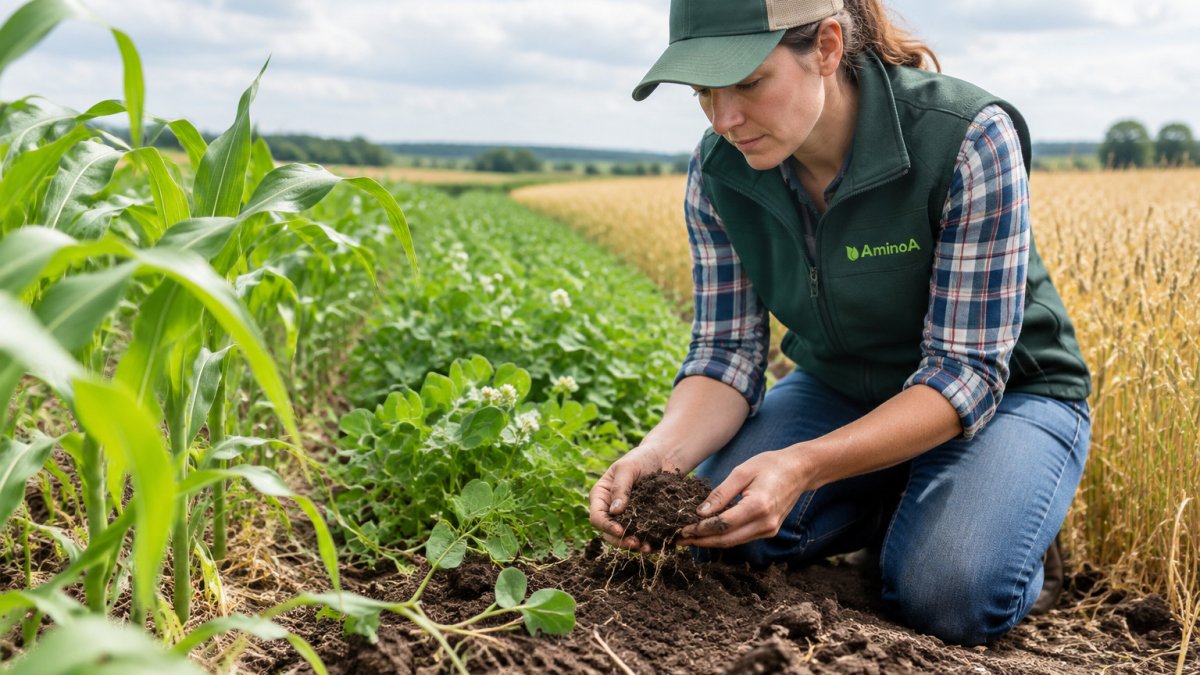
Next, look at the soil itself. Test soil organic matter, and if you can, ask a lab for microbial biomass or enzyme activity. Our guide on measuring soil microbial activity step by step walks through the methods. These numbers give you a baseline to measure against later.
- List each field and its crop history
- Note tillage practice and how often you cultivate
- Record any disease or pest problems in past crops
- Request a baseline soil biology test
Watch out: a single soil test tells you little. Repeat the audit after each season to see the trend.
Step 2: Plan a Diverse Sequence with Living Roots
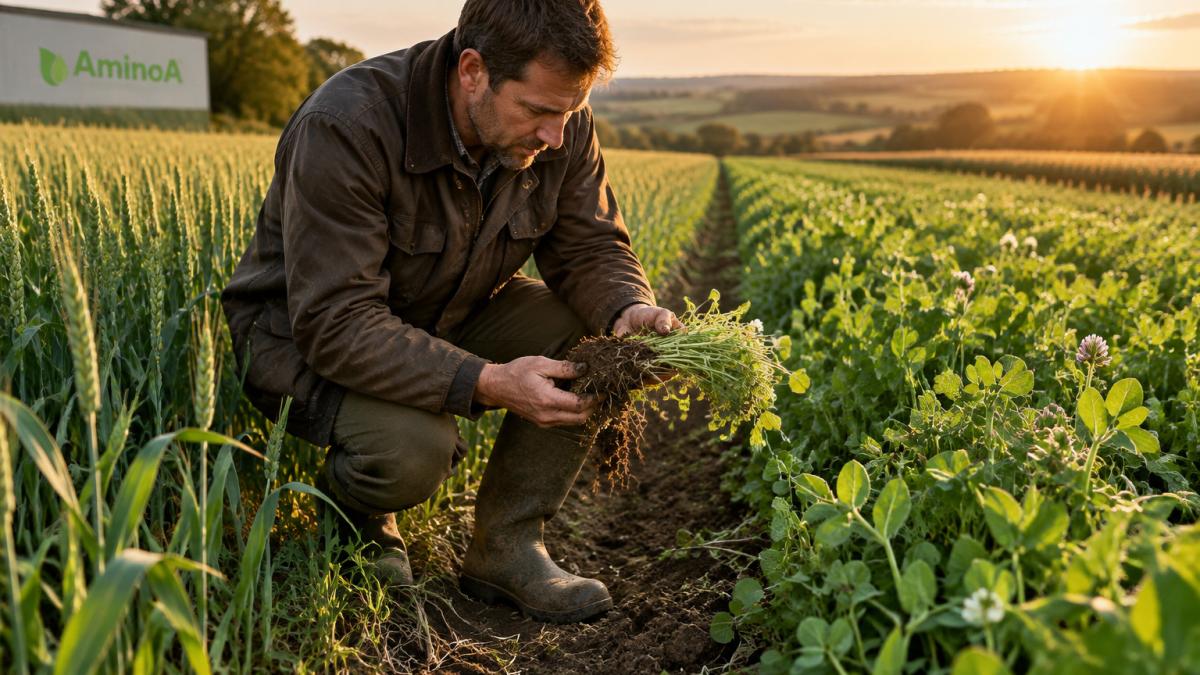
Aim for a rotation that keeps living roots in the ground for as much of the year as possible. Roots feed microbes, and gaps in cover leave the soil biology idle.
Choosing Crops and Cover Crops
Mix crops with different root depths and families. A cereal followed by a legume and then a brassica breaks disease cycles and changes the microbial community at each step.
Add a cover crop where the field would otherwise sit bare. Mixed cover crops often support a broader microbial community than a single species.
Timing Rotations and Reducing Tillage
Timing matters. Sow cover crops soon after harvest so roots are active through the autumn. Strip-till combined with living roots is one approach that research shows can help revive declining soil organic matter (strip-till and living roots study).
Reduce tillage where you can. Every pass of the cultivator disturbs fungal networks, so cut passes to the minimum your system allows.
The planning principles in this step can be summarised as follows.
| Planning point | What to do | Why it matters |
|---|---|---|
| Crop mix | Vary root depths and families | Breaks disease cycles |
| Crop order | Cereal, then legume, then brassica | Changes microbial community at each step |
| Cover crop | Add where the field would sit bare | Keeps soil biology active |
| Cover crop mix | Use several species together | Supports a broader microbial community |
| Sowing time | Sow soon after harvest | Keeps roots active through autumn |
| Tillage | Cut passes to the minimum | Protects fungal networks |
Soil Microbiome Restoration Techniques for Rotated Fields
Rotation alone may not restore a depleted soil. Some fields need extra help to rebuild biology, and the practical gap in most guidance is knowing which lever to pull first and how to measure whether it worked. Physical intervention often becomes necessary when the structural integrity of the earth has collapsed, particularly when cultivating heavy soil requires a delicate balance between aeration and the preservation of vital microbial networks.
Prioritise the levers in order
Most practitioners find that the biggest gains come from the cheapest interventions first. Address living roots, organic matter and disturbance before spending on inputs.
- Keep living roots in the ground: Bare soil starves the microbial community. A cover crop or an early-sown following crop keeps root exudates flowing through autumn and winter.
- Return organic matter: Crop residues, cover crop biomass and well-rotted manure feed the microbes that cycle nutrients. Aim to return as much biomass as your system allows without creating a disease risk.
- Reduce disturbance: Every pass of the cultivator breaks fungal networks. Cut passes to the minimum your system allows, and consider strip-till or direct drilling where soil conditions permit.
- Introduce mycorrhizal fungi where they are missing: These fungi form partnerships with plant roots and extend their reach for water and nutrients. Our guide on mycorrhizal fungi in crop nutrition explains how these partnerships work in practice.
A practical restoration sequence for a depleted field
- Establish a baseline. Test soil organic matter, microbial biomass and enzyme activity before changing anything. A single test tells you little, so plan to repeat it after each season.
- Fix the rotation first. Add a legume and a brassica to break disease cycles and vary root exudates. Avoid repeating the same crop family within three years where disease pressure is high.
- Add a cover crop. A mixed cover crop with different root depths supports a broader microbial community than a single species. Sow soon after harvest so roots are active through the autumn.
- Reduce tillage gradually. Sudden changes can cause compaction or weed problems, so transition over two or three seasons rather than all at once.
- Monitor and adjust. Track soil organic matter every one to two years, record yield and disease incidence, and adjust the sequence if a field shows declining biology.
What to expect over time
Short-term responses are often bacterial, with a rapid increase in microbial activity after a cover crop or organic matter addition. Fungal and structural improvements take longer, often several seasons. Long-term rotation studies consistently show that the benefits to soil organic matter and disease suppression accumulate over years rather than months, so treat restoration as a multi-season plan.
Watch out: adding organic matter or biostimulants without fixing a compaction layer or a drainage problem will give disappointing results, because the microbial community cannot thrive in poorly structured soil.
Best Practices for Regenerative Crop Rotation
Regenerative rotation focuses on building soil health rather than only managing inputs. Start with diversity, keep roots growing, and limit soil disturbance.
Biostimulants can support this work. Our guide to integrating amino acid biostimulants covers how to fit them into a rotation plan. As a manufacturer, AminoA produces L-α amino acid biostimulants that support root development and stress tolerance, but results vary by crop and season.
Treat the rotation as a long-term plan. Benefits to the microbiome often take several seasons to show clearly.
Monitoring Soil Biology and Adjusting Your Rotation Plan
Monitoring shows whether your rotation is working. Repeat your soil tests each year and compare them against the baseline from Step 1.
Look at root health, earthworm counts and crop vigour alongside lab results. Field observations often flag problems before a test does.
- Track soil organic matter every one to two years
- Record yield and quality for each crop in the sequence
- Note disease incidence in each rotation cycle
- Adjust crop order if a field shows declining biology
Measuring rhizosphere microbial activity offers a method you can use alongside these checks.
Book a Trial and Plan Your Next Rotation with AminoA
Planning a rotation with soil biology in mind is a practical step. If you want to test amino acid biostimulants on your own fields, visit the AminoA website or request a quote. Pricing depends on quantity, dates and delivery.
Frequently Asked Questions
How does crop rotation affect soil microbial diversity?
Crop rotation changes the root inputs and residues that feed soil organisms, which shifts the microbial community over time. Studies generally report that fungal richness tends to rise in rotated systems compared with monoculture. Bacterial responses are less consistent: some trials show more species richness under rotation, while others find lower bacterial diversity. The practical lesson is that rotation tends to strengthen fungal networks, and its effect on bacteria depends on the crops chosen and site conditions.
How long does it take for crop rotation to change the soil microbiome?
Shifts can appear within a single season, but measurable changes in soil organic carbon, bacterial functional diversity and enzyme activity generally need several seasons. Rotation can alter soil microbial communities, and changes in carbon and enzyme activity generally take more than a single season to become clear. Track results with soil tests rather than assuming one season will reset the biology.
Can crop rotation reduce the need for synthetic fertilisers?
Rotation can reduce fertiliser needs by including legumes that fix nitrogen and by breaking pest and disease cycles that drain crop nutrition. It does not remove the need for fertiliser entirely, particularly on high-demand cereals. Biostimulants based on L-alpha amino acids can complement a rotation by supporting root development and nutrient uptake, but results depend on crop, soil and season. Ask your agronomist to set a fertiliser programme against soil test results for each field.
How do biostimulants complement crop rotation strategies?
Crop rotation shapes the soil biology over years, while biostimulants act on the crop during the growing season. AminoA L-alpha amino acid biostimulants are designed to support root, leaf and bud development and to improve tolerance to cold, heat, drought and agrochemical stress. Used alongside a diverse rotation, they can help crops establish well in each sequence. Pricing depends on quantity, dates and delivery, so visit the AminoA website for current prices or request a quote.