 How-to
How to Improve Drought Tolerance Through Soil Biology
Quick Summary
Improving drought tolerance through soil biology means protecting the bacteria and fungi that help roots hold water and access nutrients when rainfall drops. Practices that reduce disturbance, keep the surface covered and add organic matter support these microbes. Results vary by soil type, so test your own conditions before relying on any product.
- Mycorrhizal fungi reach soil pores that roots cannot enter, helping plants draw water during dry periods.
- Reduce tillage and keep cover crops or residue on the surface to protect soil biology.
- On clay soils, avoid trafficking when soils are at field capacity to limit compaction.
- On sandy soils, add organic matter and use deep-rooted cover crops to improve water-holding capacity.
- Establish a biological baseline now, then compare results after three to five years of steady management.
Table of Contents
- How Soil Biology Helps Crops Withstand Drought
- Soil Microbes and Drought Tolerance: What the Research Shows
- Step 1: Assess Your Soil's Biological Activity
- Step 2: Improving Soil Health for Water Retention
- Step 3: Building Mycorrhizal Fungi for Drought Stress
- Step 4: Using Microbial Products for Crop Resilience
- Maintaining Soil Biology Year After Year and Next Steps With AminoA
- Frequently Asked Questions
How Soil Biology Helps Crops Withstand Drought
Soil biology is one of the most underused tools a grower has against drought. Beneath every field sits a dense community of bacteria, fungi and other microbes, and many of them help plants hold on to water when rainfall drops. Focusing on this living layer can strengthen crop resilience without relying only on irrigation or heavier fertiliser programmes.
Root exudates, biofilms and the rhizosphere are where this happens. Research on host-mediated microbiome selection for drought performance in rice
Root exudates, biofilms and the rhizosphere
The rhizosphere is the thin zone of soil directly around plant roots. Roots release sugars, amino acids and other compounds into it, called root exudates, and these feed microbes that cluster into biofilms. Those biofilms coat soil particles and roots, which helps keep moisture close to where the plant can reach it.
Nitrogen fixation and nutrient uptake under stress
Some soil bacteria convert atmospheric nitrogen into forms plants can use. Under drought, uptake of nutrients slows, so a healthy microbial population keeps nutrients available when the crop most needs them. Mycorrhizal fungi extend the reach of roots, improving access to phosphorus and water in the soil.
Soil Microbes and Drought Tolerance: What the Research Shows
Field research is starting to confirm these effects, though results vary with soil type and climate. Work on biochar in field conditions reports improved water retention through higher soil porosity and water-holding capacity. Field study on maize yield and drought tolerance
A review of drought stress interventions in crops points the same way, highlighting biological and soil-based approaches alongside other measures. Review of approaches to overcoming drought stress in crops
Beneficial bacteria and fungi produce exopolysaccharides and form biofilms that coat soil particles and root surfaces, which can help maintain aggregate stability. Mycorrhizal fungi extend hyphal networks beyond the root depletion zone, improving access to water held in smaller pores. Plant-microbe signalling, including strigolactones released by roots under stress, recruits these partners at the moment they are most needed. Nitrogen-fixing bacteria and phosphorus-solubilising organisms keep nutrients available when uptake slows. By extending the effective reach of roots into water-bearing pores, organic mycorrhizal fungi can complement the soil’s own microbial networks and help sustain uptake as surface layers dry.
What the research does not support is a single universal product or inoculant that works everywhere. A common pattern in trial work is that responses depend on the starting biological status of the soil, the crop, and the timing of drought. The practical lesson is to test your own conditions rather than assume a single mechanism. Review of plant-microbe signalling under drought
Watch out: research results from glasshouse or single-site trials often do not transfer to field conditions, so treat any product claim as a hypothesis to test on your own farm rather than a guaranteed outcome.
Step 1: Assess Your Soil's Biological Activity
Before changing anything, find out what your soil is doing now. A simple baseline stops you from guessing.
- Dig a few soil samples from different parts of the field
- Note the smell, colour and crumb structure of each sample
- Look for earthworms and visible root hairs
- Send a sample for a biological activity test if your agronomist offers one
Expected result: A baseline you can compare against in the next season.
Before you change anything, the four checks below give you a baseline to compare against next season. To go further, see how to measure rhizosphere microbial activity for methods you can use on your own soil.
| Check | How to do it | Expected result |
|---|---|---|
| Sample | Dig a few soil samples from different parts of the field | Samples from across the field |
| Observe | Note the smell, colour and crumb structure of each sample | A baseline description of each sample |
| Look for signs | Check for earthworms and visible root hairs | Evidence of biological activity |
| Test | Send a sample for a biological activity test if your agronomist offers one | A measured activity figure |
Step 2: Improving Soil Health for Water Retention
Water retention depends on soil structure, and soil structure depends on biology. Practices that protect living roots and keep the soil covered support the microbes that bind soil into stable aggregates. The unique angle here is that the right approach depends on your soil type, and UK soils vary enormously.
On clay-heavy soils, the priority is avoiding compaction and building aggregate stability. Clay holds water well but can become anaerobic and structureless if worked wet. Minimise tillage, keep cover crops or residue on the surface, and avoid trafficking when soils are at field capacity. Fungal networks do more of the binding work in clay, so protect them by reducing disturbance.
On sandy and light soils, the priority is building organic matter and microbial biomass, because these soils drain freely and hold little water. Add organic matter, use cover crops with deep roots, and consider compost or mulch to improve water-holding capacity. Bacterial communities tend to dominate in these soils, and regular additions of organic material support them.
On chalk and limestone soils, water retention is limited by depth and drainage. Focus on rooting depth and mycorrhizal associations, which help crops exploit water in fissures and small pores.
Across all soil types, the practical steps are the same in principle but differ in emphasis:
- Reduce tillage where you can
- Keep cover crops or residue on the surface
- Rotate crops to feed a wider range of soil organisms
- Add organic matter to build soil organic carbon over time
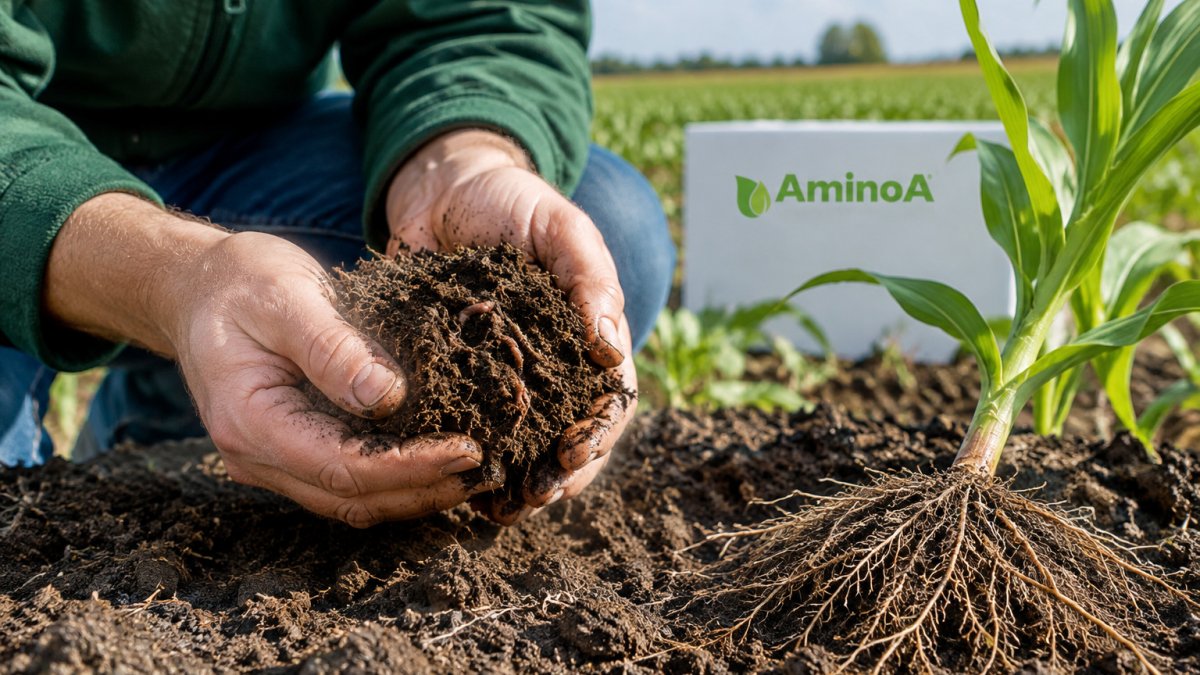
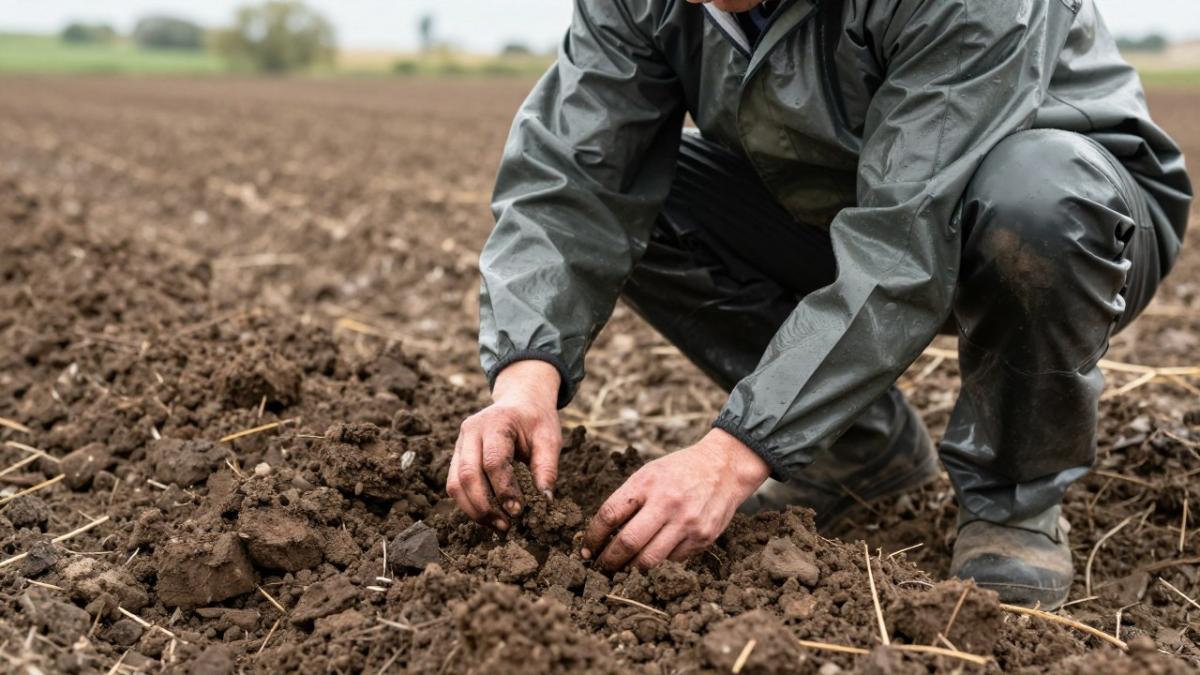
A farmer in waterproof clothing examines crumbly topsoil from an open pit in an arable field after rain. Look for soil that crumbles into rounded aggregates rather than clods or a crust.
Watch out: adding organic matter to a compacted clay soil without addressing the compaction first can simply sit on the surface and fail to improve structure.
Step 3: Building Mycorrhizal Fungi for Drought Stress
Mycorrhizal fungi form a partnership with plant roots. The fungal threads reach into soil pores that roots cannot enter, which can help the plant draw water and phosphorus during dry periods.
Their numbers are reduced by heavy tillage, some fungicides and long fallows. Protecting them is often cheaper than trying to replace them. For a deeper look at managing these fungi in crop nutrition, see our practical guide.
Step 4: Using Microbial Products for Crop Resilience
Microbial and biostimulant products can support the soil community, especially on fields where biological activity is low. Choose products based on the outcome you need, not on marketing claims.
AminoA produces L-alpha amino acid biostimulants made by enzymatic hydrolysis. Trials carried out by Velcourt found that adding AminoA FLO to reduced fungicide rates maintained yields and improved green leaf area in winter wheat.
For guidance on choosing the right product, see how to choose the right biostimulant for soil health. For a grower's view on integrating amino acid products into a programme, see our integration guide.
Maintaining Soil Biology Year After Year and Next Steps With AminoA
Soil biology builds slowly. A single season of good practice rarely changes a field, but three to five years of steady management can. Keep a rotation that includes cover crops, minimise disturbance and monitor your biological baseline each year.
For guidance on rotation practices that keep the microbiome healthy, read our crop rotation guide.
Pricing for AminoA products depends on quantity, dates and delivery, so please contact us for a current quote. Subscribe to our newsletter for updates on trials and product guidance.
Last Updated: 9 November 2026
Frequently Asked Questions
How does soil biology help crops tolerate drought?
Soil organisms build aggregates and porosity, which let rain infiltrate and stay available to roots. Bacteria and fungi also produce root exudates and biofilms that help hold moisture near the rhizosphere, and they support nutrient uptake when plants are under stress. The research identifies these mechanisms, though field results vary with soil type, climate and management. Measuring infiltration and organic matter over several seasons is the most practical way to judge whether soil biology is working on your land.
Can mycorrhizal fungi improve crop drought tolerance?
Mycorrhizal fungi extend the reach of plant roots, helping crops access water and minerals from a larger volume of soil. Field studies on biochar and microbial management show gains in water retention and yield under dry conditions, but the research does not give a single guaranteed percentage for mycorrhizal inoculation. Results depend on whether the fungi colonise roots, which is influenced by existing soil biology, tillage and fertility. Treat inoculation as one part of a wider soil health programme.
When should microbial products be applied to crops?
Microbial and biostimulant products are generally most useful when crops face predictable stress, such as early establishment, flowering or dry spells, and when soil conditions support microbial activity. Timing should follow the product's label and your agronomist's advice. Applications made to soil that is waterlogged, very cold or heavily compacted are unlikely to perform well. Pricing depends on quantity, dates and delivery, so request a current quote from AminoA directly.
Do soil microbes guarantee higher yields during drought?
No. Soil microbes improve the conditions that help crops cope with drought, but they cannot make up for a severe, prolonged shortage of rain. The research indicates that microbes can help plants cope with drought through mechanisms that are not always the ones first expected, so results should be judged on trials under your own conditions. Use soil biology as part of a resilience strategy alongside sound irrigation, cultivation and nutrition practice.