 How-to
How to Choose Soil Conditioners for Water Retention
Quick Summary
Soil conditioners improve water retention by changing how soil stores moisture, slowing drainage so more water stays in the root zone. The right choice depends on soil texture: sandy soils gain most from organic matter, biochar or hydrogels, while heavy clay benefits from better drainage and aeration. Start by testing your soil and drainage rate before choosing a product.
- Sandy soils drain fast and gain the most from water-retention products
- Organic matter acts like a sponge, releasing stored water slowly to roots
- Hydrogels can hold many times their weight in water and release it as soil dries
- Hydrogels may degrade and perform poorly in saline soils or heavy clay
- Run a strip trial with untreated comparison strips before treating a whole field
Table of Contents
- How Soil Conditioners Improve Water Retention
- Choosing an Amendment: Organic, Mineral, Biochar and Hydrogel Options
- Soil Conditioners for Sandy Soil: Where Water Retention Matters Most
- Hydrogel Soil Amendment for Agriculture: Benefits, Limits and Costs
- Soil Conditioner Application Rates, Placement and Timing
- Measuring Soil Water Retention Capacity on Your Own Land
- Planning Your First Trial With AminoA
- Frequently Asked Questions
How to Choose Soil Conditioners for Water Retention
Last Updated: November 7, 2026
How Soil Conditioners Improve Water Retention
Soil conditioners for water retention in agriculture help soil hold more moisture for longer.
The main job of a soil conditioner is to change how the soil stores water. Dry, sandy ground lets water drain straight past the root zone.
Research from Soil Use and Management journal study on biochar, compost, iron-based residue and polymer hydrogel examined several of these materials for water retention.
Soil structure and water-holding capacity
Water-holding capacity depends mainly on soil texture and structure. Sand has large pores, so water runs through quickly. Clay holds water well but can become waterlogged and compacted.
Conditioners work by changing the soil's pore spaces. They help bind fine particles into stable clumps called aggregates. These aggregates create a mix of small pores that hold water and larger pores that let air and excess water move through.
- Sandy soils gain the most from better pore structure
- Heavy clay soils benefit from improved drainage and aeration
- Stable aggregates resist breakdown when the soil is wet and dry
Why organic matter helps soil hold moisture
Organic matter acts like a sponge in the soil. It can hold many times its own weight in water, and it releases that water slowly to plant roots.
Organic matter tends to improve water retention over seasons rather than weeks, as it breaks down and binds with soil particles. To see which organic soil treatments are proven to build root and soil resilience, read our best soil amendments for root development.
Choosing an Amendment: Organic, Mineral, Biochar and Hydrogel Options
There are four main groups of soil conditioners. Each one suits different soils, budgets and time frames.
Organic amendments include compost, manure and similar materials. For a ranked view, see our guide to the best organic soil conditioners for large-scale farming.
Mineral amendments such as bentonite and attapulgite are clay-based materials with high surface area.
Biochar is charcoal made from plant material and applied to soil.
Hydrogels, also called super-absorbent polymers, absorb large volumes of water and release it as the soil dries.
Start with the soil problem, not the product.
Soil Conditioners for Sandy Soil: Where Water Retention Matters Most
Sandy soil is the clearest case for water retention products. It drains fast, holds few nutrients, and dries out between rain events.
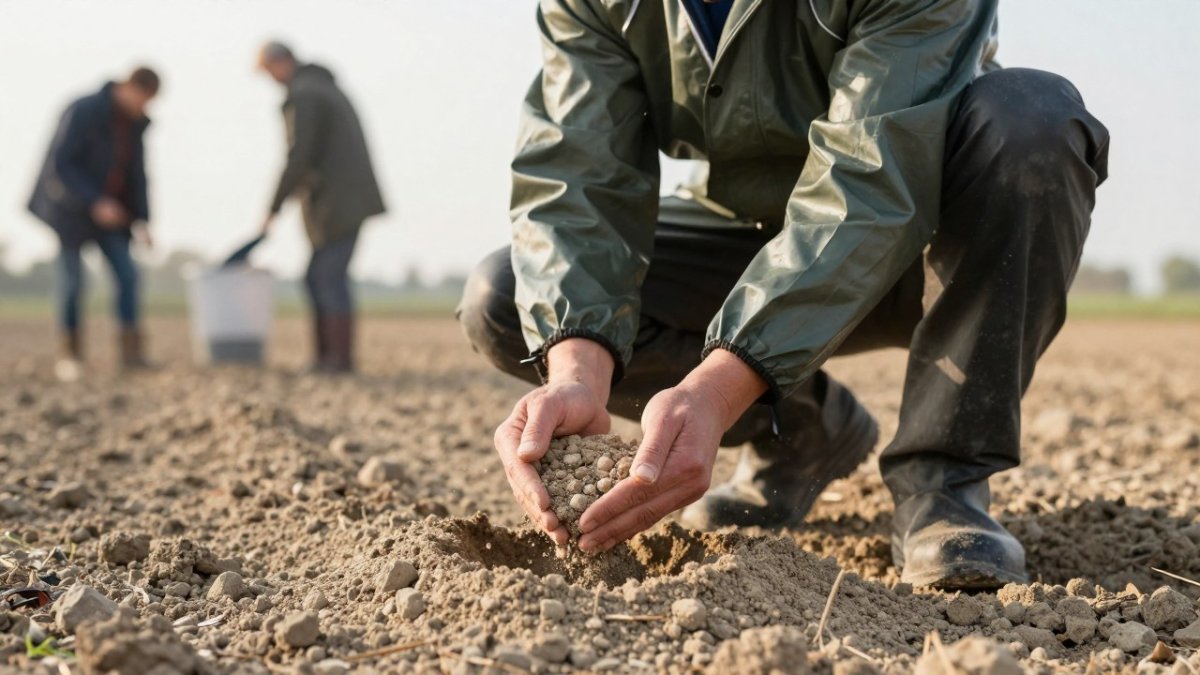
Watch out: a hydrogel applied to sand without organic matter may not improve the soil long term. Pair fast-acting amendments with compost or manure where possible.
Hydrogel Soil Amendment for Agriculture: Benefits, Limits and Costs
Hydrogels, also called super-absorbent polymers, are among the most concentrated water-retention materials available. A small mass of dry polymer can absorb many times its own weight in water and release it slowly as the surrounding soil dries. That makes them attractive where irrigation water is scarce or expensive, but the economics only work when the product is matched to the right soil, crop and water price.
What hydrogels realistically deliver
- Fast response. Unlike compost, a hydrogel can begin holding water in the first season after application.
- Low application mass. Because the material is concentrated, handling and transport costs per hectare are usually far lower than for bulky organic amendments.
- Root-zone targeting. Placed in the seedbed or planting furrow, the polymer releases water where germinating and young roots can use it.
Where they fall short
- They degrade. Agricultural hydrogels can break down over time under field conditions, so the benefit may not be permanent.
- Salinity and fertiliser interactions. High salt levels and some fertiliser compounds reduce a polymer's swelling capacity, so performance can drop sharply in saline soils or where heavy fertiliser is banded with the polymer.
- Soil-type dependence. Hydrogels perform inconsistently in heavy clay, where they may do little that the clay is not already doing, and in very coarse sand, where they can be washed down the profile.
The cost and value calculation
Hydrogel pricing varies with product, concentration, packaging and delivery. For current prices, request a quote from AminoA. For a broader breakdown, see our cost-benefit analysis of organic soil amendments.
- Water savings. Estimate the irrigation volume you currently apply in a dry season and the proportion you might realistically reduce. Multiply the saved volume by your water cost, for mains or trickle irrigation this is a metered charge; for abstraction it includes licence and pumping costs.
- Yield protection. In drought-sensitive crops, the value of avoided stress can outweigh the product cost, but only in seasons where drought actually bites. Budget across several seasons, not one good year.
- Lifespan. Divide the per-hectare cost by the number of seasons the product is expected to remain effective. A cheap product that lasts one season can cost more per year than a dearer one that lasts three.
A common pattern is that hydrogels pay back most reliably on high-value crops under trickle irrigation in light soils, and least reliably on low-value combinable crops in heavy land. Run the numbers for your own rotation before buying.
Watch out: a hydrogel applied to sand without organic matter may improve moisture in the first season but do little for long-term soil structure. Pairing organic matter with a hydrogel can support lasting moisture retention, while AirField Systems’ approach to green-roof drainage highlights the value of managing excess water as carefully as holding it.
Soil Conditioner Application Rates, Placement and Timing
Application rate, placement and timing decide whether a conditioner works. Too little has no effect. Too much can alter soil chemistry, waste money or, in the case of some polymers and salts, damage the very structure you are trying to build. The guidance below is a framework for planning a rate, not a substitute for the product label or a soil test.
Start with a soil assessment, not a product
Before choosing a rate, establish three things:
- Texture class. A jar test or hand-texturing gives a rough split between sand, loam and clay. Sandy soils with low organic matter respond most to conditioners; heavy clay often needs structure and drainage work first.
- Organic matter content. Many arable soils have modest organic matter content, so organic amendments are often a sensible starting point before specialist products.
- Infiltration rate. A simple ring test, a bottomless tin driven into the soil, filled with water, and timed until it soaks away, tells you whether water is running off or draining straight through. Slow infiltration points to structure problems; very fast infiltration points to sand or gravel.
Typical application rate ranges
Rates vary by product, soil and crop. Always follow the manufacturer's label and discuss rates with your supplier:
- Hydrogels and super-absorbent polymers: placement and rates should follow the manufacturer's label.
Placement: put the product where roots will be
- Incorporated granular products belong in the top 10-20 cm, the zone where most crop roots forage. Deep placement below the cultivation layer wastes product.
- Hydrogels work best mixed into the seedbed or placed in the planting furrow, where they can swell and release water close to germinating roots.
- Surface-applied compost is better used as a mulch in perennial systems or incorporated before drilling in arable rotations; left on the surface in arable fields it breaks down slowly and is easily washed or blown away.
Watch out: incorporating a conditioner into bone-dry soil and then applying a heavy irrigation can move light polymers or fine minerals down the profile before roots reach them. Moisten the soil before incorporation where the product allows.
Timing: work back from the dry period
- Autumn and early winter are the practical window for compost, manure and clay minerals on arable land, because there is usually time for the material to integrate with soil structure before spring drilling.
- Before sowing or planting is the right moment for hydrogels and root-zone products, so they are in place when the seedling roots arrive.
- Ahead of a forecast dry spell is when biochar and mulch-type applications earn their keep, provided there is enough soil moisture at application for the material to charge.
Plan a strip trial first
Before committing a whole field, treat strips and leave untreated strips alongside them, with the same seed, fertiliser and irrigation. Record the rate, date, product and soil conditions for each strip. One season of strip-trial data is worth more than any generic recommendation, because it reflects your soil, your weather and your crop.
The table below summarises where each type of product should be placed and when it should go on, drawn from the guidance in this section.
| Product | Placement | Timing |
|---|---|---|
| Incorporated granular products | Top 10-20 cm, the main root zone | Before drilling or planting |
| Hydrogels | Seedbed or planting furrow | Before sowing or planting |
| Surface-applied compost | Mulch in perennials, or incorporated in arable rotations | Autumn and early winter on arable land |
| Clay minerals | Incorporated into the cultivation layer | Autumn and early winter on arable land |
| Biochar and mulch-type applications | Surface or incorporated, with soil moist at application | Ahead of a forecast dry spell |
Measuring Soil Water Retention Capacity on Your Own Land
You do not need a laboratory to check whether a conditioner is working. Simple field checks give useful answers.
- Jar test: Mix a soil sample with water, let it settle, and compare how much water each layer holds
- Soil moisture probes: Install probes at the same depth in treated and untreated areas
- Visual checks: Watch how long plants stay healthy between irrigation or rainfall
Record dates, rainfall, irrigation and crop condition. Over one season, these records show whether the conditioner is making a difference.
Planning Your First Trial With AminoA
Start with one field or one crop. For a wider overview to shape your trial plan, see our best soil health practices for sustainable farming.
AminoA's L-α amino acid biostimulants are designed to support root development and crop stress resistance.
Get started with AminoA to build healthier root zones and stronger crop resilience. Our biostimulants are made from 100% L-α amino acids and support root, leaf and bud development.
Frequently Asked Questions
What soil conditioners can improve water retention in agricultural soils?
The main options are organic amendments such as compost and manure, mineral amendments such as bentonite and attapulgite, biochar, and hydrogels or super-absorbent polymers. Organic and mineral materials mainly improve soil structure and water-holding capacity over time, while hydrogels act faster by absorbing water and releasing it to roots. Published studies show differing results depending on soil type, rate and climate, so trial results on your own land should guide the choice. Pricing depends on quantity, delivery and timing, so request a quote from AminoA for current figures.
Are hydrogels effective for improving water retention in farm soils?
Studies on super-absorbent polymers report increased soil water-storage capacity in arid regions under deficit irrigation, but the supplied research does not give sample sizes or application rates, so the size of the effect in any given field is uncertain. Hydrogels can break down or lose capacity over time and their performance depends on soil salinity and irrigation water quality. Treat them as one tool to test on a small area before committing to larger applications.
How should a soil conditioner be applied in agriculture?
Incorporate the conditioner into the root zone rather than leaving it on the surface, so that it sits where plant roots can use the stored moisture. Mix it thoroughly into the top layer of soil before planting, and follow the rate recommended by the manufacturer for your soil type. Avoid applying during very wet conditions when machinery can compact the ground. Record the rate, date and method so you can compare results across seasons.
Can organic matter improve soil water retention?
Organic matter improves soil structure, helping sandy soils hold more water and heavy soils drain better. Compost and manure are common sources, and their effect builds gradually over several seasons. Results vary with the material used and the starting condition of the soil, so monitor soil moisture over time rather than expecting an immediate change.