 how-to
Best Foliar Feeding Practices for Crop Resilience
Table of Contents
- Why Foliar Feeding Builds Crop Resilience
- What You'll Need Before You Start
- The Best Time to Apply Foliar Fertiliser
- Foliar Fertiliser Application Rate: Getting the Dose Right
- Preventing Leaf Scorch from Foliar Sprays
- Foliar Feeding for Drought Stress and Heat Events
- Common Mistakes to Avoid
- Conclusion
- Frequently Asked Questions
Last Updated: October 21, 2026
Why Foliar Feeding Builds Crop Resilience
Foliar feeding is the practice of applying dissolved nutrients directly to crop leaves rather than to the soil. At AminoA, we see it as one of the fastest ways to support a crop when roots cannot keep up with demand. Leaves absorb small nutrient doses within hours, which matters when a cold snap, a dry spell or a heavy spray programme puts plants under pressure.
Resilience here means the ability to keep growing through stress. A plant that has ready access to amino acids and trace minerals can maintain cell function when conditions turn.
How Amino Acids Support Stress Tolerance
Amino acids are the building blocks of proteins, and plants use them to regulate how they respond to stress. Three things matter most:
- Osmotic balance. Free amino acids help cells hold water, which reduces wilting during drought.
- Recovery speed. After heat or cold damage, a crop with available amino acids rebuilds tissue faster.
- Chelation. Amino acids bind iron, magnesium and other metals, keeping them available to the leaf.
We manufacture our biostimulants from 100% L-α amino acids through enzymatic hydrolysis, because the L form is the one plants actually recognise and use.
What You'll Need Before You Start
Before you mix a single tank, get the basics right. Most failed foliar programmes fail on equipment or water quality, not on the product.
Total time: 1-2 hours per spray pass, including mixing and calibration.
What you'll need:
- A calibrated sprayer with a fine droplet nozzle set
- Clean water, ideally low in calcium and bicarbonate
- A water test kit or a recent water analysis
- A jug, a stirring stick and a pH meter
- Your chosen foliar fertiliser, stored out of direct sunlight
- Personal protective equipment as stated on the label
Check your water first. Hard water can lock up nutrients before they ever reach the leaf.
The Best Time to Apply Foliar Fertiliser
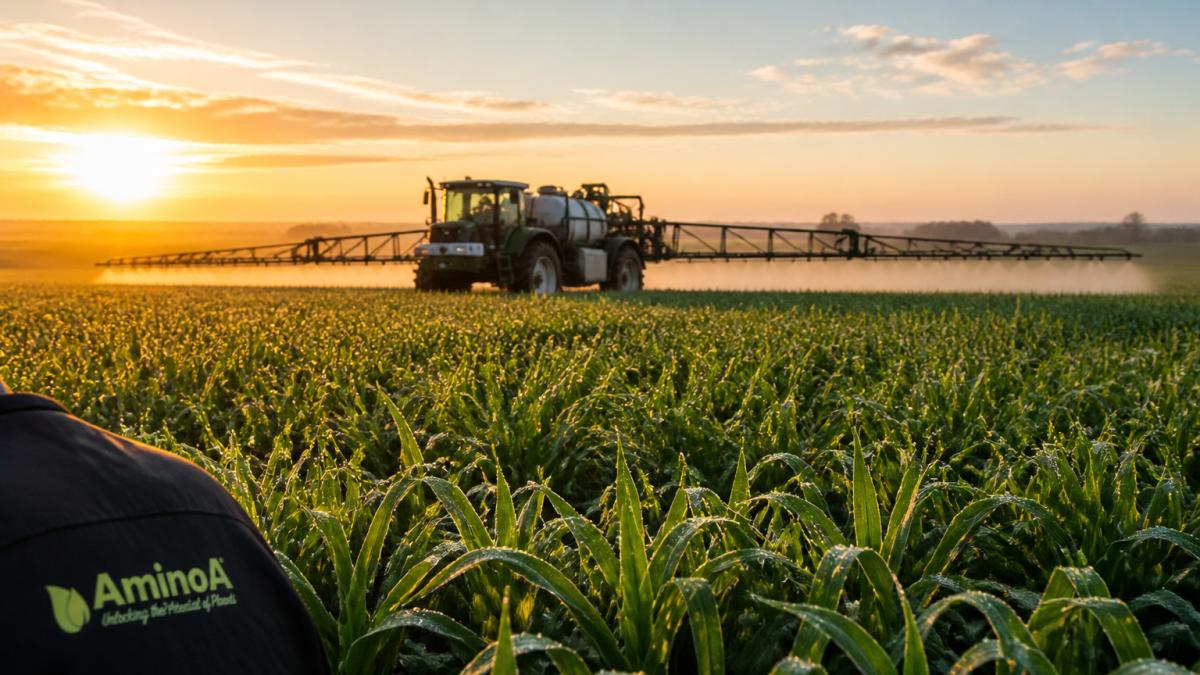
The best time to apply foliar fertiliser is early morning or late evening, when temperatures are lower and stomata are open. Avoid the middle of the day in summer. Spraying onto hot leaves drives evaporation and raises scorch risk.
Aim for a dry window of at least four to six hours after application. Rain within that window washes the product off before absorption.
Reading the Weather Window
Wind speed, humidity and the forecast all shape your decision. Use this quick check before every pass:
| Condition | Good to spray | Hold off |
|---|---|---|
| Wind | Below 3 m/s | Above 5 m/s |
| Temperature | 10-22°C | Above 25°C |
| Rain forecast | 6+ dry hours ahead | Rain within 4 hours |
| Leaf surface | Dry at application | Dew or standing water |
Foliar Fertiliser Application Rate: Getting the Dose Right
Foliar fertiliser application rate depends on the crop, growth stage and product concentration. There is no single figure that fits every field. Always start from the label rate and adjust for your conditions.
A practical approach:
- Start low. Run a small strip at the lower label rate before treating the whole field.
- Match the stage. Young leaves take up more than hardened, waxy leaves.
- Watch the water volume. More water per hectare gives better coverage but dilutes the dose.
- Never exceed the label. Overdosing is the fastest route to leaf damage.
Pricing for our biostimulants depends on quantity, pack size and delivery. Contact us for a current quote rather than working from an old figure.
Preventing Leaf Scorch from Foliar Sprays
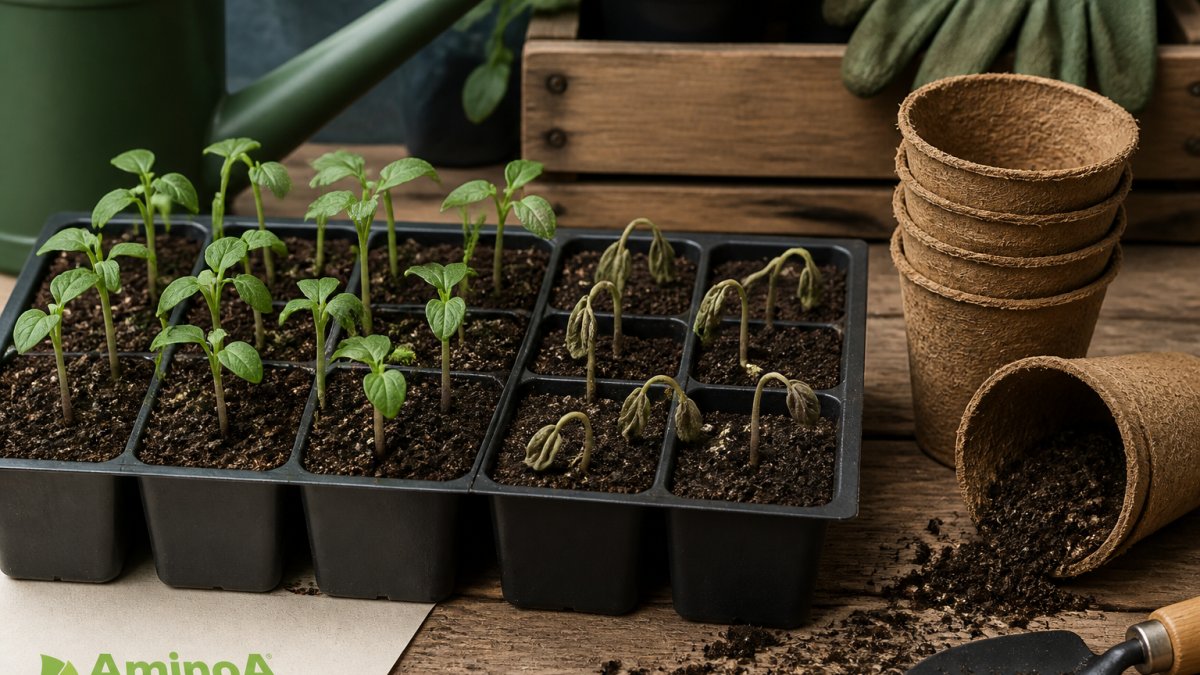
Preventing leaf scorch from foliar sprays comes down to three things: correct concentration, correct timing and correct tank partners. Scorch shows as brown or bleached patches on the leaf, usually at the margins or between veins.
Common causes:
- Mixing too strong a dose for the crop stage
- Spraying in high heat or strong sunlight
- Adding incompatible products to the same tank
- Using hard or high-pH water
Tank Mix Safety and Phytotoxicity Risk
Always run a jar test before mixing a new combination. Add the products in label order to a clear jar of your spray water, stir, and leave for 30 minutes. Look for separation, curdling or heavy sediment. If any appear, do not spray.
Amino acid biostimulants generally mix well with many fungicides and insecticides, but compatibility must be confirmed for your specific partners. Our amino acids also help reduce agrochemical phytotoxicity risk by supporting the plant's own recovery.
Foliar Feeding for Drought Stress and Heat Events
Foliar feeding for drought stress works because it bypasses the root system. When soil moisture is low, roots struggle to pull up nutrients. A leaf-applied spray delivers a small but timely dose exactly where the plant needs it.
Timing matters more than volume here. Spray in the cool of the evening during a heat event. Add amino acids to help the plant hold water and recover once the stress passes.
Our customers often ask whether a biostimulant can replace a fungicide programme. The honest answer is no. What we can point to is the Velcourt trial work, where adding AminoA FLO to reduced fungicide rates maintained yields and improved green leaf area in winter wheat.
Common Mistakes to Avoid
The biggest mistakes in foliar feeding are predictable, and each one is easy to fix:
- Spraying at midday. Heat and light break down nutrients and burn leaves.
- Ignoring water quality. Hard water locks up nutrients before they reach the crop.
- Skipping the jar test. Incompatible mixes cause scorch and wasted spend.
- Overdosing to "be safe". More is not better; it is a scorch risk.
- Spraying before rain. A wash-off wastes the whole pass.
- No record keeping. Without notes on rate, timing and result, you cannot improve next season.
Conclusion
Crop resilience is built pass by pass, not in a single spray. Get the water right, spray in the cool of the day, keep the dose within label limits, and test every new tank mix before it touches a field.
At AminoA, we make 100% L-α amino acid biostimulants through enzymatic hydrolysis, with high levels of nitrogen, potassium, iron and magnesium. Our products support root, leaf and bud development and help crops resist cold, heat, drought and spray damage. Subscribe to our newsletter for seasonal guidance on getting the most from every foliar pass.
Frequently Asked Questions
How does foliar feeding help crops cope with stress?
Foliar feeding delivers nutrients directly to the leaf surface, where they are taken up faster than through the roots. During stress events such as drought, heat or cold, root activity often slows, so a foliar application keeps the plant supplied when soil uptake is limited. L-α amino acids are particularly useful here because they are the building blocks the plant uses to maintain cell function and repair damage. Products such as AminoA supply every essential amino acid in the L form, supporting the plant's own stress-response processes rather than simply topping up nitrogen.
When is the best time to apply foliar fertiliser?
The best time to apply foliar fertiliser is early morning or late afternoon, when temperatures are lower and stomata are open. Avoid spraying in the heat of midday, when rapid drying can concentrate salts on the leaf and increase scorch risk. Aim for a window with low wind, no rain forecast for at least six hours, and ideally some leaf moisture from dew. For drought stress, an early morning application after overnight dew gives the best uptake before the day heats up.
Can foliar feeding replace soil-applied fertiliser?
No. Foliar feeding is a supplement, not a replacement for a balanced soil fertility programme. Soil-applied fertiliser supplies the bulk of nitrogen, phosphorus and potassium that a crop needs across the season. Foliar applications are most valuable for targeted top-ups during stress, at key growth stages, or where soil conditions limit nutrient availability. Treat foliar feeding as a precision tool that improves resilience and quality alongside your existing soil programme, not as a way to cut base fertiliser rates.
How can growers reduce the risk of leaf scorch?
Preventing leaf scorch from foliar sprays comes down to dose, timing and tank mix discipline. Stick to the label application rate rather than adding extra product, spray in cooler parts of the day, and avoid tank mixing with incompatible agrochemicals. Check water quality, since hard water can affect how products dissolve. A jar test before mixing a new combination is a simple safeguard. Amino acids such as those in AminoA are associated with increased resistance to agrochemical phytotoxicity, which is useful if you are reducing fungicide rates and adding a biostimulant to the tank.