 How-to
Amino Acid Biostimulants for Transplant Shock: A Practical Guide
Quick Summary
Transplant shock is the growth check seedlings suffer when moved from a tray or glasshouse into open ground, as damaged roots reduce water uptake. Amino acid biostimulants can support recovery by supplying building blocks for repair, though research on their reliability remains limited.
- Apply a foliar spray 24-48 hours before lifting, at the label rate.
- Follow planting with a root-zone drench at the label dilution, after watering in.
- Repeat by foliar spray or second drench 7-14 days after planting.
- Check labels for free amino acid content, L-form claim and hydrolysis method.
- Do a jar test before tank-mixing, since phytotoxicity can mimic transplant shock.
Table of Contents
- What Transplant Shock Does to Crops and Why It Matters
- What Amino Acid Biostimulants Are and Where They Come From
- How Amino Acids Support Root Development and Nutrient Uptake
- Evidence on Amino Acids and Transplant Stress: What the Research Shows
- A Transplant-Day Protocol: Timing, Dose and Repeat Applications
- Choosing a Formulation and Avoiding Compatibility Problems
- Measuring Recovery and Setting Realistic Expectations
- Plan Your Next Transplant Programme With AminoA
- Frequently Asked Questions
What Transplant Shock Does to Crops and Why It Matters
Last Updated: November 18, 2026
Transplant shock is the check in growth that seedlings suffer when they are moved from a nursery tray or glasshouse into open ground. Roots are damaged or disturbed, water uptake drops, and the plant can stall for days or weeks. Growers feel this most in high-value vegetables, where a slow start means a lower yield at harvest.
That stall is the real cost. A plant that spends its first fortnight recovering is a plant that enters the season behind its neighbours. Crop uniformity suffers, and harvest windows become harder to plan.
Watch out: transplant shock is often blamed on the wrong thing. Poor soil, late watering and heat stress all look similar in the field, so check root condition before reaching for a product.
What Amino Acid Biostimulants Are and Where They Come From
Amino acid biostimulants are products that supply free amino acids or short chains of them to support plant metabolism rather than to feed the plant directly. They are typically made from plant or animal protein that has been broken down, either by enzymatic hydrolysis or by chemical hydrolysis.
Enzymatic hydrolysis is the route we use at AminoA. Our products contain 100% L-α amino acids, and every essential amino acid is present in the L form.
The product is also high in nitrogen, potassium, iron and magnesium. A reader who wants to understand the stereochemistry behind this can read our guide on L-Amino Acids vs D-Amino Acids in Agriculture, and a basic definition is covered in what an L-alpha amino acid is.
How Amino Acids Support Root Development and Nutrient Uptake
Amino acids are building blocks for proteins and enzymes, so a plant under transplant stress needs them to rebuild tissue and keep metabolism running.
A practical way to think about it: the plant has to repair itself before it can grow. For a deeper look at the role of amino acids in crop growth, see Amino Acids in Plants: How They Boost Crop Growth.
- Supports new root and leaf tissue formation
- Helps plants keep metabolic activity during stress
- Works alongside the nutrients the crop already receives
Evidence on Amino Acids and Transplant Stress: What the Research Shows
The research base is limited. A 2024 review by Sun et al. surveys amino acids, protein hydrolysates and phenols as agricultural biostimulants, and reports that several amino-acid treatments could increase fresh and dry weight and shoot length Amino Acids Biostimulants and Protein Hydrolysates in Agricultural, 2024 review. The search result does not give effect sizes, so the scale of those gains is not established here.
A 2023 lettuce study by Krinis et al. concluded that a non-microbial biostimulant affected some mechanisms involved in transplanting shock. It did not report a numerical outcome, and it did not identify the product as an amino-acid treatment Biostimulants as a Means to Alleviate the Transplanting Shock in Lettuce, 2023. A 2017 study on woody nursery plants found minimal growth effects from four commercial biostimulants, which is a reminder that results vary by crop Biostimulants Have Minimal Effects on Growth of Some Woody Nursery Plants, 2017.
What the research does and does not establish
The evidence shows that amino-acid biostimulants have plausible mechanisms and some positive crop results. It does not yet prove that amino acids reliably cut transplant shock across crops.
A Transplant-Day Protocol: Timing, Dose and Repeat Applications
A workable protocol has three phases: pre-transplant, planting day and post-transplant. The exact rates and intervals must come from the product label for your crop, but the sequence below is the pattern most growers and agronomists follow when using amino acid biostimulants around transplanting.
Pre-transplant (24-48 hours before lifting). Apply a foliar spray at the label rate while seedlings are still in the tray or glasshouse. The aim is to load the plant with amino acids before root disturbance, so metabolic repair can begin as soon as the roots are damaged.
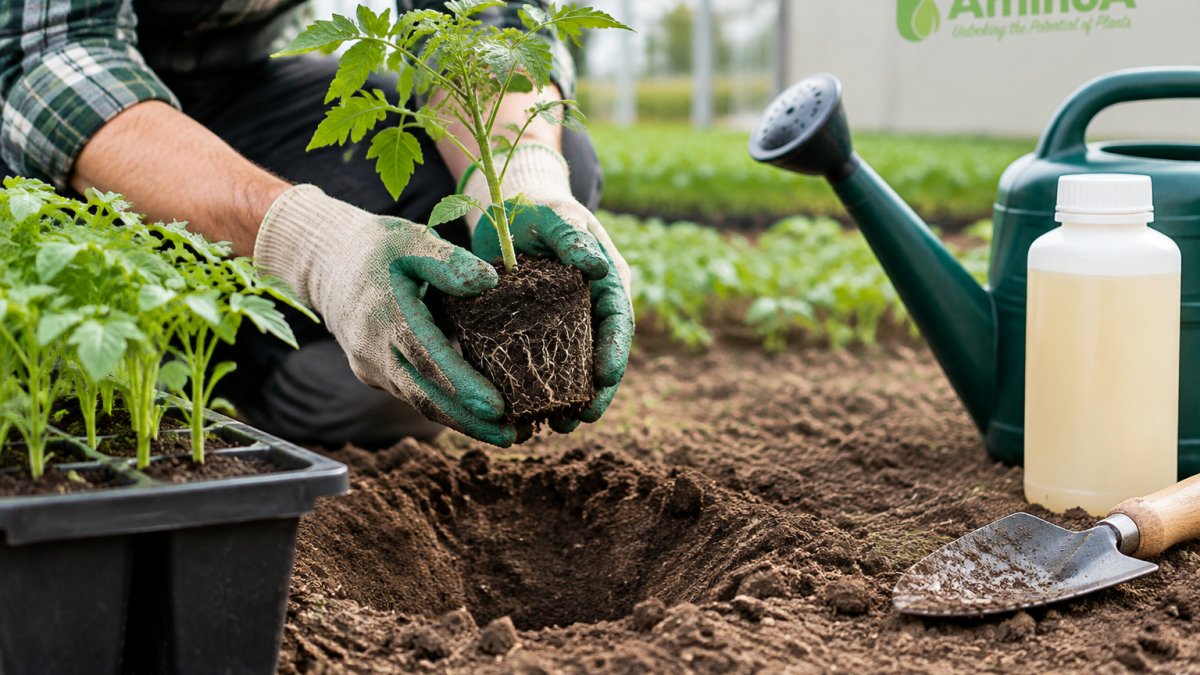
Planting day. Apply a root-zone drench at the label dilution immediately after the seedling is settled into the soil and watered in. A drench places the product directly in the root zone, where uptake does not depend on leaf condition or weather.
Post-transplant (7-14 days after planting). Repeat with either a foliar spray or a second root-zone application, following the label interval. A common pattern is one drench at planting and one foliar spray once new growth is visible. Do not exceed the label's maximum number of applications per season.
Crop-type adjustments. High-value vegetables such as lettuce, brassicas and alliums usually respond to the full three-phase sequence. Woody nursery stock and bare-root transplants benefit most from the planting-day drench and a single follow-up, because their slower establishment makes repeated foliar applications less reliable. Container-grown ornamentals can be treated with a root-zone drench at potting on and again at planting out.
Dilution and repeat-application guidance. Rates vary by formulation, liquid concentrates, soluble powders and ready-to-use products all carry different dilution ratios, so never transfer a rate from one product to another. Mix only the volume you will use that day, and record the product name, batch, rate, water volume and weather conditions for each application. Repeat applications should follow the label interval rather than a fixed calendar date.
Measuring recovery. Track survival rate, time to first new leaf, leaf turgor in the first week and root establishment at three weeks. Compare treated rows with an untreated control on the same field, and record the same indicators for both. A simple scorecard, survival percentage, days to new growth, and a visual wilting score, is enough to show whether the protocol is working on your site.
Watch out: applying a root-zone drench to dry soil without watering in first can concentrate the product around the roots and cause localised phytotoxicity; water the planting hole before applying.
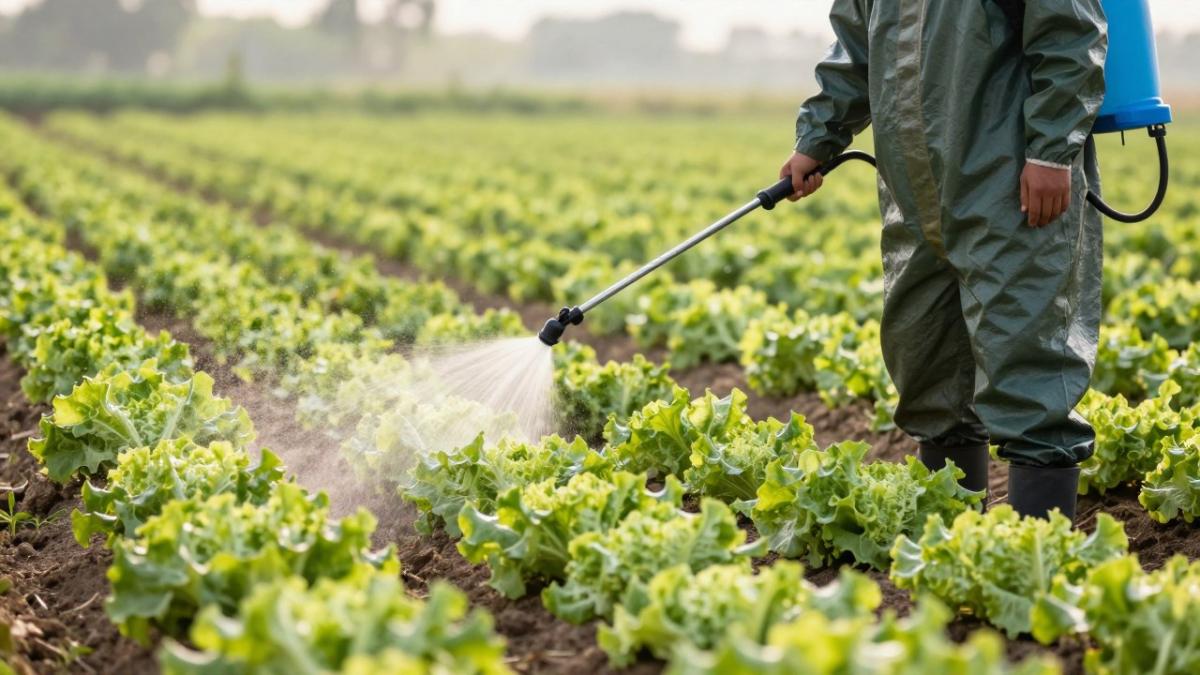
!A grower in waterproof clothing spraying freshly transplanted lettuce rows with a knapsack sprayer in an early-morning field
Foliar spray versus root-zone application
Foliar sprays deliver product to leaves and are quick to apply, but uptake depends on leaf condition and weather. Root-zone application, such as a soil drench, places the product where roots can take it up directly. Many growers choose root-zone application at transplanting and a foliar spray later, but the right mix depends on your crop and system. For more on timing foliar sprays, see Foliar Feeding Timing: When to Spray for Best Results. Absorption technique is covered in Foliar Application Techniques for Better Absorption.
The article sets out a three-phase sequence for applying amino acid biostimulants around transplanting, summarised below.
| Phase | Timing | Application |
|---|---|---|
| Pre-transplant | 24-48 hours before lifting | Foliar spray at label rate |
| Planting day | Immediately after planting and watering in | Root-zone drench at label dilution |
| Post-transplant | 7-14 days after planting | Repeat by foliar spray or second drench |
| Season limit | Per label | Do not exceed maximum applications |
Choosing a Formulation and Avoiding Compatibility Problems
Formulation is where most buying decisions go wrong. Two products can both say 'amino acid biostimulant' on the label and behave very differently in the tank and in the field.
Free amino acids versus peptides. Free amino acids are single molecules that plants can take up and use quickly; peptides are short chains that must be broken down further before use. Check the label for the free amino acid content, not just total amino acids.
Hydrolysis method. Enzymatic hydrolysis keeps amino acids in the L-form that plants use and avoids the harsher conditions of chemical hydrolysis, which can produce D-forms and salt by-products. If the label does not state the hydrolysis method, ask the supplier; a product that cannot tell you how it was made is hard to compare with one that can.
Plant versus animal sources. Plant-derived hydrolysates are often preferred for organic systems and for crops where animal by-products are restricted. Animal-derived products can be effective but may carry certification and handling requirements. Confirm the source against your certification body's approved inputs list before purchase.
What to check on the label. Look for: total and free amino acid content; the L-form claim; the hydrolysis method; the source material; the nitrogen, potassium and any micronutrient content; the recommended crops and application methods; the maximum number of applications per season; and tank-mix compatibility statements. A label that gives only a total amino acid figure and no free amino acid figure is giving you incomplete information.
Compatibility and application risks. Check the label before tank-mixing with fungicides, insecticides or other biostimulants, and always do a small jar test first. Mix in the recommended order, usually water, then product, then partner product, and keep the sprayer clean. Water quality matters: hard water or high-pH water can affect mixing and uptake, so check your water source if you see precipitation or poor results.
Watch out: phytotoxicity from a poor tank mix is a real risk, and symptoms can look like transplant shock itself; avoid combining products the label does not approve, and never assume that because two products are both biostimulants they are compatible.
Interactions with other inputs. Amino acid biostimulants are often used alongside humic substances, seaweed extracts and microbial products. These can complement each other, but they can also compete for uptake or destabilise a tank mix. Introduce one new input at a time and record the result, rather than changing the whole programme at once.
If you are organic, confirm that the product is approved for your certification body before use.
Measuring Recovery and Setting Realistic Expectations
Set expectations before you buy. A biostimulant is one part of a crop programme, not a replacement for good planting, irrigation and nutrition. Recovery varies with weather, soil and variety, and a single season on one farm will not settle the question.
Compare treated and untreated areas on the same field, measure establishment and yield, and judge the result over more than one season. Pricing depends on quantity, dates and delivery, so request a quote from AminoA for current costs.
Plan Your Next Transplant Programme With AminoA
AminoA supplies L-α amino acid biostimulants made by enzymatic hydrolysis, for growers who want to support root and leaf development at transplanting. Contact us to discuss a trial on your crops and to request current pricing.
Frequently Asked Questions
What is transplant shock in plants?
Transplant shock is the temporary stress a plant experiences when it is moved, through root disturbance, loss of fine root hairs and reduced water uptake while the plant re-establishes. Symptoms include wilting, leaf scorch, yellowing and slowed growth. Shock is usually most severe in the first days to weeks after planting and depends on species, root condition, weather and soil moisture. Keeping roots moist, planting in cooler conditions and avoiding root damage all reduce its severity.
Can amino acid biostimulants help plants recover from transplant shock?
Some research suggests they may. A 2023 lettuce study concluded that a non-microbial biostimulant affected some mechanisms involved in transplanting shock, although the summary did not report a numerical effect size or identify an amino-acid product. Evidence specific to amino acids and transplant shock is limited, so growers should treat biostimulants as one part of a wider establishment plan and trial them on their own crops before committing to a full programme.
When should you apply amino acid biostimulants after transplanting?
Many growers apply a first treatment at or soon after transplanting, once roots are watered in, then repeat according to the product label and crop stage. Application timing should follow the manufacturer's instructions for your crop. Avoid spraying foliage in strong midday sun or during frost, and check weather forecasts so the product is not washed off soon after application.
Can amino acid biostimulants be used with other plant nutrients?
They can often be used alongside standard nutrient programmes, but compatibility should be checked before mixing. Do a small jar test, follow label guidance and never tank-mix without confirming that products are compatible. Mixing incompatible products can cause phytotoxicity, so ask AminoA for current compatibility guidance or a quote for your specific programme.