 Comparison
L-Amino Acids vs D-Amino Acids in Agriculture
Last Updated: November 12, 2026
Quick Summary
L-amino acids are the mirror-image form that plant enzymes recognise and build proteins from, so they are the preferred form for crop nutrition. D-amino acids occur in nature and have biological roles, but the evidence does not yet support routine use in commercial crops. Buy products that declare their L-form content.
- L- and D-amino acids are stereoisomers: identical atoms arranged as mirror images around a chiral central carbon.
- A product can be 80% amino acids and still deliver only a fraction in the usable L form.
- Foliar application is the most common route because it bypasses soil interactions and reaches the leaf surface.
- Apply at two or three key stages rather than spreading the same total volume thinly across the season.
- AminoA biostimulants are 100% L-α amino acids, produced through enzymatic hydrolysis.
Table of Contents
- L-Amino Acids vs D-Amino Acids in Agriculture: Why Chirality Matters
- The structural difference between L- and D-amino acids
- Comparison Table: Bioavailability and Efficacy of L- vs D-Amino Acids
- L-Amino Acids for Plants: The Preferred Form for Growth and Yield
- D-Amino Acids in Plants: Biological Roles and Limits
- Amino Acid Biostimulants: How to Assess Composition and Claims
- Amino Acids and Plant Stress Resistance: What the Evidence Shows
- Application Rates, Timing and Delivery Methods for L-Amino Acids
- Choosing an L-Amino Acid Biostimulant for Your Farm
- Frequently Asked Questions
L-Amino Acids vs D-Amino Acids in Agriculture: Why Chirality Matters
The difference between L-amino acids vs D-amino acids in agriculture comes down to a single structural detail: the arrangement of atoms around one carbon. Get it right and you buy the form plants can actually use.
Amino acids are the building blocks of proteins, and plants rely on them for growth, signalling and stress response.
Below, we break down what separates the two forms, what the evidence actually supports, and how to choose a biostimulant without wasting money on the wrong isomer.
The structural difference between L- and D-amino acids
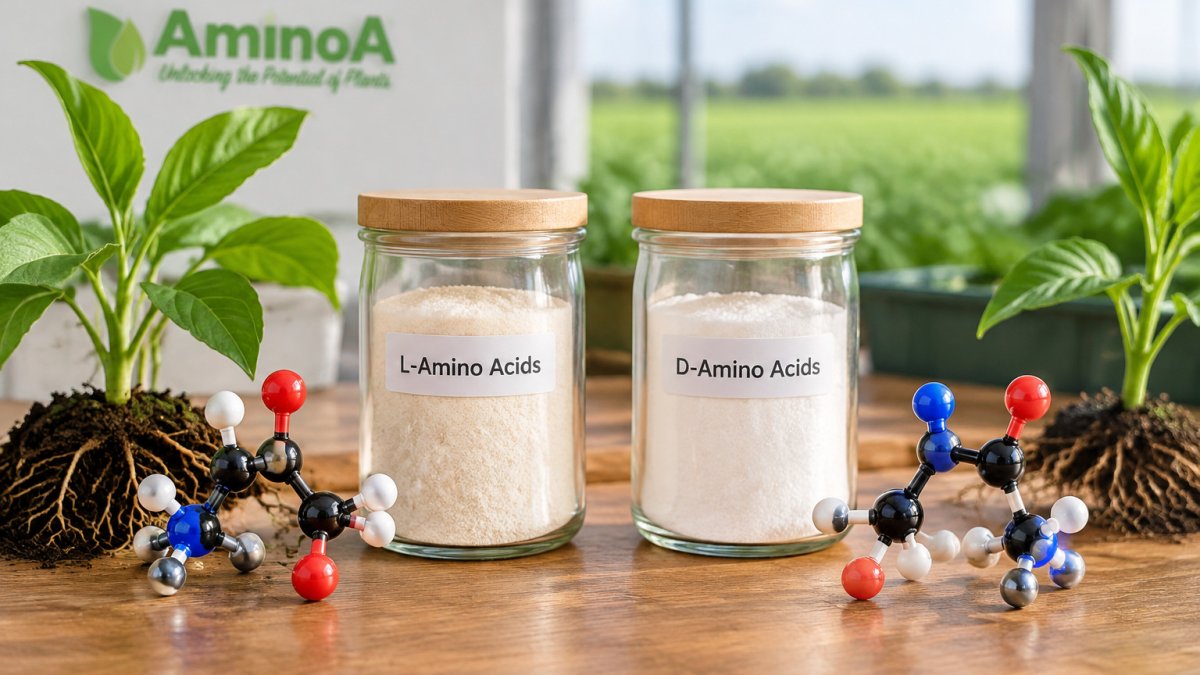
L- and D-amino acids are stereoisomers: identical atoms, arranged as mirror images around a chiral central carbon. Think of your left and right hands. Same parts, opposite arrangement, and they do not fit the same glove.
That mirror-image difference matters because plant enzymes are themselves chiral. A binding site shaped for an L-amino acid will not accept the D form properly, in the same way a right-hand glove will not take a left hand.
If the terminology is new to you, our plain-language explainer on D and L amino acids walks through the basics for growers.
Comparison Table: Bioavailability and Efficacy of L- vs D-Amino Acids
The table below summarises how the two forms compare across the factors that decide product performance.
| Factor | L-Amino Acids | D-Amino Acids |
|---|---|---|
| Configuration | Match natural protein structure | Mirror image of L form |
| Uptake by plants | Readily recognised by plant enzymes | Poorly matched to uptake sites |
| Role in protein synthesis | Direct building blocks | Not directly incorporated |
| Natural occurrence | Dominant form in plant metabolism | Present in nature, specific roles |
| Typical use in agriculture | Formulated as biostimulants | Limited, evidence still developing |
| Best for | Growth, yield, stress support | Research interest, not routine use |
The practical takeaway: for crop nutrition, the L form is the one with a clear route into plant metabolism.
L-Amino Acids for Plants: The Preferred Form for Growth and Yield
L-amino acids are the form plants build proteins from, which is why they dominate both plant metabolism and commercial biostimulant formulations. They support protein synthesis, enzyme function and nutrient uptake, and they are the configuration plant enzymes evolved to work with.
Product literature from manufacturers makes strong claims here. One supplier states that L-amino acid formulations can improve crop growth, stress tolerance, nutrient uptake and yield, though the published excerpt provides no numerical results Unlocking the Power of L-Amino Acids in Agriculture.
What we can say with confidence is narrower and more useful: supplying nitrogen and carbon in a form the plant recognises removes a conversion step. If you want the deeper definition, our guide to what an L-alpha amino acid is covers it in detail.
D-Amino Acids in Plants: Biological Roles and Limits
D-amino acids are not biologically irrelevant, and any guide that dismisses them outright is oversimplifying. They occur in plants, in soil and in microbes, and they carry out specific functions that the L forms do not. The question for growers is not whether D-amino acids do anything, but whether those functions translate into a reliable benefit in a commercial crop.
Where D-amino acids occur
D-amino acids are present in plant tissues, in bacterial cell walls and in soil organic matter. They arise through several routes: direct synthesis by enzymes such as racemases, release from microbial metabolism, and gradual chemical racemisation of L forms over time in soil and in stored products. A review by Grishin and colleagues (2020) examines D-amino acids in nature, agriculture and biomedicine and notes that their effects can differ from those of L-amino acids D-amino acids in nature, agriculture and biomedicine.
What D-amino acids do in plants
The published roles fall into a few broad categories. Some D-amino acids act as signalling molecules or influence root architecture. Some are taken up and metabolised, but slowly and through different routes from the L forms. Others appear to be tolerated rather than used, and at higher concentrations some can inhibit growth.
That variability is the central point. The research does not establish that D-amino acids are generally beneficial or harmful to crops. It establishes that they are biologically active in ways that are not yet predictable enough to build a nutrition programme around.
Why the evidence is harder to read than it looks
Most of the mechanistic work on D-amino acids comes from laboratory and controlled-environment studies using purified compounds and defined concentrations. Field trials with formulated products are far scarcer, and where they exist they rarely isolate the D fraction from the rest of the formulation. A product that is not specified as L-form may contain a meaningful proportion of D isomers, and you have no clear evidence base telling you what those isomers will do in your crop at your rate.
The practical position
For growers, the honest position is caution rather than condemnation. Where the science is unsettled, buy the form with the established route into plant metabolism. If a supplier cannot tell you the L/D composition of its product, that is a reason to ask harder questions rather than to assume the D fraction is harmless.
Watch out: a product described only as "free amino acids" or "plant-derived amino acids" tells you nothing about configuration, and the D fraction in such products is rarely declared.
Amino Acid Biostimulants: How to Assess Composition and Claims
Most amino acid biostimulants look identical on the label. The differences that matter sit in the specification sheet, not the marketing copy.
Use this checklist before committing to a product:
- Does the label state the percentage of L-α amino acids, or only total amino acid content?
- Is the production method named (enzymatic hydrolysis versus chemical hydrolysis)?
- Is the free amino acid content stated separately from total nitrogen?
- Are the declared nutrients (nitrogen, potassium, iron, magnesium) listed with figures?
- Does the supplier provide trial data on a crop comparable to yours?
- Is the product's legal status as a biostimulant clear under current UK rules?
The single most useful question is the first one. Total amino acid content tells you nothing about configuration. A product can be 80% amino acids and still deliver a fraction of that in the usable L form.
Amino Acids and Plant Stress Resistance: What the Evidence Shows
Amino acids support stress tolerance through their role in plant signalling and metabolism. The 2026 Plants review links amino acids to plant responses under stress conditions, which is a broad mechanism rather than a guaranteed field result.
This is where expectations need managing. Cold, heat and drought tolerance are complex traits influenced by genetics, soil, water management and timing. A biostimulant supports the plant's own defences; it does not replace them.
For a practical look at how biostimulants interact with drought specifically, see our breakdown of how biostimulants impact drought stress tolerance.
Application Rates, Timing and Delivery Methods for L-Amino Acids
Most ranking pages stop at the mechanism and never tell a grower how to put an amino acid product on a crop. This section closes that gap with the delivery routes, timing windows and rate logic that actually decide whether an L-amino acid application earns its place in a programme.
Delivery routes
Foliar application is the most common route because it bypasses soil interactions and puts the amino acid where the plant can take it up through the leaf surface. Root drench and fertigation are used where the programme already runs through irrigation, and they suit high-value horticultural crops with frequent waterings. Soil application is the least efficient per unit of product, because a proportion of the amino acid is taken up by soil microbes or bound before the root reaches it.
Timing windows
Timing matters more than most growers expect.
A common pattern is to apply at two or three key stages rather than spreading the same total volume thinly across the season. Splitting the dose across the stages that matter tends to give a clearer response than a single large application.
Rate logic
The honest answer on rates is that they are product-specific. Dose depends on concentration, crop, growth stage and whether you are tank-mixing. Follow the manufacturer's label, and always jar-test a new tank mix before spraying a full block.
Tank-mix compatibility and phytotoxicity
Watch out: phytotoxicity from a badly sequenced tank mix is a real risk. If you are combining with fungicides or insecticides, check compatibility and spray order first.
Interactions with soil and other inputs
Our guidance on foliar feeding timing covers when to spray for the best results.
Choosing an L-Amino Acid Biostimulant for Your Farm
Choose a product that declares its L-form content, names its production method and gives you trial evidence on your crop type. Everything else is secondary.
This is where we make our case. AminoA biostimulants are 100% L-α amino acids, produced through enzymatic hydrolysis, with every essential amino acid supplied in the L form.
For help integrating amino acids into an existing programme, our grower's guide to amino acid biostimulants sets out the practical steps.
The gap between a product that works and one that merely contains nitrogen is a single letter on the specification sheet.
Frequently Asked Questions
What is the difference between L-amino acids and D-amino acids?
L-amino acids and D-amino acids are mirror-image forms of the same molecule, a property called chirality. The difference lies in the arrangement of atoms around the central carbon. In agriculture, this matters because plant enzymes recognise the L-form, while the D-form is not used efficiently for protein synthesis. A 2020 review by Grishin and colleagues notes that D-amino acids occur in nature and can have biological effects, but they are not a direct substitute for L-forms in crop nutrition.
Do plants absorb L-amino acids more readily than D-amino acids?
Yes, plants absorb and use L-amino acids more readily. The review in Plants (2026) describes amino acids as key molecules in plant nutrition, signalling and stress responses, and the L-form fits the enzymes involved in these processes. D-amino acids can be taken up but are not efficiently incorporated into proteins. For practical crop nutrition, choose products that specify 100% L-α amino acids, such as those from AminoA, which are produced through enzymatic hydrolysis.
Can D-amino acids affect plant development?
D-amino acids are not biologically irrelevant. Research, including a 2020 review on D-amino acids in nature and agriculture, shows they can have specific biological roles in plants and other organisms. However, the supplied research does not establish that D-amino acids are generally beneficial or harmful to crops. They should not be treated as a replacement for L-amino acids in a nutrition programme. The safest approach is to use products with a known L-form content and to trial any new input on a small area first.
How do amino acids help crops cope with environmental stress?
Amino acids support stress resistance by acting as signalling molecules and by feeding into plant metabolism. A 2026 review in Plants describes their roles in plant nutrition, signalling, growth and stress responses. AminoA states that its products increase resistance to cold, heat, drought and agrochemical phytotoxicity, and Velcourt trials found that adding AminoA FLO to reduced fungicide rates maintained yields and improved green leaf area in winter wheat.
How should growers choose an amino acid biostimulant?
Check the label for the form and source of amino acids. Look for 100% L-α amino acids produced by enzymatic hydrolysis, and avoid products that do not state the L-form content. Consider the nitrogen, potassium, iron and magnesium content, and ask for trial data on your crop type. AminoA has 10 years of experience in the UK market and offers L-α amino acid biostimulants. Request current pricing from AminoA's website or a quote before committing to a full season.