 ultimate-guide
D and L Amino Acids: What Growers Need to Know
Table of Contents
- What Makes D and L Amino Acids Different
- Why Plants Use L-Amino Acids Almost Exclusively
- Where Each Form Occurs in Nature and in Manufactured Inputs
- L-Alpha Amino Acid Benefits for Crop Development
- Amino Acid Uptake Mechanisms in Leaves and Roots
- How to Read a Biostimulant Label for Amino Acid Form
- Conclusion
- Frequently Asked Questions
Last Updated: September 17, 2026
What Makes D and L Amino Acids Different
D and L amino acids are mirror-image versions of the same molecule, and that geometric difference changes everything about how plants use them. This guide from AminoA explains why the distinction matters before you spend money on any biostimulant.
Amino acids are the building blocks of proteins, and every amino acid (except glycine) exists in two forms: a left-handed L form and a right-handed D form. They share the same chemical formula, the same atoms, and the same molecular weight. The only difference is spatial arrangement around a central carbon atom. Think of it as a pair of gloves: identical in every measurable way except that one fits the left hand and one fits the right.
That mirror-image relationship is called chirality, from the Greek word for hand.
The Mirror-Image Structure Behind the Difference
The technical term for this handedness is chirality, and the naming convention comes from how each form rotates polarised light. An L-amino acid rotates it left; a D-amino acid rotates it right.
The critical point for growers is that enzymes are themselves chiral. A plant enzyme built to bind an L-amino acid simply cannot bind the D version, the same way a right-handed glove will not accept a left hand. This is not a matter of preference or efficiency. It is a structural impossibility.
This single fact explains almost everything that follows about how plants absorb, transport, and use amino acid inputs.
Why Plants Use L-Amino Acids Almost Exclusively
Plants build their proteins from L-amino acids almost without exception. Ribosomes, the cellular machinery that assembles proteins, recognise only the L configuration.
A common mistake is assuming that because a product contains "amino acids," the plant can use all of them. In practice, the D forms present in a poorly manufactured input may contribute little to protein synthesis, though some soil microbes can convert them over time.
What most guides miss is that the L designation on a label is not marketing language. It describes a specific molecular geometry that determines whether the plant's biochemistry can engage with the product at all.
If you are coming from a standard NPK programme, this is the conceptual shift: amino acid biostimulants are not simply another nutrient source. They are substrates that must match the plant's molecular machinery to work.
Where Each Form Occurs in Nature and in Manufactured Inputs
L-amino acids dominate living systems, but D-amino acids are not absent from nature. They appear in bacterial cell walls, in some insect and marine organisms, and in certain signalling roles in mammals. In agricultural soils, they turn up mainly through microbial activity.
Manufactured inputs vary widely in form composition. Some are produced by chemical synthesis, which typically yields a racemic mix of roughly equal D and L forms. Others are produced by enzymatic hydrolysis, which preserves the L configuration because it mimics the way nature breaks proteins down.
The production method, not the raw material, usually determines what you actually get in the bottle.
D-Amino Acids in Soils and Microbial Systems
In soil, D-amino acids are primarily a microbial phenomenon. Certain bacteria release them as signalling molecules or incorporate them into cell wall structures, and other microbes can enzymatically convert D forms to L forms.
For growers, the practical implication is that soil biology provides a slow, partial conversion pathway. A product heavy in D forms is not necessarily useless, but you are relying on microbial conversion rather than direct plant uptake. That is a slower and less predictable route to the same destination.
Enzymatically hydrolysed L-α products skip that step entirely.
L-Alpha Amino Acid Benefits for Crop Development
The benefits of L-alpha amino acid inputs trace directly back to the fact that plants can use them immediately. Free L-α amino acids are small enough to be absorbed and are already in the correct configuration for protein synthesis and other metabolic roles. While these naturally occurring forms drive efficient plant development, researchers are also exploring how advancements in unnatural amino acid synthesis might eventually expand the range of metabolic tools available for crop resilience.
Growers using L-α amino acid biostimulants report improvements across several areas:
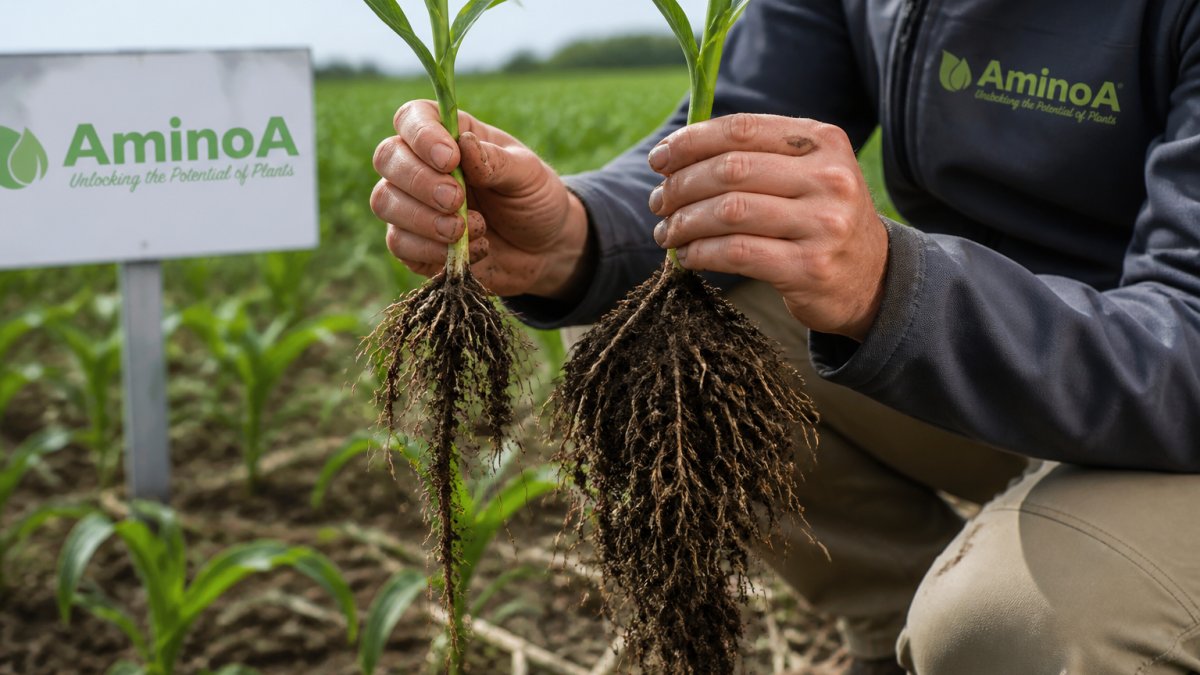
- Root, leaf, and bud development, particularly during establishment and early growth
- Blossom stimulation and more consistent fruit formation
- Greater resistance to cold, heat, and drought stress
- Reduced phytotoxicity damage when tank-mixed with agrochemicals
- Improved overall yield and crop quality at harvest
At AminoA, every essential amino acid in our formulations is supplied in the L form, produced through enzymatic hydrolysis rather than chemical synthesis.
Amino Acid Uptake Mechanisms in Leaves and Roots
Amino acid uptake mechanisms differ between roots and leaves, and understanding both helps you time applications correctly.
Root uptake happens through specific transporter proteins in the root cell membrane. These transporters are selective for L-amino acids, which means the D forms largely cannot enter through this pathway. Once inside, L-amino acids feed directly into nitrogen metabolism and protein building.
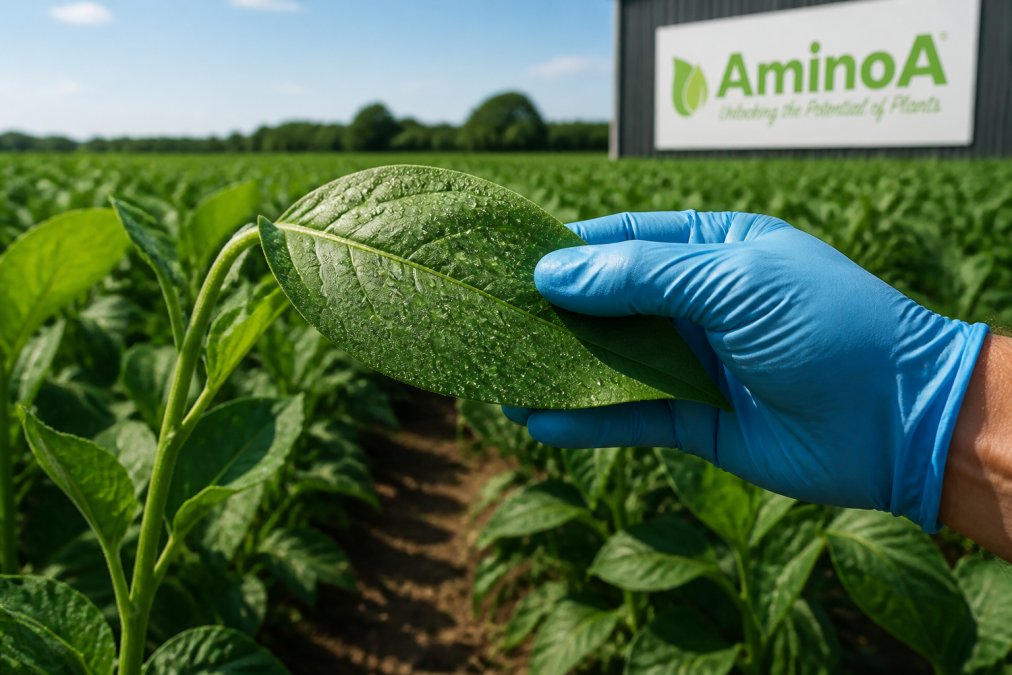
Foliar uptake works differently. Dissolved amino acids pass through the leaf cuticle and stomata, then cross the cell membrane via similar L-selective transporters. Because foliar absorption bypasses the soil entirely, it delivers a faster response, often within days rather than weeks.
In practice, most programmes combine both routes: soil application for sustained supply and foliar sprays for rapid intervention during stress or key growth stages.
How to Read a Biostimulant Label for Amino Acid Form
Most labels state total amino acid content without specifying form. That figure tells you how much nitrogen and carbon the product contains, but not how much the plant can use directly.
Here is a short checklist for evaluating any amino acid product:
- Does the label state "L-α amino acids" or "free L-amino acids," or only "amino acids"?
- Is the production method named? Enzymatic hydrolysis preserves the L form; chemical synthesis does not.
- Is the percentage of L-form specified, or only total content?
- Are the declared nutrients (nitrogen, potassium, iron, magnesium) listed with concentrations?
- Is the product's certification status clear if you farm organically?
If a supplier cannot tell you the L-form proportion and the hydrolysis method, treat that as a gap in the specification rather than a detail to overlook.
Conclusion
Working out which amino acid products will actually perform in the field comes down to one question: how much of the declared content is in the form plants can use. AminoA has spent a decade supplying L-α amino acid biostimulants produced through enzymatic hydrolysis, with every essential amino acid in the L form and a high content of nitrogen, potassium, iron, and magnesium. Trials with Velcourt found that adding AminoA FLO to reduced fungicide rates maintained yields and improved green leaf area in winter wheat. Subscribe to our newsletter for trial updates and practical guidance on building amino acids into your programme.
Frequently Asked Questions
What is the main difference between D and L amino acids?
They are mirror images of each other, like a left and right hand. Both share the same chemical formula, but the arrangement of atoms around the central carbon is reversed. This small structural difference changes how they behave in living systems. Plants build proteins almost entirely from L forms, while D forms appear mainly in bacterial cell walls and some microbial metabolites. For crop nutrition, the distinction decides whether an applied amino acid is used efficiently or largely wasted.
Why do plants primarily utilise L-amino acids?
Plant enzymes are built to recognise the L configuration. The transport proteins in leaf and root membranes, and the enzymes that assemble proteins, are shaped to bind L forms specifically. A D-amino acid will not fit these binding sites correctly. This is why a biostimulant built on 100% L-alpha amino acids delivers more of what the crop can actually use, rather than a mix where a portion of the product cannot be taken up efficiently.
Are D-amino acids found in nature?
Yes, but in specific places. D-amino acids occur in bacterial cell walls, in some microbial signalling compounds and in certain marine organisms. Soil microbial communities produce and consume them as part of normal turnover. Their presence in soil does not mean crops can use them the way they use L forms. When you apply a biostimulant, what matters is the form the plant can absorb and metabolise, and that is overwhelmingly the L configuration.
What role do L-alpha amino acids play in stress resistance?
L-alpha amino acids support the plant's own defence and recovery systems. They feed into the production of stress-related compounds and help maintain cell function when conditions turn against the crop, whether that is cold, heat or drought. Trials with AminoA FLO added to reduced fungicide rates in winter wheat maintained yields and improved green leaf area, which suggests the crop coped better with disease pressure when amino acid nutrition was maintained.