 ultimate-guide
Amino Acids in Plants: How They Boost Crop Growth
Table of Contents
- What Amino Acids Do Inside a Plant
- Do Plants Make All the Amino Acids They Need?
- L-Alpha Amino Acid Biostimulants: What Sets Them Apart
- Plant Stress Resistance Mechanisms and Amino Acids
- Foliar Application of Amino Acids: Getting It Right
- Amino Acids and Nutrient Uptake: What the Evidence Shows
- Common Mistakes When Using Amino Acid Products
- Conclusion
- Frequently Asked Questions
Last Updated: September 13, 2026
What Amino Acids Do Inside a Plant
Amino acids in plants are the nitrogen-containing compounds that build proteins, regulate growth signals, and move nutrients between tissues. They are not a peripheral input; they sit at the centre of how a crop grows, ripens and survives stress. This guide from AminoA examines what they do, where they come from, and how growers get the most from them.
Every amino acid has the same basic architecture: a central carbon atom bonded to an amino group, a carboxyl group, and a side chain that determines its behaviour. That side chain is why glycine behaves differently from tryptophan. The plant does not treat them interchangeably.
The Building Blocks of Protein and Growth
Proteins are chains of amino acids, and every enzyme, receptor and structural component in a plant is built from them. Without a steady supply, cell division stalls and new tissue cannot form.
The practical consequence is straightforward: nitrogen applied as nitrate must be converted before it can be used, while nitrogen delivered as amino acids is already in a usable form. That conversion step costs the plant energy.
Signalling, Transport and Hormone Precursors
Amino acids also act as signals. Glutamate and glutamine carry nitrogen around the plant, moving it from source leaves to growing points. Others serve as precursors for hormones: tryptophan is the starting point for auxin, which drives root and shoot development.
This dual role explains why deficiency symptoms rarely look like simple hunger. A crop short of amino acids may show uneven growth, poor root development or slow recovery after stress rather than a uniform yellowing.
Do Plants Make All the Amino Acids They Need?
Plants synthesise all twenty protein-forming amino acids themselves, unlike animals, which must obtain several from their diet (peer-reviewed research). This is the point most growers miss when they question whether supplementation makes sense.
Synthesis, however, is not free. Each amino acid requires carbon skeletons, ATP and reducing power drawn from photosynthesis. Under cold, drought, salinity or disease pressure, photosynthesis slows and the plant's own production falls short of demand at exactly the moment demand is highest. Supplementary amino acids bridge that gap.
Royal Horticultural Society guidance on plant nutrition and biostimulants
L-Alpha Amino Acid Biostimulants: What Sets Them Apart
L-alpha amino acid biostimulants are products built from the L-form of amino acids, the mirror-image configuration that plant metabolism actually uses. The distinction matters more than most product labels suggest.
Amino acids exist in two mirror forms, L and D. Plant enzymes are built to recognise the L form. A product containing a high proportion of D-isomers is largely wasted, because the plant cannot slot those molecules into its metabolic pathways without first converting them.
Why the L Form and Enzymatic Hydrolysis Matter
How a product is manufactured determines what the plant can use. Enzymatic hydrolysis breaks protein down under mild conditions, preserving the L configuration. Harsher chemical extraction can racemise part of the material, converting L forms into D forms the crop cannot use directly.
AminoA manufactures 100% L-α amino acids through enzymatic hydrolysis, with every essential amino acid present in the L form. The range also carries a high content of nitrogen, potassium, iron and magnesium, so the application delivers both the amino acid fraction and supporting nutrition. A common mistake is assuming all amino acid products are equivalent; the isomer profile and extraction method are what separate them.
Plant Stress Resistance Mechanisms and Amino Acids
Amino acids support stress resistance through several overlapping mechanisms rather than a single switch. Understanding them helps explain why results vary between seasons and sites.
- Osmotic adjustment: free amino acids help cells hold water balance under drought and salinity
- Reactive oxygen species scavenging: certain amino acids and their derivatives neutralise oxidative damage
- Membrane stabilisation: amino acids support the integrity of cell membranes under heat and cold
- Hormone precursor supply: stress responses depend on hormones built from amino acids
The practical effect is that treated crops tend to recover faster after a stress event, not that they become immune to it. Growers should expect better recovery and greener tissue, not a crop that shrugs off frost.
Foliar Application of Amino Acids: Getting It Right
Foliar application of amino acids delivers the material directly to the leaf, bypassing the soil and root pathway. Uptake is fast, which makes it well suited to correcting a shortfall during a critical growth stage.
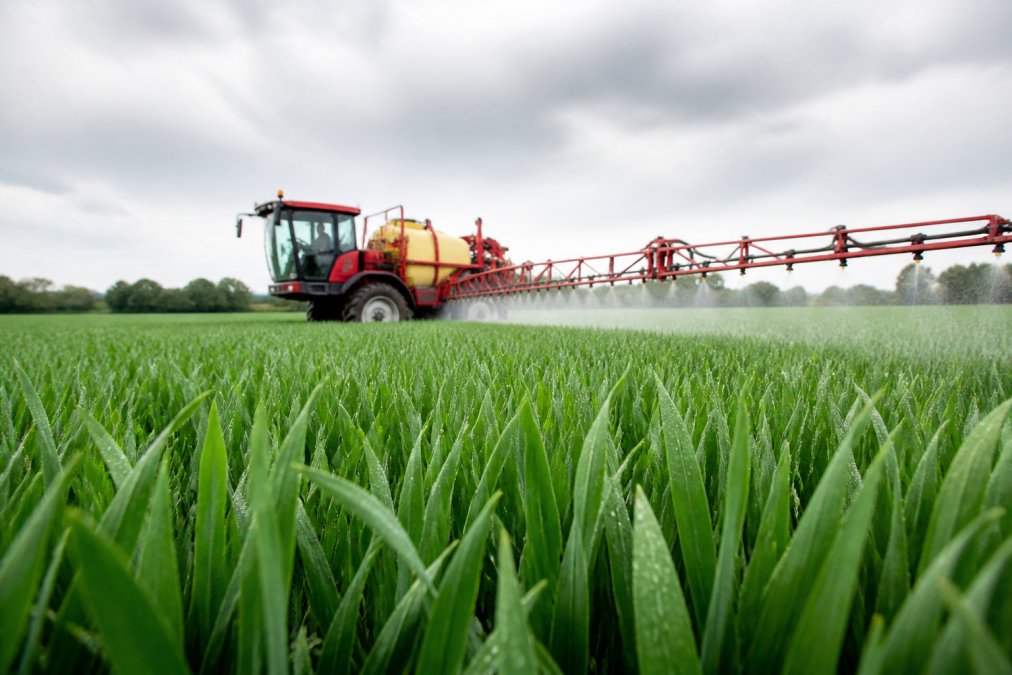
The leaf is a surprisingly effective entry point, but only under the right conditions. Stomata must be open, the leaf surface must stay wet long enough for absorption, and the solution must not run off before it has been taken up.
Timing, Rates and Tank Mixing
Timing drives results more than rate. Applications land best just before or during a known stress window, or at a growth stage where demand spikes: early tillering, stem extension, flowering and fruit set.
| Situation | Best Timing | Notes |
|---|---|---|
| Cold spell forecast | 2-3 days before | Supports recovery after the event |
| Drought stress | Early morning | Stomata open, evaporation low |
| Flowering and fruit set | At first flower | Supports blossom and set |
| Post-phytotoxicity | Within 48 hours | Aids recovery of damaged tissue |
Tank mixing is where good intentions go wrong. Amino acids are generally compatible with many fungicides and insecticides, but high-concentration mixes, extreme pH or tank mixes with several actives can cause problems. Always jar-test a small quantity before committing a full sprayer load.
Amino Acids and Nutrient Uptake: What the Evidence Shows
Amino acids improve nutrient uptake in two ways: they chelate metal ions, keeping iron, zinc and manganese available rather than locked up, and they support root development, which expands the surface area doing the absorbing.
Growers often ask whether this replaces conventional fertiliser. It does not. Amino acids improve the efficiency of a nutrition programme; they do not remove the need for one. Trials run by Velcourt found that adding AminoA FLO to reduced fungicide rates maintained yields and improved green leaf area in winter wheat, which is the kind of outcome to expect: maintained performance with less input, not a free lunch.
For growers weighing the cost, the honest answer is that return depends on crop, season and how the product is used. AminoA publishes trial results and offers smaller pack sizes so growers can test on their own land before committing to a full season.
Agriculture and Horticulture Development Board resources on crop nutrition and biostimulants
Common Mistakes When Using Amino Acid Products
The same errors show up again and again, and most are avoidable. Watch for these:
- Buying on price alone. A cheap product with a poor L-isomer profile delivers less usable material per litre.
- Applying at the wrong stage. Amino acids help most at stress windows and demand peaks, not as a routine calendar spray.
- Skipping the jar test. Tank incompatibility is the fastest way to damage a crop and waste a pass.
- Expecting a rescue treatment. Amino acids support recovery; they are not a cure for a crop already under severe stress.
- Ignoring the rest of the programme. Nutrition, drainage and disease control still do the heavy lifting.
Conclusion
Getting more from every hectare means making inputs work harder, and amino acids are one of the more reliable levers available when they are used at the right time and in the right form.
AminoA has spent ten years supplying L-α amino acid biostimulants built through enzymatic hydrolysis, with every essential amino acid in the L form and a high content of nitrogen, potassium, iron and magnesium. The range supports root, leaf and bud development, helps crops resist cold, heat, drought and agrochemical phytotoxicity, and is backed by trial work on commercial farms.
Get started with AminoA and put a proven L-α amino acid programme behind your next crop. Subscribe to our newsletter for trial results and application guidance.
Frequently Asked Questions
What is the role of L-alpha amino acids in plant physiology?
L-alpha amino acids are the form plants can use directly. They build proteins, act as precursors to hormones like auxins and gibberellins, and help transport nutrients such as nitrogen and potassium around the plant. Because they are already in the L configuration, the plant does not need to convert them before use, which saves metabolic energy that can go into growth instead. This is why L-alpha amino acid biostimulants are absorbed and used more efficiently than synthetic alternatives.
How do amino acids help plants cope with environmental stress?
When a plant faces cold, heat, drought or phytotoxicity, it produces stress proteins and osmolytes to protect cells. Amino acids are the raw material for both. Proline, for example, helps maintain cell water balance during drought, while other amino acids support chlorophyll production and root recovery after stress events. Applying amino acids before or immediately after a stress period gives the plant the building blocks it needs to respond faster and recover more fully.
Do plants synthesise all their own amino acids?
Plants can synthesise all 20 proteinogenic amino acids, but doing so costs energy. Under stress, disease pressure or rapid growth, demand can outstrip supply. That is where external amino acids help. A foliar application of amino acids delivers ready-made L-form amino acids that the plant absorbs through leaves, bypassing the need for synthesis. This is particularly useful during early establishment, flowering and grain fill, when energy demand is highest.
What are the benefits of applying amino acid biostimulants to crops?
Growers use amino acid biostimulants to support root and leaf development, improve blossom and fruit formation, and increase resistance to cold, heat, drought and agrochemical phytotoxicity. They can also improve nutrient uptake and help maintain yield when fungicide rates are reduced. Velcourt trials found that adding an amino acid product to reduced fungicide rates maintained yields and improved green leaf area in winter wheat, showing that these inputs can support a more balanced spray programme.