 ultimate-guide
Liquid Humic Acid in Hydroponics: Benefits and Limits
Last Updated: 3 November 2026
Quick Summary
Liquid humic acid can improve root development and help roots take up micronutrients, because its molecules hold minerals in forms plants can absorb. Growers usually start near 40ppm in nutrient solution, test before scaling up, and watch for clogging and pH shifts.
- Humic molecules hold micronutrients in forms roots can take up, supporting uptake without changing the base recipe.
- Science in Hydroponics suggests about 40ppm of humic and fulvic acids as a starting point to test.
- Add humic acid to the diluted working solution, never to a concentrated calcium or iron stock.
- Measure alkalinity before dosing, since hard and soft water respond very differently to the same dose.
- Watch for colloidal deposits in emitters and filters, and reduce the dose before blaming the product.
Table of Contents
- What Liquid Humic Acid Is and How It Behaves in Solution
- Humic vs Fulvic Acid for Hydroponics: Which Suits Your System
- Impact of Humic Acid on Root Development and Nutrient Uptake
- Dosage, ppm Targets and Timing in Nutrient Solution
- How to Use Humic Acid in Hydroponic Systems
- pH Stability, Water Quality and Mineral Compatibility
- Managing Clogging and System Maintenance Risks
- Choosing a Liquid Humic Acid Product and Getting Advice from AminoA
- Frequently Asked Questions
What Liquid Humic Acid Is and How It Behaves in Solution
Liquid humic acid is a dark, organic extract derived from decomposed plant and microbial matter, and it is one of the more commonly added biostimulant inputs in hydroponic nutrient programmes. Humic acid can hold up to 20 times its weight in water (Southland Organics on the physical properties of humic substances), which is one reason growers consider it useful in soilless media.
In a nutrient solution, the behaviour of the product matters more than its marketing. Humic molecules carry negatively charged functional groups, so they bind cations and influence how minerals remain available to roots. That same chemistry means they interact with the rest of your solution, which is where most problems begin.
Here we explain what changes when humic acid goes into water, and why those changes affect your system. We also explain where the benefits end. Growers tend to get the best results when they treat humic acid as one tool in a balanced programme, not a substitute for correct nutrition.
Humic vs Fulvic Acid for Hydroponics: Which Suits Your System
Humic and fulvic acids come from the same family of substances but behave differently. Fulvic acid has a lower molecular weight and remains soluble across a wider pH range, which is why it moves more readily through a solution. Humic acid is larger and less soluble, so it tends to stay more active at the particle level. Because its greater solubility lets it move more readily through hydroponic solutions, fulvic acid benefits are worth considering alongside humic acid’s particle-level activity.
For most hydroponic systems, the practical question is which fraction keeps your solution clear and your lines flowing. Fulvic-rich products can be easier to dose in recirculating systems, while humic-rich liquids suit growers focused on root-zone conditioning. Check the certificate of analysis for the stated fraction rather than relying on the label alone.
Impact of Humic Acid on Root Development and Nutrient Uptake
Humic substances are generally associated with better root development. Research published in the International Journal of Plant & Soil Science found that foliar application of humic acid significantly improves growth physiology, quality and yield in crops (International Journal of Plant & Soil Science study on humic acid foliar application). Earlier work by M. Haghighi also reported that amending nutrient solutions with humic acid benefits plant growth parameters, specifically yield and root development (Haghighi's study on humic acid in nutrient solutions).
The mechanism is partly chelation. Humic molecules can hold micronutrients in forms roots can take up, which supports nutrient uptake without changing your base recipe. For a deeper look at the root-level effects, see our guide on humic acid for root growth, benefits and application. Growers also link these effects to the wider root zone, which we cover in benefits of rhizosphere health for crop yield and how to improve rhizosphere microbial activity.
Dosage, ppm Targets and Timing in Nutrient Solution
Dosage is where humic acid programmes most often go wrong. Science in Hydroponics recommends a supplementation level of approximately 40ppm for humic and fulvic acids in nutrient solution (Science in Hydroponics on humic and fulvic acid dosing). Treat this as a starting point to test, not a fixed target.
Excessive application can interfere with nutrient solution management and electrical conductivity. A dosage that looks harmless on the label can shift your EC reading enough to affect how your crop takes up feed. Dose in small steps, record your EC before and after, and adjust only one variable at a time.
Timing matters too. Add humic acid to a freshly mixed solution rather than to one that has already been pH-adjusted and fed, so you can see its effect on your readings.
The article gives a starting dose and a few timing points that growers can check against their own readings.
| Item | Value | Note |
|---|---|---|
| Supplementation level | Approximately 40ppm | Starting point to test, not a fixed target |
| Dosing approach | Small steps | Record EC before and after |
| Adjustment rule | One variable at a time | Keeps effects easy to attribute |
| Timing | Freshly mixed solution | Not one already pH-adjusted and fed |
| Excess risk | Shifts EC reading | Can affect crop feed uptake |
How to Use Humic Acid in Hydroponic Systems
Application in hydroponics follows a simple sequence, but the order is important. Work through it in this order:
- Test your source water for pH, EC and alkalinity before adding anything.
- Mix your base nutrients to your normal recipe and stir thoroughly.
- Add the humic acid product at the rate you have set, starting at the low end of your range.
- Recheck pH and EC, then adjust pH to your target window.
- Monitor the reservoir for 24 to 48 hours and watch for colour change, cloudiness or sediment.
Growers who run a foliar programme alongside hydroponic feeding should note that foliar applications are a separate method with their own rates. Our advice is to keep root-zone and foliar dosing records separate so you can judge which one is producing the result.
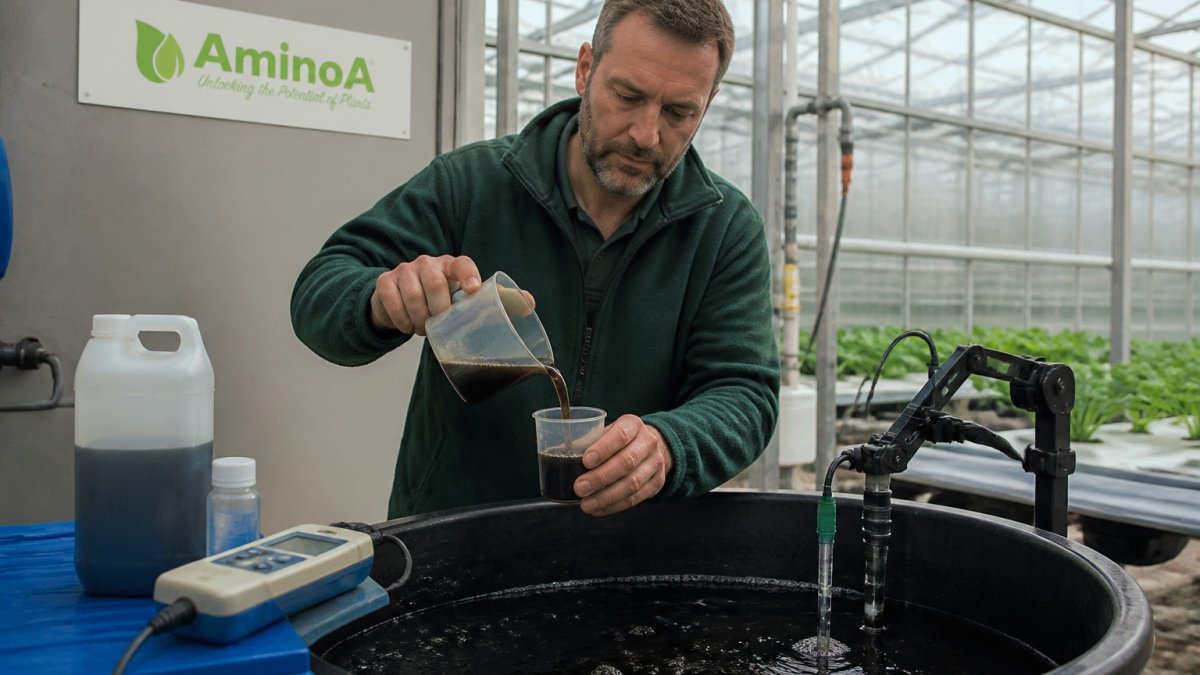
!A grower in a UK glasshouse measuring liquid nutrient solution in a hydroponic reservoir with a dosing cup and pH meter nearby
pH Stability, Water Quality and Mineral Compatibility
Humic acid is itself acidic, so its pH effect depends on the source material and the extraction process.
The practical consequence is that you cannot treat the label rate as a fixed pH outcome. Measure alkalinity, not just pH, before you start, because alkalinity tells you how much acid the water will absorb before the pH moves.
Mineral compatibility is the second half of the problem. Humic molecules bind divalent and trivalent cations, calcium, magnesium, iron, zinc, copper and manganese, and that binding is the same mechanism that makes them useful as chelating agents.
Watch out: adding humic acid to a concentrated calcium nitrate stock tank, or to a tank containing soluble iron chelates, can cause precipitation that permanently removes those nutrients from the solution and blocks emitters.
A workable test sequence before committing a whole crop:
- Record source-water pH, EC and alkalinity (carbonate and bicarbonate hardness).
- Mix your normal nutrient recipe at full strength in a small sample and record pH and EC.
- Add humic acid at your intended rate, stir, and record pH and EC again after 30 minutes and after 24 hours.
- Check for cloudiness, sediment or a colour shift that does not clear, any of these suggests precipitation.
- Only then scale the recipe to the full reservoir, and keep the sample record so you can compare against the next batch of water.
If your water source changes seasonally, many UK supplies blend surface and groundwater, repeat the test rather than assuming last month's dose still applies.
Managing Clogging and System Maintenance Risks
Liquid humic acid is a colloidal suspension of large organic molecules, and in a hydroponic system that colloid has nowhere to go.
The mechanism matters because it explains where the risk concentrates. Humic colloids are most likely to flocculate and deposit when the solution chemistry changes abruptly: a pH swing, a temperature drop, a sudden dilution, or the addition of a calcium-rich feed.
Different system types carry different exposure:
- Drip and micro-irrigation, emitters and pressure-compensating drippers are the highest-risk points because their internal pathways are narrow and any film reduces flow uniformity across the crop.
- NFT and deep water culture, roots and gully surfaces collect organic film, and the recirculating volume means any deposit is repeatedly passed through pumps and chillers.
- Aeroponic and misting systems, nozzles are the most sensitive of all; even a light colloidal film can alter spray patterns and droplet size.
- Filter and UV stages, organic loading blinds UV lamps and clogs filter media faster, reducing disinfection efficiency at the same time as it increases maintenance frequency.
A maintenance schedule that keeps the risk manageable:
- Flush lines and gullies on a fixed interval, weekly in recirculating systems running humic acid, and always at reservoir changeover.
- Clean or replace filter media before it restricts flow, not after; a partially blocked filter is already redistributing flow unevenly.
- Inspect a sample of emitters at each reservoir change and compare flow rates across the run.
- Keep the reservoir covered and clean to limit the biological growth that binds with humic deposits and compounds the problem.
- Clean UV quartz sleeves and chiller coils on the manufacturer's schedule, because organic film reduces their performance before it becomes visible.
Watch out: if you see persistent brown deposits despite a clean schedule, reduce the dose before blaming the product, over-dosing is the most common cause of colloidal dropout, and lowering the rate is usually more effective than adding a cleaning agent.
A practical compromise many growers adopt is to run humic acid in the vegetative and early-flower stages, when root-zone conditioning matters most, and to reduce or pause it during late flower and any period when the system is being run lean.
Choosing a Liquid Humic Acid Product and Getting Advice from AminoA
Choosing a product comes down to fit: the fraction it contains, how clearly it is documented, and how well it suits your water and system. Ask for the certificate of analysis, look for the stated humic and fulvic content, and check the recommended dosage against the ppm guidance above.
Pricing depends on quantity, delivery and current stock, so please contact AminoA directly for a current quote. If you want to compare options before you buy, read our guide on benefits of amino acid biostimulants for crop yield and how to choose the right biostimulant for soil health.
For tailored advice on your system, water and crop, get in touch with the AminoA team and we will help you set a dosing plan you can test and verify.
Frequently Asked Questions
Can you use liquid humic acid in hydroponic reservoirs?
Yes, liquid humic acid can be added to hydroponic reservoirs, but it should be dosed into the nutrient solution after the base mineral nutrients are fully dissolved and the pH has been checked. Adding it to concentrated stock too early can cause precipitation or interactions with certain minerals. The right dosage depends on your crop, your system and your product's label. Start with the manufacturer's recommended rate, monitor electrical conductivity and pH after each addition, and adjust gradually rather than in large single doses.
What is the difference between humic and fulvic acid for plants?
Humic and fulvic acids are both humic substances, but they differ in molecular size and solubility. Fulvic acid has a lower molecular weight, is soluble across the full pH range and is more mobile within the plant, which makes it useful for moving nutrients. Humic acid is larger, less soluble at low pH and tends to bind to particles and improve structure, and it can hold large amounts of water relative to its weight. In hydroponics, where there is no soil structure to improve, the practical question is which fraction stays stable in your nutrient solution and works with your existing fertiliser programme.
How does humic acid improve nutrient absorption in hydroponics?
Humic substances carry many functional groups that can act as chelating agents, holding positively charged micronutrients in forms roots can take up more easily. This relates to cation exchange capacity and can reduce nutrient lockout where minerals would otherwise precipitate. Results depend on crop, dose and baseline nutrition. The effect is supportive rather than a substitute for a balanced nutrient programme.
Does humic acid affect the pH of hydroponic nutrient solutions?
Yes. Humic substances have buffering properties and their acidic functional groups can shift the pH of a nutrient solution, usually in the direction of stability rather than sudden swings. Because the effect varies with product, concentration and water hardness, check pH before and after dosing and again after the solution has circulated for a few hours. Adjust your pH correction protocol to the readings you see rather than assuming a fixed offset.
Subscribe to our Newsletter for practical biostimulant guidance from AminoA.