 how-to
How to Improve Rhizosphere Microbial Activity
Last Updated: 22 October 2026
Quick Summary
To improve rhizosphere microbial activity, feed the bulk soil carbon with organic matter in autumn, keep living roots in the ground for as much of the year as possible, and cut excessive tillage, over-application of soluble nitrogen and waterlogging. Cover crops bridge the gap between cash crops, and you should take a baseline test before changing anything.
- Apply organic matter in autumn when soil is warm and moist, spread evenly rather than in heaps.
- Give cover crops at least six weeks of active growth and terminate by grazing, rolling or shallow incorporation.
- Apply amino acid biostimulants ahead of a forecast stress event rather than after damage appears.
- Sample the same points, at the same depth, at the same time of year, and retest after a full season.
- Fix the soil environment first, because microbial products perform poorly in compacted, anaerobic or carbon-starved soil.
Table of Contents
- What Rhizosphere Microbial Activity Actually Means
- How to Increase Soil Microbial Activity Before You Touch the Rhizosphere
- Root Exudates and Soil Microbes: The Partnership You Can Influence
- Cover Crops and Soil Microbes: Building the Rhizosphere Between Cash Crops
- Where Amino Acid Inputs Fit Into Rhizosphere Management
- Measuring Soil Microbial Activity: What to Test and When
- Common Mistakes to Avoid
- Conclusion
- Frequently Asked Questions
What Rhizosphere Microbial Activity Actually Means
Rhizosphere microbial activity is the biological work carried out by bacteria, fungi and other microbes in the thin layer of soil that clings to plant roots. Roots release organic compounds that feed these microbes, and the microbes return the favour by cycling nutrients back into plant-available forms.
That exchange is the engine room of soil fertility. A 2024 review by W. Thepbandit and co-authors reports that root exudates stimulate microbial activity in the rhizosphere and help determine how available soil nutrients become to the crop (review of rhizosphere microorganisms and soil nutrient availability). Growers often treat this as a fixed property of their soil. It isn't. It responds to management, and usually faster than people expect.
Below, we'll show you exactly how to improve rhizosphere microbial activity, from pre-season soil prep through to the tests that tell you whether it worked.
How to Increase Soil Microbial Activity Before You Touch the Rhizosphere
The biggest mistake with how to increase soil microbial activity is starting at the root zone. Microbes need food, air and a stable home before they can colonise a root. Get the bulk soil right first, and the rhizosphere looks after itself.
Feed the Soil Carbon, Not Just the Crop
Carbon is the limiting input on most arable land. A 2023 review notes that manure has been shown to improve microbial activity and diversity in rhizosphere soil and increase root exudation (review of pathways for engineering the rhizosphere). The practical version:
- Apply organic matter in autumn, when soil is warm and moist
- Spread it evenly rather than in heaps
- Keep a living root in the ground for as much of the year as possible
- Avoid bare, cultivated soil over winter
Cut Practices That Set Microbes Back
Some routine operations work against you. Excessive tillage breaks fungal networks and burns through carbon. Over-application of soluble nitrogen can suppress the very associations that fix nitrogen for free. Waterlogging starves aerobic microbes of oxygen within days.
Root Exudates and Soil Microbes: The Partnership You Can Influence
Root exudates and soil microbes form a two-way trade. The plant leaks sugars, organic acids and amino compounds from its roots, and in return microbes mineralise nutrients, suppress pathogens and help the plant cope with stress. A 2024 review by C. Luo and co-authors describes rhizosphere microorganisms as contributors to plant growth and stress tolerance, noting that some microbes produce ACC deaminase, which degrades a precursor to ethylene (review of rhizosphere microbiome regulation).
That matters because ethylene stalls root growth under stress. More ACC-degrading microbes means less self-inflicted damage when conditions turn.
You can't dictate what a root exudes. You can influence it:
- Keep plants actively growing, since exudation follows photosynthesis
- Avoid prolonged stress that shuts down root metabolism
- Support root mass, because more roots means more exchange surface
A plant with a poor root system has little to trade. That is where a targeted input earns its place.
Cover Crops and Soil Microbes: Building the Rhizosphere Between Cash Crops
Cover crops and soil microbes do their best work in the gap between cash crops. A living cover keeps roots exuding carbon through autumn and winter, feeding the microbial community when the field would otherwise be bare.

Species choice shapes the outcome. Deep-rooted brassicas and legumes open different soil layers and support different microbial groups. A mix usually beats a monoculture, because a diverse root community feeds a diverse microbiome.
The rules for making it work:
- Drill early enough for establishment before cold sets in
- Match species to your soil type and rotation
- Terminate by grazing, rolling or shallow incorporation, not deep burial
- Give the cover at least six weeks of active growth
Where Amino Acid Inputs Fit Into Rhizosphere Management
Amino acid inputs support the root side of the partnership. Plants build proteins from amino acids, and supplying them in the L-form, ready to use, spares the crop the energy cost of synthesis. That saved energy goes into root growth and exudation, which in turn feeds the rhizosphere.
Our position at AminoA is straightforward: amino acids are not a replacement for good soil management. They are what you add when the soil is right but the plant needs support to exploit it. Our L-α amino acid biostimulants are produced through enzymatic hydrolysis and supply every essential amino acid in the L form, alongside nitrogen, potassium, iron and magnesium.
The stress angle matters most. Crops under cold, heat or drought stress redirect resources away from root growth. Supporting the plant through those windows keeps roots active and exudation running.
Measuring Soil Microbial Activity: What to Test and When
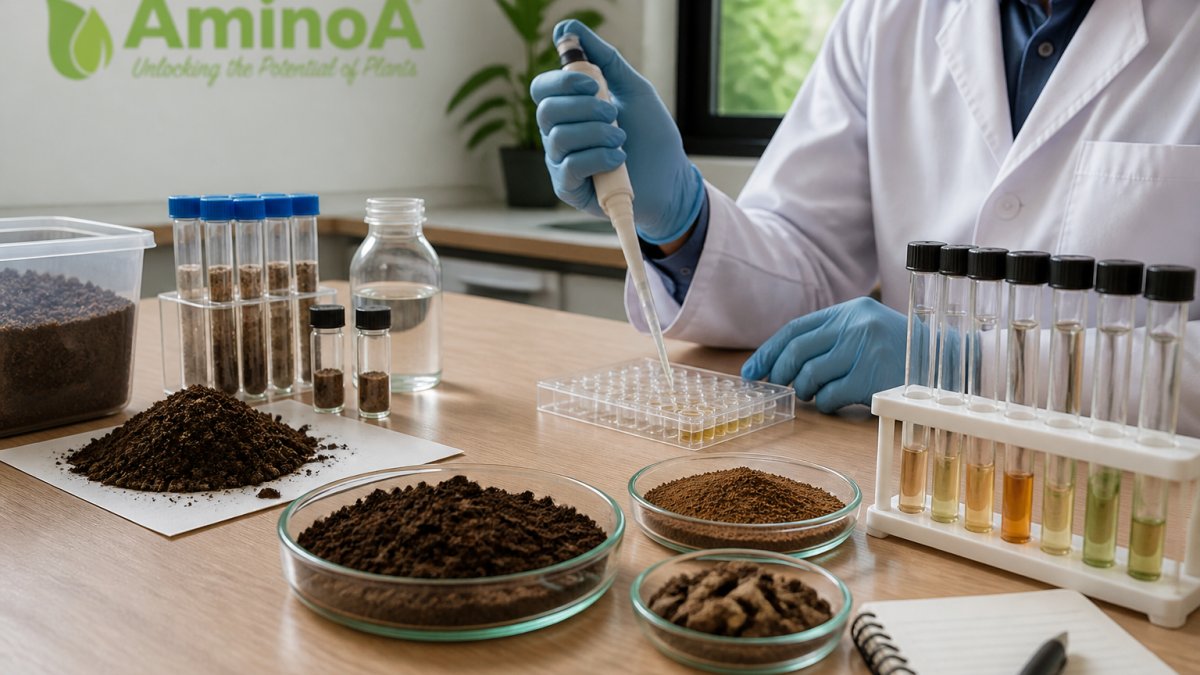
Measuring soil microbial activity means choosing a test that answers a management question. Respiration, microbial biomass and active carbon each tell you something different, and a single test rarely covers it.
Choosing a Test That Tells You Something Useful
Match the test to the decision:
| Test | What it shows | Best timing | Cost signal |
|---|---|---|---|
| Soil respiration | Overall biological activity | Spring and autumn | Low |
| Microbial biomass | Size of the living community | Once per rotation | Medium |
| Active carbon | Readily available food supply | Before changing inputs | Medium |
| Earthworm count | Soil structure and biology | Autumn | Free |
Sample the same points, at the same depth, at the same time of year. Otherwise you are measuring the weather, not your management. Take a baseline before you change anything, then retest after a full season.
Common Mistakes to Avoid
The most common error is chasing a single metric. A high respiration score on a waterlogged field means nothing useful. Biology, structure and chemistry move together, and a test read in isolation misleads.
Watch for these too:
- Changing several practices at once, then not knowing what worked
- Testing only in the best field on the farm
- Applying biology-boosting products to compacted soil, where roots cannot grow anyway
- Expecting a result in weeks rather than seasons
Fix the soil environment first. Microbial products and root inputs perform poorly in compacted, anaerobic or carbon-starved soil, no matter how good the product is.
Conclusion
Improving rhizosphere microbial activity is a management habit, not a single purchase. Feed the soil carbon, keep roots growing, protect the biology from damaging practice, and measure before and after. Do that, and the root zone responds.
If you want to support the plant side of that partnership, our amino acid biostimulants are built for exactly that job. AminoA products deliver 100% L-α amino acids, produced through enzymatic hydrolysis, with a full profile of essential amino acids plus nitrogen, potassium, iron and magnesium. They support root, leaf and bud development and help crops handle cold, heat, drought and agrochemical stress. Velcourt trials found that adding AminoA FLO to reduced fungicide rates maintained yields and improved green leaf area in winter wheat.
Subscribe to our newsletter for trial updates, application timing guidance and practical soil biology notes through the season.
Frequently Asked Questions
What is rhizosphere microbial activity?
It is the biological work done by bacteria, fungi and other microorganisms in the thin zone of soil immediately around plant roots. Roots release sugars and organic acids, and microbes use these to grow and multiply while cycling nitrogen, phosphorus and micronutrients into forms the plant can take up. A 2024 review by Thepbandit and co-authors describes how these root exudates stimulate microbial activity in the rhizosphere and how the microorganisms in turn contribute to soil nutrient availability.
How long does it take to improve soil microbial activity?
Expect the first measurable shifts within a single growing season, but a full rebuild takes several years. Adding organic matter, introducing cover crops and reducing aggressive cultivations will start changing the community quickly, though the size and diversity of the population build gradually. Test the same fields at the same time each year so you compare like with like, and judge progress across two or three seasons rather than one.
Does adding organic matter improve microbial activity in soil?
Yes. A 2023 review on engineering the rhizosphere reports that manure has been shown to improve microbial activity and diversity in rhizosphere soil and to increase root exudates. Compost, farmyard manure and incorporated crop residues all supply the carbon and energy microbes need. Apply them at realistic rates for your soil type and rotation, and remember that the benefit depends on the material breaking down in contact with soil rather than sitting on the surface.
How do cover crops affect the rhizosphere microbiome?
Cover crops keep living roots in the ground through the winter, and those roots release exudates that feed a microbial community between cash crops. Species choice matters: legumes support nitrogen-fixing rhizobia, while deep-rooted brassicas and grasses change soil structure and fungal networks. A March 2026 review reports that inoculating soil with rhizobia has been shown to promote soybean growth and enhance rhizosphere microbial activity, illustrating how a specific plant-microbe pairing can be encouraged deliberately.