 How-to
7 Steps to Optimise Nitrogen Timing in Cereal Crops
Quick Summary
Nitrogen application timing for cereal crops should match the crop's peak demand rather than a fixed calendar date. The main window is stem extension from GS31, when most of the crop's nitrogen requirement is set. Check soil temperature, moisture and crop vigour before each application, and adjust for the weather.
- Stem extension from GS31 is the period of greatest nitrogen demand.
- Soil temperature and moisture set the pace; a calendar date tells you little.
- Confirm growth stage by inspection, not by calendar date.
- Avoid applying the first dose just before a forecast period of heavy rain.
- A second dose arriving after the demand window wastes both the nitrogen and the pass.
Table of Contents
- Why Nitrogen Application Timing Matters for Cereals
- Mapping Cereal Crop Growth Stages and Nitrogen Demand
- Setting the First Nitrogen Application After Winter
- Deciding Between Split Nitrogen Applications for Cereals
- Choosing the Optimum Nitrogen Rate for Cereals
- Improving Nitrogen Use Efficiency in Cereals
- Booking Your Nitrogen Plan and Trial Support with AminoA
- Frequently Asked Questions
Why Nitrogen Application Timing Matters for Cereals
Getting nitrogen application timing wrong costs money, yield and, increasingly, environmental performance. Applied too early, nitrogen can sit in the soil and be lost before the crop needs it. Applied too late, the crop may miss the peak demand that drives tillering and grain development.
Timing matters because cereal crops do not need nitrogen at a constant rate. Demand rises sharply during rapid leaf-area expansion and stem elongation, which the Grains Research and Development Corporation identifies as the period of greatest nitrogen demand, from stem elongation at GS31 onwards (GRDC guidance on nitrogen fertiliser application timing).
Recent research supports this view. A thesis on cereal rye reports that delaying nitrogen application from early spring to mid-spring was associated with a 26% reduction in emissions (South Dakota State University thesis on nitrogen timing and emissions).
Timing also carries a loss risk. Nitrogen that is not taken up can leach or be lost to the air, which wastes input cost and works against environmental targets. Good timing reduces that exposure.
- Timing affects yield through tillering and grain development.
- Timing affects losses through leaching and volatilisation.
- Timing affects cost, because unused nitrogen is wasted spend.
Mapping Cereal Crop Growth Stages and Nitrogen Demand
Growth stages give you a practical way to time applications. Rather than working to a fixed calendar date, you match each application to what the crop is actually doing.
Early in the season, tillering sets the number of potential ears. Pre-GS30 applications can increase tillering and dry matter, according to Incitec Pivot Fertilisers, with yield gains depending on adequate moisture (Incitec Pivot guidance on nitrogen use efficiency in tough seasons).
Stem extension, from GS31, marks the start of the period of highest demand. This is the window where most of the crop's nitrogen requirement is set. Missing it is the most common timing error.
Later applications feed grain development and protein. Research identifies application at the eighth leaf stage as potentially effective for enhancing productivity under high-density dryland conditions (Taylor and Francis study on nitrogen application at the eighth leaf stage).
Use this crop-by-crop mapping as a starting point, then confirm each stage by inspection:
| Crop | Early timing | Main timing | Later timing |
|---|---|---|---|
| Winter wheat | Late February to early March, once soil is fit and the crop is actively growing | GS30-GS32 (stem extension), the peak-demand window | Flag leaf to ear emergence, where grain protein is the target |
| Winter barley | Late February, earlier than wheat where the crop is forward | GS30-GS31, a shorter window than wheat | Limited; late nitrogen mostly risks lodging and does little for yield |
| Spring wheat | At drilling or soon after emergence, where the seedbed is moist | GS31-GS32, which arrives quickly in a short season | Flag leaf, only where protein is a premium objective |
| Spring barley | At drilling or early tillering | GS30-GS31, the main yield-building dose | Usually none; late nitrogen raises grain nitrogen and can compromise malting specification |
Always confirm stage by inspection rather than by calendar. Seasons vary, and a crop that is a fortnight behind needs a later application than the date suggests.
Setting the First Nitrogen Application After Winter
The first spring application is the one most often mistimed. Apply too early, and the nitrogen may be lost before the crop can use it. Apply too late, and the crop may lose tillers it would otherwise have kept.
Soil conditions set the pace. Alberta Grains reports that the relevant soil process may take 1 to 2 weeks in warm, moist soil but 3 to 4 weeks in cold or dry soil (Alberta Grains guidance on managing in-crop nitrogen in cereals).
Check the crop as well. Look at plant vigour after winter and count tillers where you can. A crop that has come through winter poorly may need an earlier, lighter feed to support recovery. A crop that looks strong may need less.
Watch the weather for the following fortnight. Heavy rain soon after application increases leaching risk. Dry conditions can stop the nitrogen reaching the root zone at all.
- Check soil temperature and moisture before the first application.
- Assess crop vigour and tiller count after winter.
- Avoid applying just before a forecast period of heavy rain.
Watch out: applying the first dose on a set date regardless of soil and crop conditions is the commonest way to lose the early nitrogen.
Deciding Between Split Nitrogen Applications for Cereals
Splitting nitrogen into two or more applications lets you respond to crop need and conditions instead of committing the whole rate in one pass. It usually suits longer seasons and higher rates, where the risk of loss from a single large application is greater. The decision is not "split or don't split", it is how many splits, how big each one is, and what would make you change the plan mid-season.
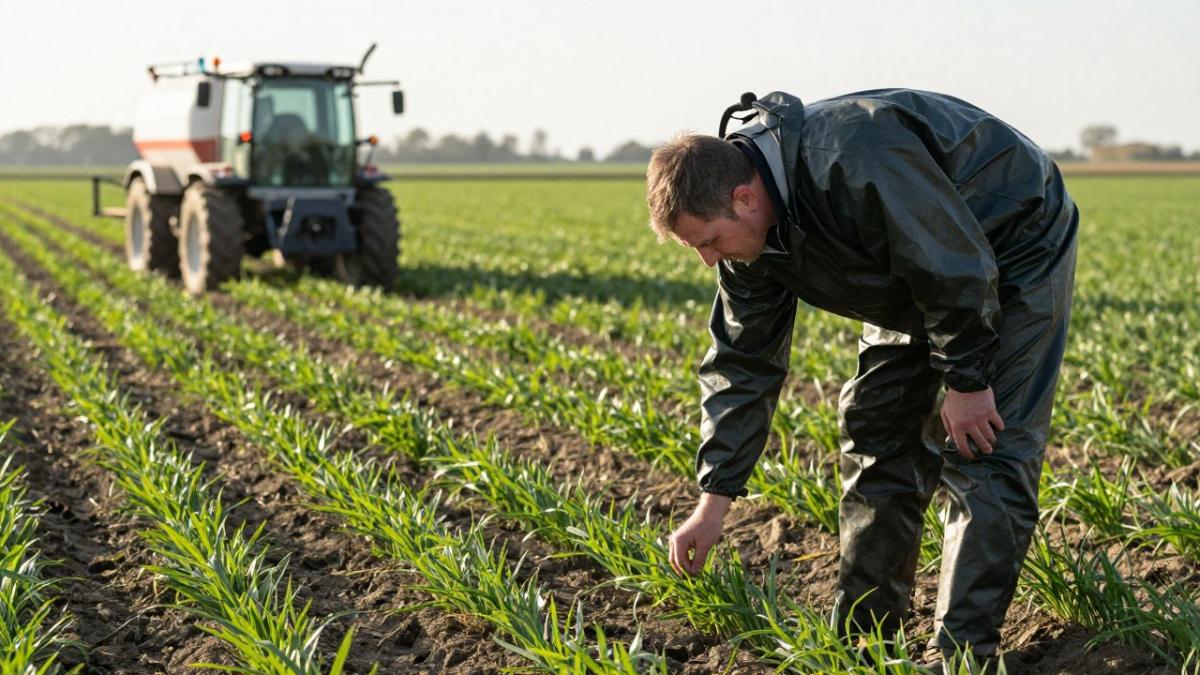
A split programme gives you control. You can hold back part of the rate until the crop shows its demand, and you can adjust the second dose to the season. A single application is simpler and cheaper to apply, but it commits you before you know how the season will run.
Compare the three common strategies before you commit:
| Strategy | Purpose | Likely benefit | Main risk |
|---|---|---|---|
| Single early dose | Cover the whole requirement in one pass | Lowest application cost, simplest logistics | Commits you before the season is known; high loss risk in a wet spring |
| Two-way split (early + GS31) | Secure tillers, then feed peak demand | Balances early support with protection of the main window | Second dose can slip past GS32 if field access is lost |
| Three-way split (early + GS31 + flag leaf) | Fine-tune supply to demand and protein | Best fit to variable seasons and premium-protein crops | More passes, more compaction risk, more chances to mistime |
Decide the split by asking four questions:
- Is the season likely to be wet, creating loss risk for a large early dose?
- Is the target rate high enough that one application would be exposed to loss?
- Can you apply the later split on time, in the correct growth window?
- Does the crop have a protein premium that justifies a late dose?
If the answer to the third question is no, a single well-timed application may outperform a split that slips.
Then set the rules that would change your plan in real time, rather than treating the schedule as fixed:
- Crop condition after winter. A thin, backward crop justifies moving more of the rate into the early split; a thick, forward crop justifies holding more back for GS31 to reduce lodging and loss risk.
- Soil nitrogen. Where a soil test or a previous legume shows good available nitrogen, cut the early dose and protect the main window; where nitrogen is low, do not starve the crop waiting for GS31.
- Rainfall forecast. If more than about 15-20 mm of rain is forecast within 48 hours of a planned application on a light or drained soil, delay it or reduce the dose, because leaching risk rises sharply. On heavy land, waterlogging is the bigger concern, and applying to saturated soil risks denitrification and run-off.
- Field access. If the window at GS31 is likely to be lost to wet ground, bring the main dose forward rather than let it slip into GS33, where it does less for yield.
- Drought. In a dry spring, nitrogen applied to a dry seedbed may not reach the roots; a lighter early dose and a later main dose timed to forecast rain is usually safer than a large early commitment.
Watch out: the commonest split failure is not the number of splits but a second dose that arrives after the demand window has closed, which wastes the nitrogen and the pass.
Choosing the Optimum Nitrogen Rate for Cereals
Timing sets when nitrogen works. Rate sets how much. Getting both right avoids the twin problems of under-feeding, which costs yield, and over-feeding, which costs money and raises loss risk.
The optimum rate depends on the crop, its yield potential, the soil's existing nitrogen supply and the season. Research on high-density dryland systems suggests that stage-specific application can improve productivity, but the rate must still match the crop's demand for that system (Taylor and Francis study on nitrogen rate and application stage).
Build the rate from the crop, not from habit. Start with the target yield, account for nitrogen the soil is supplying, and adjust for the season. Then check the result against the crop's condition during the season, not just at harvest.
For a practical calculation method, see our guide on how to calculate crop nitrogen requirements accurately. Once you have a rate, our guidance on how to optimise nitrogen application rates for crops covers how to refine it across fields.
Improving Nitrogen Use Efficiency in Cereals
Nitrogen use efficiency (NUE) describes how much of the applied nitrogen ends up in the harvested crop. Better timing is one of the most direct ways to raise it, because it puts nitrogen where the crop can take it up.
Efficiency gains come from matching supply to demand. When applications line up with stem extension and the other demand windows, less nitrogen is left in the soil to be lost. That raises the share the crop uses and reduces the input needed for a given yield.
Support the crop through the season as well. Healthy root development and good water supply help the plant take up what is applied. A foliar programme can complement soil-applied nitrogen where the crop needs extra support. Our article on choosing a foliar fertiliser explains what to consider. For timing a foliar spray, see foliar feeding timing and when to spray.
Measure the result. Compare yield and grain protein against your nitrogen input, field by field, season by season. Efficiency improves when you use those results to adjust next year's timing.
Booking Your Nitrogen Plan and Trial Support with AminoA
Good timing is easier to achieve with a clear plan and some support.
Velcourt trials found that adding AminoA FLO to reduced fungicide rates maintained yields and improved green leaf area in winter wheat. Results will depend on your crop, soil and season, so treat trial data as a guide rather than a guarantee.
If you want to see how a biostimulant could fit your programme, read our article on seven benefits of liquid biostimulants for cereal crops. Pricing depends on product, quantity, timing and delivery, so please visit our website for current prices or to request a quote.
Frequently Asked Questions
When should nitrogen be applied to cereal crops?
Nitrogen timing should follow crop development rather than the calendar alone. Demand rises sharply during rapid leaf-area expansion and stem elongation, which Grains Research and Development Corporation identifies at GS31 and later. Soil and weather conditions shift the window. Check crop stage and soil conditions together before committing to a date.
Should nitrogen fertiliser for cereals be applied in one dose or split?
Splitting is generally preferred where seasons are variable or soil nitrogen supply is uncertain, because it lets the grower respond to crop condition. A first split near early growth can support tillering, while later splits align with the period of greatest crop demand. A single large dose carries a higher risk of losses before the crop can take it up. The right split depends on soil type, rainfall and the crop's stage at each application.
Does nitrogen timing affect wheat yield and grain quality?
Yes. Improper application timing during crop growth can constrain production. Applications matched to growth stages tend to support tiller numbers, dry matter and the protein accumulation that grain quality depends on. Results vary with season and crop density, so monitor the crop after each application rather than assuming a fixed response.
Can nitrogen still be applied to cereals after stem extension?
Late applications can still be useful, but the crop's response depends on conditions at the time. Applications before GS30 can increase tillering and dry matter, which suggests that later applications serve a different purpose. Confirm soil moisture and crop condition, as a late application in dry conditions may not be taken up efficiently. Speak to your agronomist before applying late in the season.