 how-to
Measuring Nutrient Uptake in Field Crops: A Practical Guide
Table of Contents
- Why Measuring Nutrient Uptake Matters for Your Crops
- Plant Tissue Testing for Crops: The Core Method
- Nutrient Uptake by Crop Growth Stage
- How to Calculate Crop Nutrient Uptake From Tissue Results
- Estimating Crop Nutrient Removal at Harvest
- Combining Soil Tests and Tissue Tests for Complete Assessment
- Common Mistakes When Measuring Nutrient Uptake
- Conclusion
- Frequently Asked Questions
Last Updated: October 17, 2026
Why Measuring Nutrient Uptake Matters for Your Crops
Understanding how to measure nutrient uptake in field crops is essential for making informed fertiliser decisions. Most growers apply nutrients based on habit or blanket recommendations rather than what their crops actually need. This approach wastes money and can damage soil health over time.
Measuring nutrient uptake tells you the real story. It shows what your plants are taking from the soil at different growth stages. Armed with this data, you can adjust your feeding strategy to match crop demand, not guesswork.
The benefits are straightforward:
- Reduce overapplication of expensive nutrients
- Identify deficiencies before they tank your yield
- Fine-tune your input timing for maximum efficiency
- Build a record of what works on your specific soil
At AminoA, we work with growers who want to optimise their nutrient management without relying on outdated blanket programmes. Measuring nutrient uptake is the foundation of that approach. Whether you're managing conventional or regenerative systems, knowing what your crops are actually taking up transforms how you feed them. Precision in these measurements provides the empirical evidence necessary for verifying regenerative practices, ensuring that soil health improvements are directly linked to tangible crop performance.
Plant Tissue Testing for Crops: The Core Method
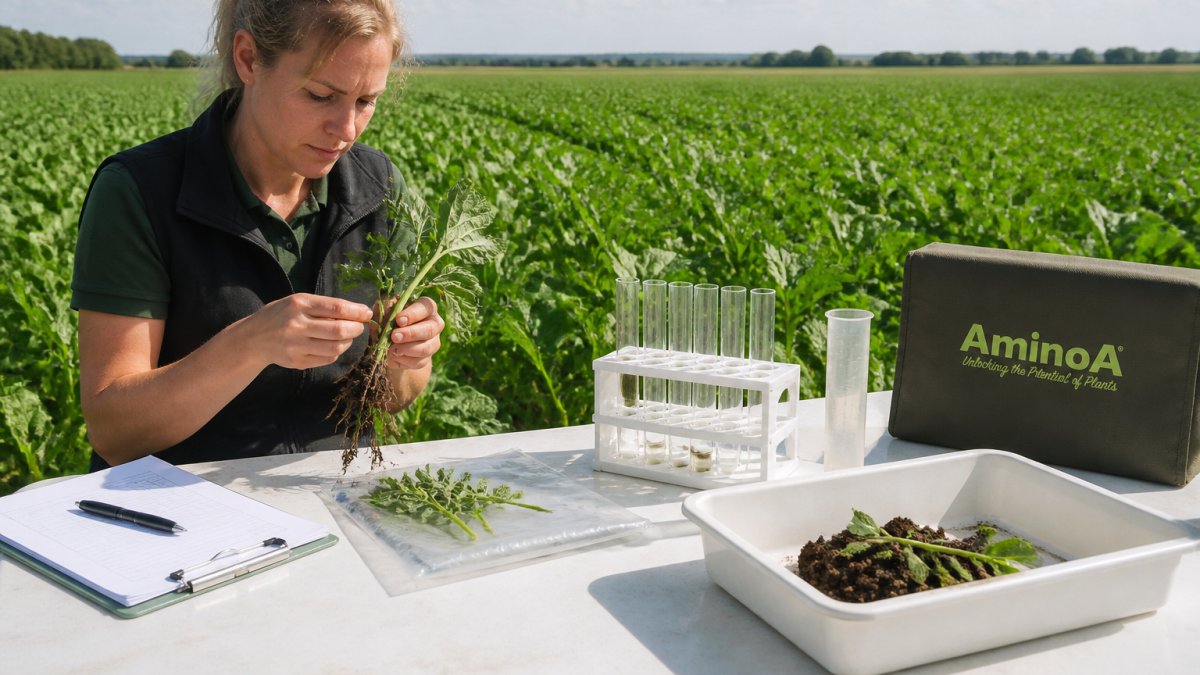
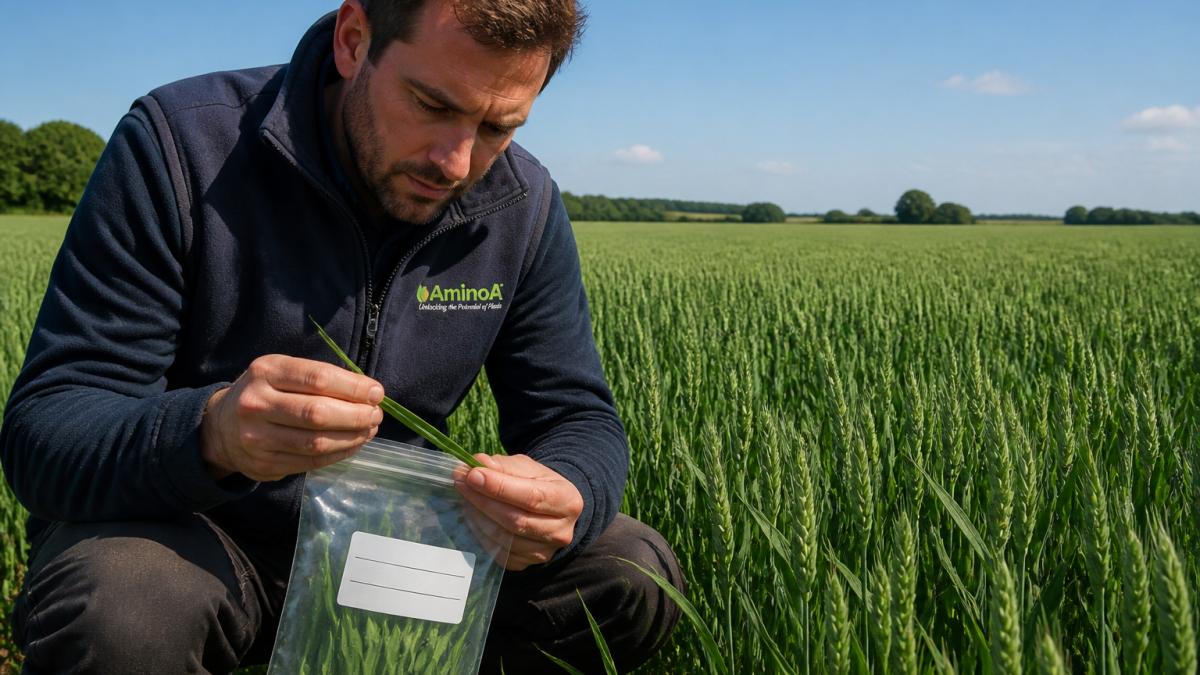
Plant tissue testing is the most practical way to measure nutrient uptake in field crops. It involves collecting plant samples at key growth stages and sending them to a laboratory for analysis. The results show exactly which nutrients your plants have absorbed and whether they're getting enough.
This method works because plant tissue reflects nutrient availability in real time. When a nutrient is deficient, it shows up in the tissue long before visible symptoms appear on the leaf. This early warning gives you time to correct the problem.
When to collect samples
Timing matters enormously. Samples taken at the wrong stage won't tell you what you need to know.
The best windows are:
- Early growth (GS13-16): Boots stage for cereals. Shows whether your establishment nutrition is working.
- Mid-season (GS30-39): Stem extension begins. Reveals whether you're on track for grain fill.
- Late season (GS65-71): Anthesis to early milk stage. Indicates if the crop can sustain grain development.
Each sample tells a different story. Early samples catch deficiencies before they cost you yield. Mid-season samples confirm your feeding strategy is working. Late samples show whether the crop has enough reserves for final grain fill.
Which plant parts to sample
Don't just grab any leaf. The plant part you collect determines what the results mean.
For cereals, collect the fully expanded leaf below the flag leaf. This leaf is actively involved in grain fill and reflects current nutrient status accurately. Avoid the flag leaf itself, it's often senescing and gives misleading results.
For broadleaf crops, collect recently matured leaves from the middle of the plant. Avoid very young leaves (not fully developed) and very old leaves (past their useful life).
For all crops, take samples from healthy-looking plants only. If you're trying to diagnose a problem, sample both affected and unaffected plants for comparison. This contrast often reveals what's going wrong.
Collect at least 20 plants per sample to get a representative average. Mix the leaves together and send about 100 grams to your laboratory.
Nutrient Uptake by Crop Growth Stage
Different nutrients are demanded at different times. Nitrogen drives early leaf development. Phosphorus supports root establishment. Potassium becomes critical during grain fill. Understanding this timing is crucial for measuring nutrient uptake effectively.
Early growth prioritises nitrogen and phosphorus. The crop needs to establish roots and build leaf area. If these nutrients are short, the crop never recovers, no matter what you apply later.
Mid-season shifts toward potassium and secondary nutrients like magnesium and sulphur. The crop is building stem strength and preparing for reproductive development. Shortages now show up as weak stems or poor flower set.
Late season demands sustained potassium and nitrogen for grain fill. A crop that ran short earlier will struggle to fill grain properly, even if you apply nutrients now. This is why early diagnosis matters, late corrections rarely compensate fully.
Tissue testing at each stage reveals whether your crop is tracking the typical demand curve for your soil and climate. If your mid-season sample shows low potassium when the crop should be loading up, you know there's a problem. If your late-season sample shows adequate nitrogen despite late applications, your feeding strategy worked.
How to Calculate Crop Nutrient Uptake From Tissue Results
Once you have tissue test results, you can work backwards to estimate total nutrient uptake. This calculation isn't precise, it's an estimate, but it's far more useful than guessing.
The basic approach uses tissue concentration and dry matter yield:
Nutrient uptake (kg/ha) = Tissue concentration (%) × Dry matter yield (tonnes/ha) × 10
Here's how it works in practice. Suppose your tissue test shows 2.5% nitrogen at mid-season and you estimate the crop will produce 8 tonnes of dry matter by harvest. The calculation is:
2.5 × 8 × 10 = 200 kg/ha of nitrogen taken up by mid-season
This tells you how much nitrogen the crop has already absorbed. You can then estimate how much more it will need to reach your target grain yield.
The limitation is that tissue concentration at mid-season doesn't perfectly predict final uptake. Growth conditions change. A wet spell boosts uptake. A dry spell slows it. But the mid-season snapshot gives you a solid baseline for adjusting your remaining applications.
Record these calculations season after season. Over time, you'll build a reference database for your soil and climate. That database becomes your best guide for next year's nutrient plan.
Estimating Crop Nutrient Removal at Harvest
Crop nutrient removal at harvest is what actually leaves your field in the grain. It's different from total uptake because some nutrients move back into the straw and stay behind.
Grain typically contains more concentrated nutrients than straw. A tonne of wheat grain removes roughly 20-25 kg of nitrogen, 8-10 kg of phosphorus, and 15-20 kg of potassium. The straw left behind removes far less because most of it stays on the field.
To estimate removal, multiply your expected grain yield by the nutrient content of grain for your crop type. If you're targeting 8 tonnes/ha of wheat and grain contains 22 kg/ha of nitrogen per tonne, you're removing 176 kg of nitrogen in the grain alone.
This is where the measure nutrient uptake data becomes actionable. If your tissue tests showed the crop took up 200 kg of nitrogen by late season but only 176 kg left the field in grain, the remaining 24 kg is still in the straw. Leave that straw on the field and you're recycling those nutrients back to the soil.
Many growers underestimate how much nutrient is removed in grain. They then over-apply the following year to compensate. Accurate removal estimates prevent this waste.
Combining Soil Tests and Tissue Tests for Complete Assessment
Soil tests and tissue tests answer different questions. Soil tests show what's available in the soil. Tissue tests show what the crop is actually taking up. Together, they give you the complete picture.
A soil test might show adequate potassium, yet a tissue test reveals the crop is deficient. This mismatch often means the soil potassium is locked up in a form the crop can't access easily. It might be tied up in clay particles or at an unsuitable pH.
Conversely, a tissue test might show adequate potassium even though the soil test is low. This can happen on soils with good potassium reserves that release slowly. The crop is finding what it needs, but you're mining the soil. Next season might be different.
The best practice is to use soil tests to plan your long-term nutrient strategy and tissue tests to fine-tune your in-season decisions. Soil tests guide your base dressing. Tissue tests guide your top-dressing and foliar applications.
According to research from the Agriculture and Agri-Food Canada research station, combining both testing methods improves nutrient use efficiency by helping growers match supply to crop demand more precisely.
Common Mistakes When Measuring Nutrient Uptake
Most growers make the same errors when they start measuring nutrient uptake. Knowing these pitfalls helps you avoid them.
Sampling at the wrong growth stage is the biggest mistake. A sample taken too early shows nutrient levels before the crop has really started demanding them.
Collecting from the wrong plant part ruins the data. Sampling old senescing leaves gives you information about what the plant is recycling, not what it's currently taking up. Sample actively growing tissue only.
Ignoring weather and soil conditions when interpreting results is another common error. A wet spring can boost nutrient availability and uptake. A dry spell can suppress it.
Not recording your data means you can't build your reference database. Every sample you take is valuable information about your soil and climate.
Applying results too broadly across different fields is also problematic. Your sandy field behaves differently from your clay field. A tissue test from one field shouldn't drive decisions on the other. Sample each field separately.
Delaying corrective action after getting results defeats the purpose. If a tissue test shows a deficiency at mid-season, you have a narrow window to fix it. Waiting weeks to act means you've already lost yield.
Conclusion
Measuring nutrient uptake in field crops transforms your fertiliser strategy from guesswork into science. Plant tissue testing at key growth stages reveals exactly what your crops are taking up and whether they're getting enough. Combined with soil tests and careful record-keeping, this approach helps you optimise inputs, reduce waste, and build a sustainable feeding programme tailored to your soil.
At AminoA, the foundation of our biostimulant programmes, enhanced root development and stress resistance, works best when combined with proper nutrient monitoring. The foundation of our biostimulant programs, enhanced root development and stress resistance, works best when combined with proper nutrient monitoring. Start measuring nutrient uptake this season, record your data, and use it to refine your approach year after year.
| Growth Stage | Best Sampling Time | Plant Part to Collect | What It Tells You |
|---|---|---|---|
| Early (GS13-16) | Boots stage | Fully expanded leaf | Establishment nutrition working |
| Mid-season (GS30-39) | Stem extension | Recently matured leaf | On track for grain fill |
| Late (GS65-71) | Anthesis to milk | Active green leaf | Reserves for final development |
For more guidance on tissue sampling protocols, consult the British Society of Plant Breeders technical guidance or your local agricultural extension service. To understand how biostimulants like amino acids complement your nutrient uptake strategy, review the latest research on plant biostimulants from the European Biostimulants Industry Council.
Frequently Asked Questions
What is the difference between nutrient concentration and nutrient uptake?
Nutrient concentration measures the percentage of a nutrient present in plant tissue (e.g. 2.5% nitrogen). Nutrient uptake refers to the total amount of that nutrient removed from the soil by the crop, calculated by multiplying tissue concentration by dry matter yield. Both are essential: concentration tells you if the plant has enough nutrition, whilst uptake shows how much nutrient your soil must supply to achieve your target yield.
When should you sample crops for nutrient analysis?
Timing depends on your objective. Sample at growth stages when nutrient demand peaks, typically mid-tillering for cereals, or pre-flowering for high-value crops. Early-season sampling (4-6 weeks after emergence) identifies deficiencies whilst you can still correct them. Late-season sampling assesses whether nutrient supply matched demand. Multiple samples across the season give the most accurate picture of nutrient uptake patterns.
How can I estimate nutrient removal at harvest?
Measure the dry matter yield of your harvested crop (grain, straw, fruit) and multiply by the nutrient concentration found in tissue analysis. For example: if grain yields 8 tonnes per hectare at 2% nitrogen, you've removed 160 kg nitrogen per hectare. Include all plant parts removed from the field, grain, straw, or foliage, to calculate total nutrient removal accurately.
How do soil tests and tissue tests work together to measure nutrient uptake?
Soil tests show nutrient availability in your soil; tissue tests show what your crop actually took up. Together, they reveal whether your soil supplied enough nutrition or if uptake was limited by availability, root development, or stress. If soil tests show adequate nitrogen but tissue tests show deficiency, the problem lies in uptake efficiency, where biostimulants like amino acids can improve root function and nutrient transport.