 ultimate-guide
Sustainable Crop Nutrition: A 2026 Guide for Growers
Table of Contents
- What Sustainable Crop Nutrition Actually Means in Practice
- Biostimulants for Commercial Farming: Where They Fit and Where They Don't
- Reducing Synthetic Fertiliser Reliance Without Losing Yield
- Improving Soil Health for Crop Yield: What the Measurements Show
- Building a Season-Long Sustainable Crop Nutrition Plan
- Common Mistakes That Undermine Sustainable Nutrition Programmes
- Frequently Asked Questions
Last Updated: 14 September 2026
What Sustainable Crop Nutrition Actually Means in Practice
Sustainable crop nutrition is the management of plant nutrition so that yield and quality hold up season after season without degrading the soil, water, or the margin on each hectare. That is the working definition, and it rules out a lot of what gets sold as sustainable. At AminoA, we have spent a decade supplying growers who want exactly this balance, and the pattern is consistent: the farms that succeed treat nutrition as a system, not a product list.
The pressure to change is real. The Agriculture and Horticulture Development Board's nutrient management guidance sets out how tighter fertiliser rules and rising input costs are reshaping nitrogen planning on arable units. Meanwhile, the Environment Agency's farming rules for water now expect every application to be justified by crop need, not habit.
Most growers already understand the theory. The gap sits between understanding and execution.
The Four Pillars of a Working Nutrition Programme
A sustainable crop nutrition programme rests on four pillars: soil condition, base nutrition, biological support, and timing. Get any one wrong and the others underperform.
- Soil condition covers structure, organic matter, pH, and biological activity. It determines how much of what you apply is actually available to the crop.
- Base nutrition is your N, P, K, sulphur, and the trace elements, matched to realistic yield targets rather than historic averages.
- Biological support means biostimulants and microbial products that improve uptake, rooting, and stress tolerance.
- Timing is where most programmes quietly lose money. A nutrient applied at the wrong growth stage is a nutrient wasted.
Biostimulants for Commercial Farming: Where They Fit and Where They Don't
Biostimulants for commercial farming work best as support for a sound base programme, not as a replacement for it. They improve how efficiently a crop uses what is already there, particularly under stress. They will not rescue a field that is short of nitrogen or badly compacted.
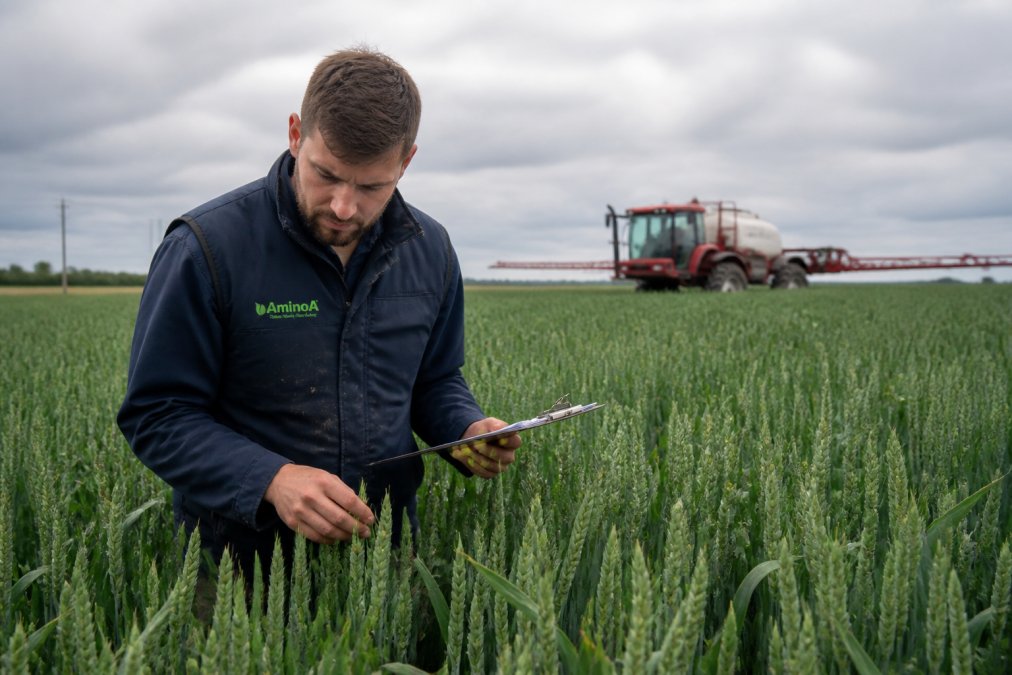
The honest limitation is this: biostimulant responses vary with season, soil, and crop. A product that shines in a cold, wet spring may show little in an easy growing year. That variability is why independent trial data matters more than marketing claims. The European Biostimulants Industry Council publishes the regulatory framework these products sit within, which is a useful starting point when checking what a label actually guarantees.
Amino Acid Biostimulants Versus Humic and Seaweed Products
Amino acid biostimulants differ from humic and seaweed products in both origin and mode of action. Amino acids are the direct building blocks of protein, so a plant can use them quickly for growth and stress repair. Humic substances work mainly on soil structure and nutrient exchange. Seaweed extracts tend to act through natural growth compounds and trace elements.
AminoA manufactures 100% L-α amino acids through enzymatic hydrolysis, with a high content of nitrogen, potassium, iron, and magnesium, and every essential amino acid present in the L form. That means the crop gets the forms it can actually metabolise, rather than waiting for conversion. For growers weighing up cost per hectare, that efficiency is the argument.
Reducing Synthetic Fertiliser Reliance Without Losing Yield
Reducing synthetic fertiliser reliance is achievable without sacrificing yield, but only through staged reduction backed by measurement. The growers who fail are the ones who cut rates sharply in one season and then blame the product when the crop runs short.
A workable approach looks like this:
- Soil test every field to establish current indices and organic matter.
- Set a realistic yield target and calculate nitrogen need from it.
- Reduce the synthetic rate by a modest step, no more than you can justify with tissue testing.
- Support the crop with a biostimulant programme at key growth stages.
- Compare treated strips against your standard practice across the whole rotation.
The Rothamsted Research long-term field experiments have shown for decades that soil condition and rotation influence how crops respond to inputs. That work underpins the case for measuring rather than assuming.
Trial Data: What Happens When You Cut Fungicide Rates
Velcourt trials found that adding AminoA FLO to reduced fungicide rates maintained yields and improved green leaf area in winter wheat. That is a specific, repeatable result, and it matters because it addresses the most common objection we hear: that cutting agrochemicals means accepting a yield penalty. In this trial, it did not.
The mechanism is straightforward. A crop with better amino acid nutrition maintains green leaf area for longer, which supports photosynthesis during grain fill. When disease pressure is moderate and the fungicide rate is trimmed, that extra leaf retention helps carry the crop through.
Improving Soil Health for Crop Yield: What the Measurements Show
Improving soil health for crop yield comes down to measurable indicators: organic matter, aggregate stability, pH, and biological activity. These respond slowly, which is why soil health is a multi-season project rather than a single application. Consistent management of these physical and chemical properties provides the essential foundation for improving soil nutrient retention throughout the entire crop cycle.
What most guides miss is that soil health and plant nutrition are not separate budgets. A soil with good structure and active biology releases nutrients more predictably, which reduces the peak demand on bagged fertiliser. Conversely, a biologically dead soil ties up what you apply.
The practical measures that move the needle are unglamorous:
- Add organic matter through manure, compost, or cover crops where the rotation allows.
- Avoid working land when it is too wet, which is the fastest route to compaction.
- Keep pH in the range your crops need, since nutrient availability collapses outside it.
- Use tissue testing through the season to catch deficiencies before they show as visible symptoms.
Building a Season-Long Sustainable Crop Nutrition Plan
A season-long sustainable crop nutrition plan maps every application to a growth stage and a crop requirement. The plan should exist before drilling, not after the first deficiency appears.
Timing Applications Around Growth Stages
Timing determines whether an input pays. Amino acid biostimulants are most effective at establishment, during rapid vegetative growth, and at flowering and fruit set, when the crop's demand for nitrogen and energy peaks.
| Growth Stage | Primary Focus | Typical Input |
|---|---|---|
| Pre-drilling | Soil condition, pH correction | Organic matter, lime, base P and K |
| Establishment | Root development | Amino acid biostimulant, starter nitrogen |
| Tillering or vegetative | Leaf area and structure | Nitrogen split, trace elements |
| Stem extension | Demand peak | Nitrogen, sulphur, magnesium |
| Flowering and fruit set | Retention and formation | Amino acid biostimulant, potassium |
| Grain or fruit fill | Quality and finish | Potassium, magnesium, foliar support |
Common Mistakes That Undermine Sustainable Nutrition Programmes
The most common mistake is treating biostimulants as a substitute for base nutrition. They are not. A crop short of nitrogen will not be rescued by an amino acid spray, however good the product.
Other recurring errors:
- Cutting synthetic inputs too fast. Staged reduction with measurement works. Sudden cuts invite deficiency.
- Ignoring tank mix compatibility. Phytotoxicity from a bad mix can undo a season's work. Always check compatibility before spraying.
- Skipping untreated strips. Without a comparison, you cannot tell whether a product earned its place.
- Applying at the wrong stage. Late applications miss the window when the crop needed support.
- Chasing certification paperwork at the last minute. Organic growers should confirm product approval before ordering, not after.
Sustainable crop nutrition is a system, and systems reward patience. The challenge for most growers is not knowing what to do, it is sequencing it correctly across a rotation while keeping yield and margin intact.
AminoA manufactures 100% L-α amino acid biostimulants through enzymatic hydrolysis, with high nitrogen, potassium, iron, and magnesium content and every essential amino acid in the L form. Our products support root, leaf, and bud development, improve resistance to cold, heat, drought, and agrochemical phytotoxicity, and help lift crop yield and quality. If you want to see how that fits your rotation, subscribe to our newsletter for trial updates and practical guidance.
Frequently Asked Questions
What are the core principles of sustainable crop nutrition?
Sustainable crop nutrition rests on four principles: feeding the soil biology that cycles nutrients, matching inputs to crop demand at each growth stage, reducing reliance on synthetic inputs where alternatives perform, and measuring outcomes rather than assuming them. In practice this means combining soil testing, targeted biostimulant applications, and cover cropping with a reduced but still strategic fertiliser programme. The goal is not eliminating synthetic inputs overnight but building a system where soil function and crop performance improve together over successive seasons.
How do L-α amino acid biostimulants improve crop resilience?
L-α amino acids are the form plants can absorb and use directly, without conversion. When applied as a foliar treatment, they give the crop ready-made building blocks for protein synthesis during stress events such as cold snaps, drought, or heat. This supports root development, maintains green leaf area, and helps the plant recover faster after stress. AminoA products contain every essential amino acid in the L form and are produced through enzymatic hydrolysis, which preserves the biologically active structure. Trials on winter wheat have shown maintained yields even when fungicide rates were reduced.
How can farmers reduce reliance on synthetic fertilisers while maintaining yields?
Start with soil testing to establish what your soil already holds, then replace a portion of your nitrogen programme with amino acid biostimulants applied at key growth stages. Velcourt trials found that adding AminoA FLO to reduced fungicide rates maintained yields and improved green leaf area in winter wheat. The realistic expectation is not eliminating synthetic inputs in one season but gradually shifting the ratio. Track yield, grain quality, and input costs per hectare across at least two seasons before making further reductions.
What role does soil health play in sustainable nutrient management?
Soil health determines how efficiently applied nutrients reach the crop. A biologically active soil with good structure holds nutrients in the root zone, reduces leaching losses, and cycles organic matter into plant-available forms. Improving soil health for crop yield means focusing on organic matter content, aggregate stability, and microbial activity, not just NPK levels. Biostimulants support this by feeding root development, which in turn supports the soil biology that makes nutrients available. Measure soil organic matter and earthworm counts annually to track progress.
What are the environmental benefits of transitioning to sustainable crop nutrition?
Reducing synthetic fertiliser reliance lowers nitrate leaching into watercourses and cuts the carbon emissions associated with fertiliser manufacture and application. Healthier soils hold more carbon and support greater biodiversity above and below ground. For growers, these environmental gains often align with commercial ones: lower input costs, better nutrient use efficiency, and crops that withstand stress with less intervention. The transition works best as a staged process, replacing inputs where trial data supports it rather than making wholesale changes across the rotation.
Do amino acid biostimulants interact badly with fungicides and insecticides in tank mixes?
Amino acid biostimulants are generally compatible with common fungicide and insecticide programmes, but compatibility depends on the specific products and rates in your tank. Always carry out a jar test before mixing a new combination, and check the label of every partner product for restrictions. Applying biostimulants separately from agrochemicals, where timing allows, removes the risk entirely. If you have experienced phytotoxicity from a previous tank mix, introduce new combinations on a small area first and monitor for 48 hours before treating the whole field.
Are amino acid biostimulants suitable for organic certification?
Certification depends on the specific product and your certifier's approval. AminoA products are based on natural L-α amino acids produced through enzymatic hydrolysis, with no synthetic chemical inputs in the active ingredient. Organic farm managers should request the product's certification documentation and confirm approval with their own certifying body before use, as requirements vary between certifiers and across crop types. This step takes little time and prevents any compliance issues at inspection.
How quickly will I see a return on investment from biostimulants?
Most growers see measurable differences within the first season, particularly in root development and stress recovery, but the financial return depends on your crop, input costs, and season conditions. Cost per hectare is higher than simply adding more NPK, so the return comes from maintained or improved yield at lower total input cost. Run a side-by-side trial on your own farm across at least one full season. AminoA offers smaller pack sizes and trial programmes so you can test on your specific crops before committing to a full season.