 ultimate-guide
Boosted Crop Yield: Improve Nutrient Uptake
Table of Contents
- Why Nutrient Uptake Is the Real Limit on Crop Yield and Quality
- The Benefits of Rhizosphere Health for Crop Yield
- Biostimulants for Nutrient Use Efficiency: What the Evidence Shows
- Optimising Root Development for Yield: Practical Steps for Growers
- Common Mistakes That Undermine Nutrient Uptake and Crop Quality
- Conclusion
- Frequently Asked Questions
Last Updated: September 16, 2026
Why Nutrient Uptake Is the Real Limit on Crop Yield and Quality
The gap between what you apply and what your crop actually takes up is where most yield potential quietly disappears. At AminoA, we have observed that nutrition programmes are rarely short of inputs; they are short of uptake. The best boosted crop yield and quality for improved nutrient uptake results come from fixing the plant's ability to absorb what is already there, not from adding another bag of product.
Crop yield is the measurable output of harvested produce per unit area, and it depends less on soil nutrient concentration than on the plant's capacity to access and assimilate those nutrients. That distinction matters because it changes where you spend your money.
Most growers focus on the soil test. The more useful question is what proportion of those tested nutrients ever reaches the grain, fruit or leaf.
The Benefits of Rhizosphere Health for Crop Yield
The rhizosphere is the narrow zone of soil immediately surrounding plant roots, where root activity and soil biology interact most intensively. A functioning rhizosphere is the single most reliable predictor of how efficiently applied nutrients convert into crop yield.
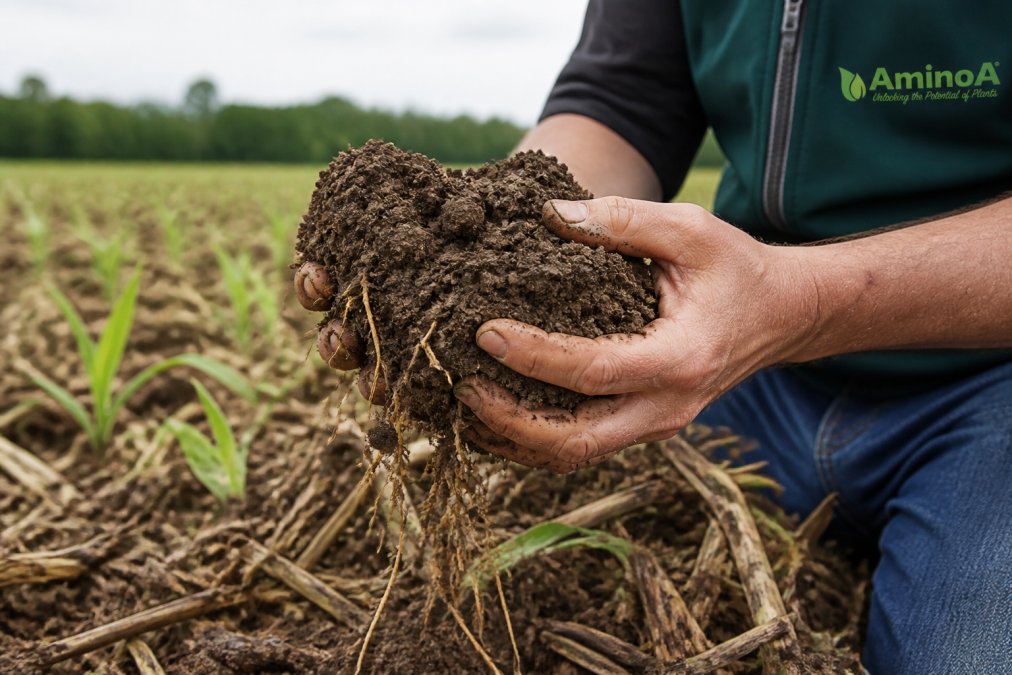
Healthy rhizosphere conditions improve three things at once: root surface area for absorption, microbial cycling of locked-up nutrients, and the plant's own stress tolerance. Addressing this zone can reduce the volume of fertiliser needed to hit the same yield, which is where the return on investment can appear.
How Root Exudates Feed the Soil Biology That Feeds Your Crop
Roots release sugars, organic acids and amino compounds into the soil. These exudates are the primary food source for the bacteria and fungi that mineralise nutrients into plant-available forms. A crop with poor root development feeds less biology, cycles fewer nutrients, and depends more heavily on soluble inputs.
The practical implication is straightforward: anything that improves root mass and root health tends to improve nutrient availability without additional fertiliser.
Biostimulants for Nutrient Use Efficiency: What the Evidence Shows
Biostimulants for nutrient use efficiency are products that improve how effectively a plant acquires and uses nutrients, rather than supplying the nutrients themselves. This category includes amino acid formulations, seaweed extracts, humic substances and microbial inoculants.
The distinction from fertiliser matters commercially. A biostimulant is judged on how much more yield you get from the nutrition you already apply. Where trials show maintained output at reduced input rates, the saving sits in the reduced programme rather than in the product itself.
Amino acid biostimulants are of particular interest to arable and horticultural growers because they are directly assimilable. Unlike raw nutrient salts, L-form amino acids can be taken up and used with minimal metabolic conversion, which is why they are often positioned around stress recovery and nutrient translocation. Efficient nutrient management also extends to the machinery used for application, where the adoption of biodegradable agricultural lubricants ensures that soil health remains uncompromised by synthetic residues during the vital stages of crop development.
Amino Acid Biostimulants and the Velcourt Trial Data
Independent trial work at Velcourt found that adding AminoA FLO to reduced fungicide rates maintained yields and improved green leaf area in winter wheat. For growers weighing up whether biostimulants can support a leaner spray programme, that is the most relevant kind of evidence: it tests the product inside a reduced-input system, not alongside a full conventional programme.
AminoA products are built on 100% L-α amino acids produced through enzymatic hydrolysis, with a high content of nitrogen, potassium, iron and magnesium. Every essential amino acid is supplied in the L form, which is the form plants can use directly.
| Approach | What it targets | Typical use point | Main trade-off |
|---|---|---|---|
| Amino acid biostimulant | Uptake efficiency, stress recovery | Foliar at key growth stages | Cost per hectare versus straight NPK |
| Humic and fulvic acids | Soil nutrient availability | Soil-applied, pre-drilling | Slower visible response |
| Microbial inoculants | Rhizosphere cycling | Seed or soil treatment | Variable establishment |
| Micronutrient correction | Specific deficiencies | After soil or tissue testing | Only fixes the tested gap |
Optimising Root Development for Yield: Practical Steps for Growers
Optimising root development for yield means managing the soil environment so roots can extend, branch and persist through grain fill or fruit set. It is a season-long discipline, not a single application.
- Test soil structure before nutrition: compaction layers cap yield regardless of how much you apply
- Correct pH into the target range for your crop so nutrients stay available
- Avoid over-application of soluble nitrogen, which discourages root exploration
- Time amino acid applications to root-active and stress-prone growth stages
- Keep traffic and tillage passes to the minimum the rotation allows
- Dig and inspect roots at two points in the season, not one
Each of these costs little and compounds. A compacted layer at 20 centimetres will limit uptake no matter what goes in the tank.
Common Mistakes That Undermine Nutrient Uptake and Crop Quality
The most expensive mistakes in nutrient management are rarely about product choice. They are about timing, placement and diagnosis.
Applying foliar nutrition in high heat or full sun reduces absorption and risks leaf damage. Tank mixing without a compatibility check is a recurring cause of phytotoxicity, and the damage to leaf area costs more than the nutrition was ever going to add. Chasing yield with more nitrogen while ignoring pH, compaction or micronutrient imbalance simply raises input cost without moving output.
Biostimulants work best as part of a system, not as a rescue treatment. If you are coming from a straight fertiliser programme, the benefit can show up as maintained yield at lower input, or improved quality at the same input, rather than as an immediate jump.
Conclusion
The limiting factor on most farms is not how much nutrition goes on, but how much of it the crop can reach and use. Fixing uptake through rhizosphere health, root development and well-timed amino acid applications is the most reliable route to better crop yield and quality without simply spending more.
AminoA supplies 100% L-α amino acid biostimulants produced through enzymatic hydrolysis, with a high content of nitrogen, potassium, iron and magnesium, and every essential amino acid in the L form. Products are used to support root, leaf and bud development, blossom and fruit formation, and resistance to cold, heat, drought and agrochemical phytotoxicity.
Subscribe to our Newsletter for trial updates and practical guidance on building uptake efficiency into your nutrition programme.
Frequently Asked Questions
How do biostimulants improved nutrient uptake in crops?
Biostimulants improved nutrient uptake by stimulating root growth and increasing the surface area available for absorption. Amino acid-based products, such as those containing L-alpha amino acids, act as chelating agents that bind to nutrients and carry them through the root membrane more efficiently. They also support rhizosphere microbial activity, which mineralises soil nutrients into plant-available forms. The result is that a greater proportion of applied fertiliser reaches the crop rather than being locked in the soil or lost to leaching.
What factors limit nutrient uptake in agricultural soils?
Several factors restrict how much nutrition a crop can access. Soil pH outside the ideal range of 6.0 to 7.0 locks up phosphorus and micronutrients. Compacted or waterlogged soils reduce root exploration and oxygen availability. Low organic matter limits microbial activity in the rhizosphere. Antagonism between ions, such as potassium blocking magnesium, also reduces efficiency. Correcting these conditions before applying inputs gives a far better return than simply increasing application rates.
Can amino acids help increase crop quality and yield?
Amino acids supply plants with ready-built protein components, saving the energy normally spent on synthesis. This energy is redirected into root development, flowering and fruit fill. Velcourt trials found that adding an amino acid biostimulant to reduced fungicide rates maintained yields and improvedd green leaf area in winter wheat. Growers typically see better establishment, stronger stress recovery and more consistent marketable quality when amino acids form part of a balanced nutrient programme.
How does soil pH affect the availability of nutrients for plants?
Soil pH controls which nutrients remain soluble and accessible. At pH below 5.5, aluminium and manganese become toxic while phosphorus binds tightly to iron and aluminium compounds. Above pH 7.5, iron, manganese and zinc become insoluble, leading to deficiency even when soil tests show adequate levels. Regular pH testing and appropriate liming or acidifying treatments keep the soil in the range where applied nutrients and biostimulants deliver the best response.
The challenge is rarely a shortage of nutrition, it is converting what you apply into harvested output. AminoA has spent ten years helping growers do exactly that with natural L-α amino acid biostimulants that support root development, stress resistance and nutrient use efficiency. Get started with AminoA and build a nutrition programme that delivers more from every hectare.