 listicle
Top 5 Sustainable Fertilizer Strategies for 2026
Table of Contents
- Quick Comparison: Top 5 Sustainable Fertilizer Strategies for 2026
- 1. L-α Amino Acid Biostimulants: Targeted Crop Nutrition
- 2. Soil Microbial Inoculants: Activating the Soil Food Web
- 3. Controlled-Release Fertilisers: Reducing Leaching and Volatilisation
- 4. Reducing Synthetic Nitrogen Dependency with Biological Fixation
- 5. Organic Soil Conditioners Review for Commercial Farms
- The Benefits of L-α Amino Acid Biostimulants for Soil Health
- Conclusion
- Frequently Asked Questions
Last Updated: 22 September 2026
Quick Comparison: Top 5 Sustainable Fertilizer Strategies for 2026
Sustainable fertilizer strategies are the practices and inputs that maintain crop nutrition while cutting waste, protecting soil biology and reducing reliance on synthetic nitrogen. For 2026, five approaches stand out for commercial growers: L-α amino acid biostimulants, soil microbial inoculants, controlled-release fertilizers, biological nitrogen fixation, and organic soil conditioners. This guide from AminoA breaks down what each one does, who it suits and where it falls short.
| Strategy | Primary Job | Best For | Main Trade-Off |
|---|---|---|---|
| L-α amino acid biostimulants | Targeted nutrition and stress support | Arable, horticulture, organic systems | Needs correct timing and rates |
| Soil microbial inoculants | Activating the soil food web | Soils with depleted biology | Results depend on existing microbes |
| Controlled-release fertilisers | Cutting leaching and volatilisation | Turf, amenity, high-value crops | Higher unit cost than straight NPK |
| Biological nitrogen fixation | Replacing synthetic N in legumes | Pulse and legume rotations | Legume crops only |
| Organic soil conditioners | Building structure and organic matter | Mixed and organic farms | Slow, multi-season returns |
The five strategies below have one thing in common: they all aim to get more from every kilogram of nutrient applied. But first, here's what most guides get wrong. They treat these as competing products when they are really a stack. Below, we'll show you exactly how each one fits into a working rotation.
1. L-α Amino Acid Biostimulants: Targeted Crop Nutrition
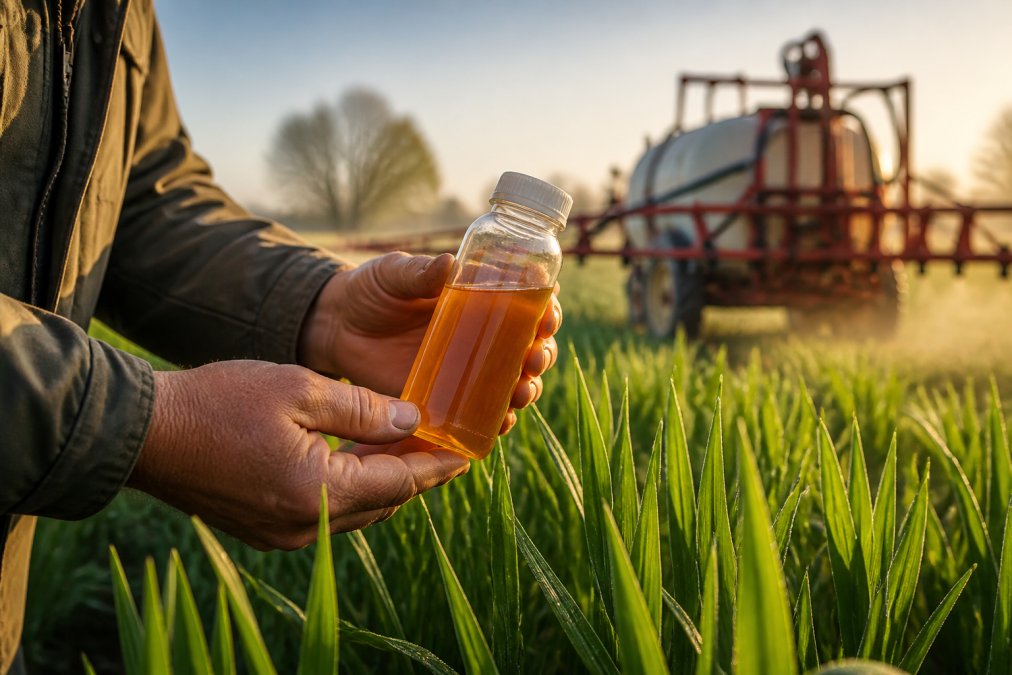
L-α amino acid biostimulants are foliar and root-applied products that supply plants with amino acids in the L form, the only form plant cells can directly use. Instead of feeding the soil, they feed the crop at the point of stress.
The practical difference shows up in three places: root and leaf development, blossom and fruit formation, and resistance to cold, heat, drought and agrochemical phytotoxicity. For growers running reduced spray programmes, that last point matters most.
How AminoA Fits into a Sustainable Programme
AminoA manufactures L-α amino acid biostimulants through enzymatic hydrolysis, giving a product built entirely from 100% L-α amino acids with high nitrogen, potassium, iron and magnesium content. Every essential amino acid is present in the L form.
The company has ten years of experience in the UK market, and its products are used by growers seeking to cut agrochemical reliance without sacrificing yield. Velcourt trials found that adding AminoA FLO to reduced fungicide rates maintained yields and improved green leaf area in winter wheat.
A common mistake is treating amino acids as a replacement for a full nutrition programme. They are not. Think of them as the precision layer on top.
2. Soil Microbial Inoculants: Activating the Soil Food Web
Soil microbial inoculants introduce or feed beneficial organisms that unlock nutrients already present in the soil. Products can act as a microbial food source, waking dormant biology rather than adding more chemistry.
The appeal is simple: if your soil already holds phosphorus and potassium your crop cannot access, biology is cheaper than another bag of fertiliser. Inoculants improve soil aggregation, water infiltration and the efficiency of whatever you do apply.
The limitation is real. Effectiveness depends on the microbial population already in your soil. On badly degraded ground, results are slower and less consistent.
3. Controlled-Release Fertilisers: Reducing Leaching and Volatilisation
Controlled-release fertilisers coat or bind nutrients so they release over weeks rather than hours. That single design change cuts leaching into groundwater and volatilisation into the air, two of the biggest losses in conventional nitrogen programmes.
Some products use a slow-release nitrogen formula with a balanced NPK ratio. The low-runoff composition suits amenity and turf management, where steady growth beats a flush of soft, disease-prone leaf.
Where it falls short: controlled-release is largely a turf and high-value crop tool. Broad-acre arable growers will find the unit cost hard to justify against straight nitrogen, unless the field is in a nitrate vulnerable zone.
4. Reducing Synthetic Nitrogen Dependency with Biological Fixation
Biological nitrogen fixation uses Rhizobium bacteria applied to legume seed, letting the plant pull nitrogen from the air instead of the bag. For pulse and legume rotations, it is the most direct route to cutting synthetic nitrogen dependency.
The economics are compelling in the right rotation. You replace a bought input with a biological process, and you leave residual nitrogen for the following cereal crop. The catch is specificity: Rhizobium inoculants work on legumes only.
For growers building a rotation around peas, beans or clover, this is a no-brainer. For continuous wheat, it does nothing.
5. Organic Soil Conditioners Review for Commercial Farms
Reviewing organic soil conditioners for commercial farms comes down to one question: does the product build organic matter fast enough to justify the cost? Composts, manures and humic products improve structure, water-holding capacity and cation exchange over multiple seasons.
The honest answer is that conditioners are a long game. Many growers see little in year one and meaningful structural change by year three. That timeline makes them hard to justify on short tenancies and easy to justify on owned land.
Pairing conditioners with a biostimulant is where the stack pays off. The conditioner rebuilds the soil's physical and biological base; the amino acid product supports the crop while that base recovers.
The Benefits of L-α Amino Acid Biostimulants for Soil Health
The benefits of L-α amino acid biostimulants for soil health sit alongside their crop effects, not instead of them. When plants take up amino acids directly, the root system invests less energy in nitrogen assimilation and more in root growth. Deeper, denser roots mean better soil exploration, improved structure and more exudates feeding soil biology.
That is the part most reviews miss. Amino acids are usually sold purely on yield. In practice, the soil benefit is the compounding one, because healthier roots build the conditions for next season's crop.
Conclusion
The hardest part of sustainable nutrition is not choosing a strategy. It is stacking them so each one carries part of the load. Get the order right and you cut input costs while protecting yield.
AminoA builds that precision layer for growers who want to reduce agrochemical reliance without giving up performance. Its L-α amino acid biostimulants are produced through enzymatic hydrolysis, deliver 100% L-α amino acids with nitrogen, potassium, iron and magnesium, and support root, leaf and bud development under stress.
Subscribe to our Newsletter for trial results and seasonal application guidance from the AminoA team.
Frequently Asked Questions
How can farmers reduce reliance on synthetic fertilisers by 2026?
Farmers can reduce synthetic fertiliser reliance by combining L-α amino acid biostimulants, soil microbial inoculants, controlled-release fertilisers, and biological nitrogen fixation. These sustainable fertiliser strategies improve nutrient use efficiency, allowing lower application rates without yield loss. For example, Velcourt trials showed that adding AminoA FLO to reduced fungicide rates maintained yields and improved green leaf area in winter wheat. Start with one strategy, monitor soil health, and adjust gradually.
What are the benefits of using L-α amino acid biostimulants for soil health?
L-α amino acid biostimulants benefit soil health by enhancing root development, improving nutrient uptake, and increasing crop resilience to cold, heat, and drought. They feed soil microbes and support the breakdown of organic matter, leading to better soil structure over time. AminoA's products contain 100% L-α amino acids produced through enzymatic hydrolysis, with high levels of nitrogen, potassium, iron, and magnesium. These biostimulants are a core part of sustainable fertiliser strategies for 2026.
Are organic soil conditioners effective for large-scale commercial farming?
Yes, organic soil conditioners can be effective on large-scale farms when chosen based on soil tests and applied correctly. Some products stimulate beneficial microbes, improving soil aggregation and nutrient availability. For commercial farms, the key is to integrate conditioners with other sustainable fertiliser strategies, such as reducing synthetic nitrogen dependency. Always check certification for organic compliance and consult an agronomist to tailor applications to your specific soil and crops.
How do sustainable fertiliser strategies impact long-term crop yield?
Sustainable fertiliser strategies support long-term crop yield by building soil organic matter, improving nutrient cycling, and reducing dependence on finite inputs. Practices like using L-α amino acid biostimulants and controlled-release fertilisers enhance root health and stress tolerance, leading to more consistent yields across variable seasons. While initial results may vary, the cumulative effect is improved soil resilience and a stronger return on investment. Regular soil testing helps track progress and fine-tune your approach.