 listicle
5 Best Natural Biostimulants for Early Root Development
Table of Contents
- Quick Comparison: 5 Natural Biostimulants for Early Root Development
- 1. AminoA: L-α Amino Acid Biostimulant for Root and Shoot Development
- 2. Radisan Pro: Targeted Root Architecture Improvement
- 3. Bioradicante: Early-Stage Root Establishment Support
- 4. Azo Root™: Microbial Biostimulant for Dense Root Systems
- 5. RootMax Mycorrhizae and Rhizophagus Intraradices: Mycorrhizal Inoculants
- Liquid Biostimulants vs Granular Fertilisers: Which Supports Roots Better?
- The Benefits of L-α Amino Acids for Crops
- Frequently Asked Questions
Last Updated: September 15, 2026
Quick Comparison: 5 Natural Biostimulants for Early Root Development
Natural biostimulants are substances and microorganisms that stimulate plant growth processes, particularly root development, without being classified as fertilisers. For growers managing cereals, high-value horticulture, or organic systems, selecting the right natural biostimulants can determine whether a crop establishes strongly or struggles through early stress. This guide from AminoA covers five products that support early root development, with practical detail on how each fits different farming operations.
The products below range from amino acid formulations to mycorrhizal inoculants, and each has a distinct role in root establishment.
| Product | Type | Best For | Application Stage |
|---|---|---|---|
| AminoA | L-α amino acid biostimulant | Cereals, horticulture, organic systems | Seed treatment to early tillering |
| Radisan Pro | Root architecture biostimulant | Transplanted crops | Transplant and early establishment |
| Bioradicante | Root growth stimulant | Commercial agriculture | Early vegetative stage |
| Azo Root™ | Microbial biostimulant | Professional turf | Establishment and renovation |
| RootMax Mycorrhizae | Mycorrhizal inoculant | Grass and crop establishment | Pre-planting and early season |
1. AminoA: L-α Amino Acid Biostimulant for Root and Shoot Development
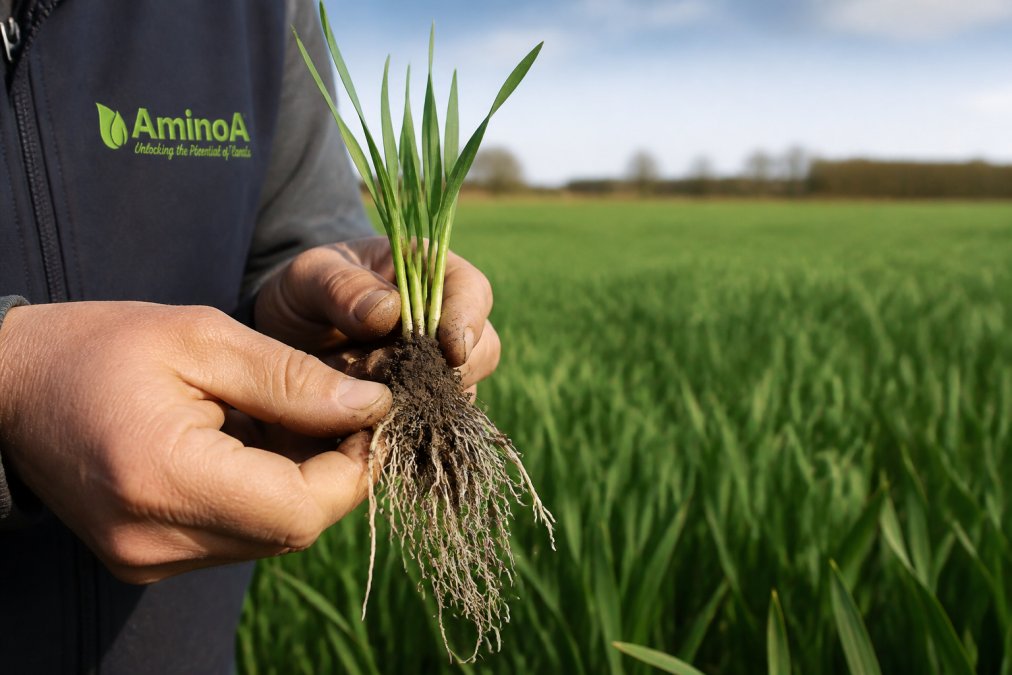
AminoA is a natural L-α amino acid biostimulant produced through enzymatic hydrolysis, delivering every essential amino acid in the L form. The formulation carries high levels of nitrogen, potassium, iron, and magnesium, which support root initiation and early shoot development.
Key Features and Root Development Benefits
The product's core advantage lies in its amino acid profile. Plants absorb L-α amino acids directly, bypassing the energy-intensive process of synthesising them from inorganic nitrogen. This matters most during early growth stages when root systems are still developing and the plant's energy reserves are limited.
AminoA supports increased root, leaf, and bud development, and stimulates blossom and fruit formation. Growers using the product report improved resistance to cold, heat, drought, and agrochemical phytotoxicity, which is particularly relevant when tank-mixing with reduced fungicide programmes.
For those asking whether amino acids genuinely differ from standard nutrient programmes, the distinction is in absorption and stress response. Unlike conventional NPK applications that feed the plant indirectly through soil processes, L-α amino acids provide ready-to-use building blocks for protein synthesis. According to the European Biostimulants Industry Council's overview of plant biostimulants, amino acid-based products work by stimulating natural plant processes rather than supplying bulk nutrition.
Pros and Cons
Pros:
- 100% L-α amino acids with every essential amino acid in the L form
- Produced through enzymatic hydrolysis
- High content of nitrogen, potassium, iron, and magnesium
- Ten years of experience in the UK market
- Supports root, leaf, and bud development alongside stress resistance
Cons:
- Higher cost per hectare than simply increasing NPK fertiliser
- Best results require correct application timing relative to growth stage
2. Radisan Pro: Targeted Root Architecture Improvement
Radisan Pro is a specialised biostimulant designed to improve root system architecture and nutrient uptake efficiency, particularly in transplanted crops.
Key Features and Root Development Benefits
The formulation promotes rapid root hair development, which increases the surface area available for water and nutrient absorption. For growers transplanting high-value crops such as strawberries or tomatoes, this translates to faster establishment and reduced transplant shock. The product also optimises nutrient absorption during early growth stages, when the plant is most vulnerable to deficiency.
Where Radisan Pro stands apart is its focus on architecture rather than raw root mass. A well-branched root system explores more soil volume than a dense but shallow one, which improves drought resilience later in the season.
Pros and Cons
Pros:
- Scientifically backed root architecture improvement
- Increases resilience during transplanting
- Optimises nutrient uptake in early growth
Cons:
- Requires professional distribution channels
- Not available for direct retail purchase
3. Bioradicante: Early-Stage Root Establishment Support
Bioradicante is a targeted root biostimulant formulated to stimulate root growth and improve plant vigour during the critical establishment window.
Key Features and Root Development Benefits
The product stimulates natural root development processes, encouraging the plant to invest energy in below-ground growth before top growth accelerates. It also improves tolerance to abiotic stress, which is valuable when early-season conditions turn adverse, whether through cold snaps or dry spells.
For commercial agriculture and horticulture operations, Bioradicante's strength is in early-stage root development. A common mistake is applying root biostimulants too late, after the establishment window has closed. Application during the first two to three weeks after planting or emergence delivers the most consistent results. Integrating these early-stage treatments with thoughtful native plant selection ensures that root systems remain robust even when transitioning into challenging soil environments.
Pros and Cons
Pros:
- High efficacy in early-stage root development
- Supports overall plant health
- Improves tolerance to abiotic stress
Cons:
- Not available for direct retail purchase
- Requires correct timing to deliver value
4. Azo Root™: Microbial Biostimulant for Dense Root Systems
Azo Root™ is a microbial-based biostimulant designed to enhance root mass and turf health through beneficial microbial activity.
Key Features and Root Development Benefits
The product promotes dense root system development by introducing microorganisms that colonise the root zone and improve the soil-root interface. This biological approach suits professional turf management, where dense, resilient root systems are essential for wear tolerance and recovery.
Golf course superintendents and turf managers using Azo Root™ typically apply it during establishment or renovation, when root development determines long-term sward performance. The microbial activity also contributes to gradual soil health improvements, though these build over seasons rather than weeks.
Pros and Cons
Pros:
- Proven performance in turf establishment
- Improves soil-root interface
- Supports long-term soil health
Cons:
- Specific to professional turf applications
- Results depend on soil conditions and microbial survival
5. RootMax Mycorrhizae and Rhizophagus Intraradices: Mycorrhizal Inoculants
RootMax Mycorrhizae and Rhizophagus Intraradices are mycorrhizal inoculants that establish symbiotic relationships with plant roots to boost nutrient uptake.
Key Features and Root Development Benefits
Mycorrhizal fungi extend the effective root surface area through fungal hyphae, which act as an extension of the root system. This enhances phosphorus uptake, a nutrient that is often poorly mobile in soil and critical for early growth. Rhizophagus Intraradices accelerates root colonisation in new plantings and increases drought tolerance through root expansion.
The Agriculture and Horticulture Development Board's guidance on soil biology notes that mycorrhizal associations can improve nutrient use efficiency, though colonisation depends on soil conditions and existing fungal populations. Where soils have been heavily cultivated or fumigated, inoculation delivers more consistent results.
Pros and Cons
Liquid Biostimulants vs Granular Fertilisers: Which Supports Roots Better?
The Benefits of L-α Amino Acids for Crops
Frequently Asked Questions
How do natural biostimulants improve early root development?
Natural biostimulants improve early root development by stimulating root hair formation, extending root surface area, and enhancing nutrient uptake efficiency. Amino acid-based products like AminoA provide L-α amino acids that plants use directly for root cell division and elongation. Mycorrhizal inoculants such as RootMax extend the root system through fungal hyphae. Microbial products like Azo Root™ promote beneficial soil organisms that improve the root-soil interface. The result is faster establishment, better stress tolerance, and stronger early vigour.
Are amino acid-based biostimulants effective for root growth?
Yes. Amino acid-based biostimulants are effective for root growth because L-α amino acids are the exact form plants use to build proteins and root tissue. AminoA products contain 100% L-α amino acids produced through enzymatic hydrolysis, plus nitrogen, potassium, iron, and magnesium. These nutrients support root cell division and energy transfer during early growth stages. Velcourt trials found that adding AminoA FLO to reduced fungicide rates maintained yields and improved green leaf area in winter wheat.
What is the best time to apply biostimulants for root establishment?
The best time to apply biostimulants for root establishment is at sowing or transplanting, and again during early vegetative growth. For cereals, apply at tillering when roots are actively expanding. A second application before stem extension supports continued root development. Liquid biostimulants can be applied as a seed treatment, soil drench, or foliar spray. Timing depends on crop type, weather conditions, and whether you are using amino acid, microbial, or mycorrhizal products. Always follow label recommendations for your specific crop.
How do biostimulants differ from traditional fertilisers for root health?
Biostimulants differ from traditional fertilisers because they stimulate natural plant processes rather than simply supplying nutrients. Granular fertilisers deliver nitrogen, phosphorus, and potassium directly. Biostimulants like amino acid products, microbial inoculants, and mycorrhizal fungi enhance how efficiently plants take up those nutrients and build root systems. They complement fertiliser programmes rather than replace them. Many growers use both: fertilisers for bulk nutrition and biostimulants to improve root architecture, stress tolerance, and nutrient use efficiency.
Can biostimulants help crops overcome early-season environmental stress?
Yes. Biostimulants help crops overcome early-season stress by improving root systems and triggering plant defence responses. Amino acid biostimulants increase resistance to cold, heat, drought, and agrochemical phytotoxicity. Mycorrhizal inoculants expand root reach so plants access water and nutrients during dry spells. Microbial products improve soil structure and root-soil contact. Applying biostimulants before stress events, such as a cold snap or dry period, gives crops the best chance of recovery. Results vary by crop, soil type, and application timing.