 listicle
7 Ways to Improve Root Mass in Cereals
Table of Contents
- Why Root Mass in Cereals Drives Yield
- The Benefits of Rhizosphere Health for Crop Yield
- The Impact of Soil Compaction on Cereal Roots
- L-α Amino Acid Biostimulants for Crops: How They Build Roots
- Match Cereal Varieties to Your Rooting Conditions
- Time Nitrogen and Nutrition to Root Growth Stages
- Use the Zadoks Scale to Time Root-Building Applications
- Measure Root Mass to Prove What Works on Your Farm
- Frequently Asked Questions
Last Updated: 20 September 2026
Why Root Mass in Cereals Drives Yield
Root mass is the engine behind every cereal crop's yield potential, and 7 ways to improve root mass in cereals start with the first thing to suffer when soil conditions or nutrition timing go wrong. This guide from AminoA sets out 7 ways to improve root mass in cereals, drawing on established agronomy and the practical experience of growers managing wheat and barley across conventional and regenerative systems.
A cereal plant with a deep, well-branched root system reaches moisture and nutrients that shallow-rooted crops simply cannot access. That difference shows up in drought years, in nitrogen efficiency, and in how well a crop finishes grain fill.
How Root Architecture Affects Nutrient and Water Uptake
Root architecture determines how efficiently a cereal crop captures water and nutrients from the soil profile. A plant with deep, branching roots explores a larger soil volume than one with shallow, compact roots.
The AHDB guidance on root growth and distribution in cereals sets out how root length density changes through the season and why the period up to stem extension matters most. During that window, the plant builds the framework it will rely on for the rest of the season.
Three practical implications stand out:
- Deeper roots buffer the crop against dry spells in late spring and early summer.
- A larger root surface area improves nitrogen recovery, so less fertiliser is lost.
- Well-branched roots support tiller survival, which feeds directly into ears per square metre.
What most guides miss is that root growth largely stops once the plant moves into stem extension. If the root system is not established by then, no amount of later nutrition will compensate.
The Benefits of Rhizosphere Health for Crop Yield
The benefits of rhizosphere health for crop yield come down to one principle: a biologically active root zone makes nutrients more available to the plant. The rhizosphere is the narrow band of soil directly influenced by root exudates, and it is where most nutrient exchange happens.
A healthy rhizosphere supports the microbial activity that cycles nitrogen and phosphorus into plant-available forms. It also improves soil aggregation, which in turn supports better root penetration. These effects compound over seasons.
Many growers find that focusing on rhizosphere condition pays off most in fields with a long history of intensive cultivation. Where soil biology has been depleted, rebuilding it takes time, but the rooting response is usually visible within a single season.
The Impact of Soil Compaction on Cereal Roots
Soil compaction is the single most common physical limit on cereal rooting, and it is often invisible from the cab. The impact of soil compaction on cereal roots shows up as flattened, horizontal growth above a dense layer, with the crop unable to reach subsoil moisture.
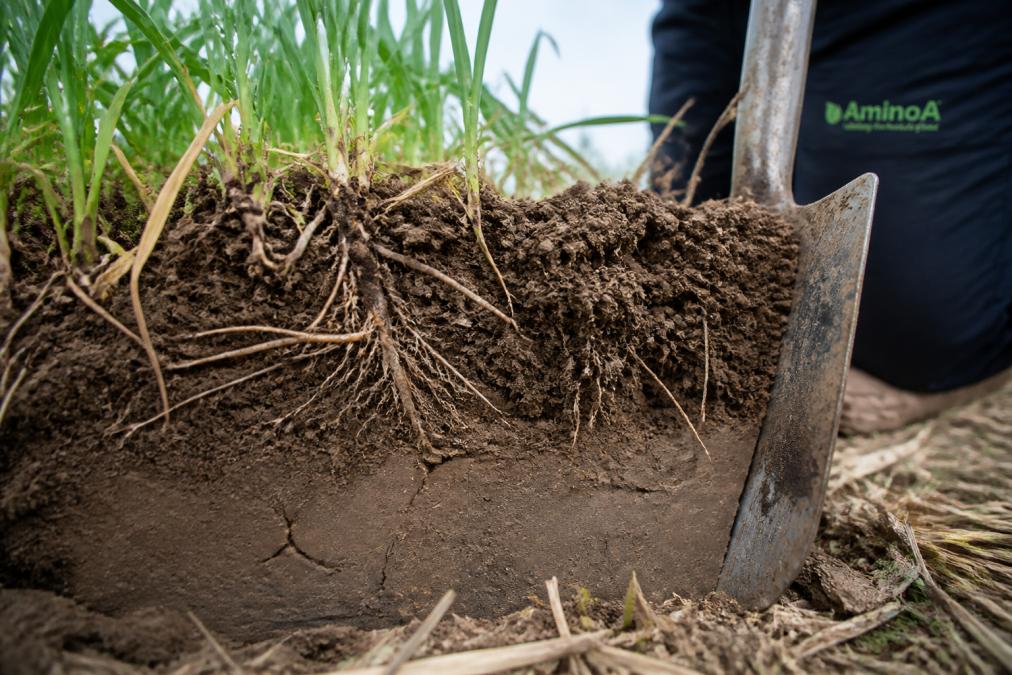
Compaction layers form from trafficking, cultivation at the wrong moisture, and repeated passes with heavy machinery. Once present, they restrict both water infiltration and root penetration.
Identifying and Alleviating Compaction Layers
Identifying compaction starts with a spade and a penetrometer, not a yield map. Dig a pit after harvest or in early spring and look for horizontal root growth, platy structure, and a distinct boundary where roots stop.
Alleviation depends on the depth and severity of the layer:
- Shallow layers (top 10 cm): often corrected with appropriate cultivations at the right moisture.
- Deeper layers: may need targeted subsoiling, ideally when the soil is dry enough to shatter rather than smear.
- Traffic management: controlled traffic farming and lower tyre pressures prevent the layer from reforming.
The AHDB soil management resources cover how to assess structure and when loosening is likely to pay. Timing matters more than depth: loosening wet soil can make the problem worse.
L-α Amino Acid Biostimulants for Crops: How They Build Roots
L-α amino acid biostimulants for crops work by supplying the plant with ready-made amino acids it can use directly for root development and stress response. Unlike conventional fertilisers, which supply mineral nutrients, these products supply the building blocks the plant would otherwise have to synthesise itself.
AminoA manufactures 100% L-α amino acid biostimulants through enzymatic hydrolysis, with every essential amino acid present in the L form. The formulation carries a high content of nitrogen, potassium, iron, and magnesium, all of which play a role in root growth and cell division.
The practical case for using them is strongest when the crop is under stress: cold soils at drilling, drought during tillering, or recovery after a phytotoxic tank mix. In those situations, the plant's own amino acid production is compromised, and an external supply helps it keep rooting.
Match Cereal Varieties to Your Rooting Conditions
Variety choice is the cheapest root-management decision available, because it costs nothing extra at drilling. Different wheat and barley varieties differ in rooting depth, root branching, and tolerance of poor structure.
If your fields have a history of compaction or a shallow profile, a variety with stronger rooting characteristics will outperform one bred purely for yield on deep, free-draining land. The reverse is also true.
Ask your agronomist for variety trial data that includes rooting and establishment scores, not just yield. The AHDB Recommended Lists publish independent variety information that includes establishment and disease ratings alongside yield.
Time Nitrogen and Nutrition to Root Growth Stages
Nitrogen timing affects root growth as much as it affects canopy growth, and getting the sequence wrong encourages shallow rooting. Early nitrogen drives top growth, and if it is over-applied before the root system is established, the plant puts its resources into leaves rather than roots.
A more balanced approach is to support root establishment first, then match nitrogen supply to the crop's demand through tillering and stem extension. This is where the timing of any biostimulant application becomes important.
Many growers find that splitting nitrogen applications and aligning them with growth stages gives better nitrogen use efficiency than a single early dressing. The crop takes up what it needs when it needs it, and rooting is not sacrificed for early canopy bulk.
Use the Zadoks Scale to Time Root-Building Applications
The Zadoks scale is the industry-standard system for identifying cereal growth stages, and it is the most reliable way to time root-building applications. It assigns a decimal code to each stage of development, from germination through to ripening.
For root-focused applications, the critical window is between germination and the end of tillering, roughly Zadoks 10 to 30.
| Zadoks Stage | Growth Phase | Root Focus | Application Window |
|---|---|---|---|
| 00-09 | Germination | Primary root emergence | Seedbed preparation |
| 10-19 | Seedling growth | Root branching begins | Early establishment |
| 20-29 | Tillering | Peak root extension | Main root-building window |
| 30-39 | Stem extension | Root growth slows | Transition to canopy focus |
| 40+ | Booting onwards | Root system largely set | Maintenance only |
Measure Root Mass to Prove What Works on Your Farm
Measuring root mass is the only way to know whether a change in management actually improved rooting, rather than assuming it did. Yield alone is a noisy signal, and plenty of variables sit between root growth and the combine.
Benchmarking with Root Length Density
Root length density (RLD) is the standard measure: the length of root per unit volume of soil, usually expressed in centimetres of root per cubic centimetre of soil. It gives a comparable number across fields, seasons, and treatments.
Frequently Asked Questions
How does root architecture affect nutrient uptake in cereals?
Deeper, more branched root systems intercept more soil volume, so they capture nitrogen and water that shallow roots miss. Cereals with a well-developed root mass access nutrients leached below the topsoil and keep growing through dry spells. Root length density is the practical measure: higher density in the top 30 cm usually means better uptake and a stronger crop going into stem extension.
What role do biostimulants play in cereal root development?
Biostimulants supply compounds that support root initiation and elongation rather than feeding the plant directly. L-α amino acid products, for example, give the crop ready-made building blocks for root tissue and can improve establishment after stress. Timing matters more than rate: applying at early tillering, when roots are actively extending, tends to give the most consistent response.
How can soil compaction limit root growth in cereal crops?
A compacted layer restricts roots to the soil above it, cutting the volume they can explore. Roots hit the pan and turn sideways instead of going deeper, which leaves the crop more exposed to drought and reduces nitrogen capture. Dig a spade pit after harvest to check for a dense layer and consider targeted loosening where it is confirmed.
How do you measure root mass in field-grown cereals?
Take soil cores to 30 cm or deeper and wash the roots free over a sieve. Root length density, measured as centimetres of root per cubic centimetre of soil, is the standard figure, and the AHDB root growth measurement guide sets out the protocol. Sample the same points each season so you can compare results on your own fields.
Can amino acid applications improve cereal root structure?
They can support it, particularly when applied at the right growth stage. Velcourt trials found that adding AminoA FLO to reduced fungicide rates maintained yields and improved green leaf area in winter wheat, which points to a crop better able to keep roots and leaves working under lower chemical input. Treat it as one part of a soil and nutrition programme, not a standalone fix.